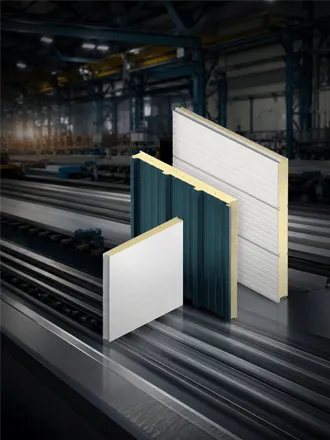
Traditional wall finishes can look attractive, but they may require several separate layers, complicated installation, and ongoing maintenance. For architects, contractors, and developers, the challenge is finding a material that combines appearance with practical performance. Embossed metal panels offer a flexible solution by adding texture, visual depth, durability, and, when integrated with insulation, building-envelope performance.
An embossed metal panel is a metal sheet or insulated panel with a raised or patterned surface created through forming or embossing. It can be used for exterior and interior walls, architectural cladding, residential buildings, villas, hotels, prefab houses, and commercial projects. The right material, thickness, finish, and panel structure depend on the project.
Proveedor de paneles metálicos gofrados en China: cómo elegir el panel metálico de pared adecuado
What Is an Embossed Metal Panel?
An embossed metal panel is made by forming a pattern into a flat metal surface. The process can emboss lines, grains, textures, or other decorative patterns into the material, creating a three-dimensional appearance rather than a completely flat surface.
The finished metal panel can be used as a decorative surface on its own or as part of an insulated wall system. In building projects, an insulated panel can combine the decorative outer layer with an insulation core, allowing the same product to contribute to both façade appearance and building-envelope performance.
For residential and commercial projects, this combination is particularly useful. A designer may want a wood, stone, or brick appearance, while the contractor needs a lightweight system that is practical to transport and install.
At Fuqiang, our current product range includes exterior and interior decorative metal wall panels as well as PU sandwich panels, rock wool panels, PU edge-sealed rock wool panels, and related accessories. The company positions these products as factory-direct building-envelope solutions for international projects.
How Does Embossing Change Sheet Metal?
The main purpose of embossing is to change the visual and physical character of a flat sheet.
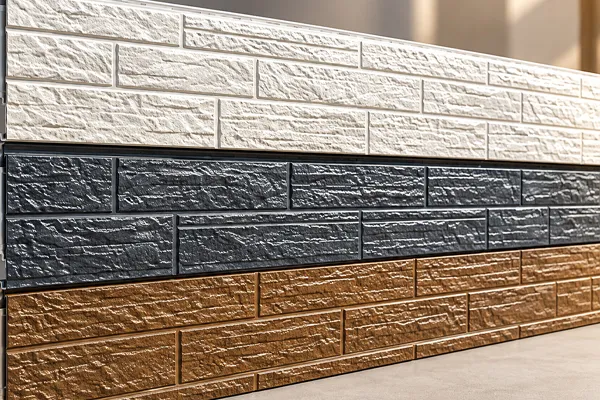
During the forming process, pressure creates a controlled pattern on the surface. Depending on the tooling, the finished sheet metal can have a wood-grain effect, stone texture, brick pattern, linear design, or other decorative appearance.
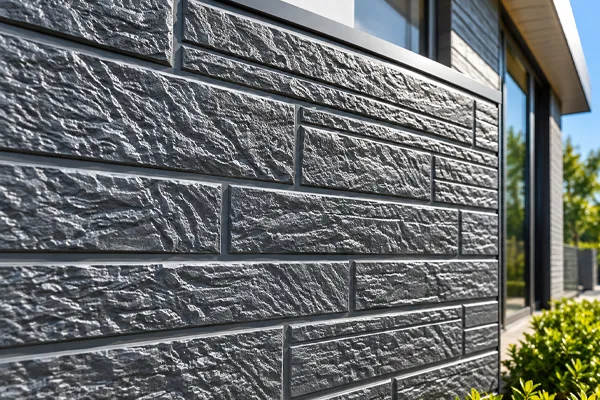
A textured surface can also make small marks or variations less noticeable than on a completely smooth surface. More importantly for architecture, it gives designers another way to create depth and visual interest without using heavy natural materials.
Common embossed patterns include:
- Wood grain
- Stone texture
- Brick patterns
- Linear grooves
- Geometric patterns
- Decorative architectural textures
The choice should match the building’s overall design, surrounding environment, and desired visual effect.
Embossing does not automatically mean that a product has better structural performance. Buyers should still evaluate the substrate, thickness, coating, core, connection system, and manufacturing quality separately.
Which Metal Materials Can Be Embossed?
Different metals can be formed into textured surfaces, but the correct material depends on the project.
Steel
Steel is widely used for architectural wall systems because it provides a practical balance of strength, durability, cost, and formability.
For insulated building panels, a coated steel facing can provide the external surface while an insulation layer is placed behind it.
Aluminum
Aluminum is lightweight and naturally resistant to corrosion. It can be useful when weight reduction is especially important.
An embossed aluminum surface can also provide a premium decorative appearance for architectural projects. However, buyers should confirm whether aluminum is required for the entire panel system or only for a decorative component.
Stainless Steel
Stainless steel is often selected for projects where appearance, corrosion resistance, and hygiene are important.
For example, certain commercial interiors, hospitality environments, and specialized architectural areas may specify stainless steel. Different stainless steel finishes can create very different visual effects.
An embossed stainless surface can provide both texture and a distinctive architectural appearance.
The important point is simple: do not select the metal only because it looks attractive. Consider the environment, exposure, weight, budget, maintenance requirements, and intended application.
What Are the Main Applications for Embossed Metal Panels?
There is a wide range of applications for textured metal products.
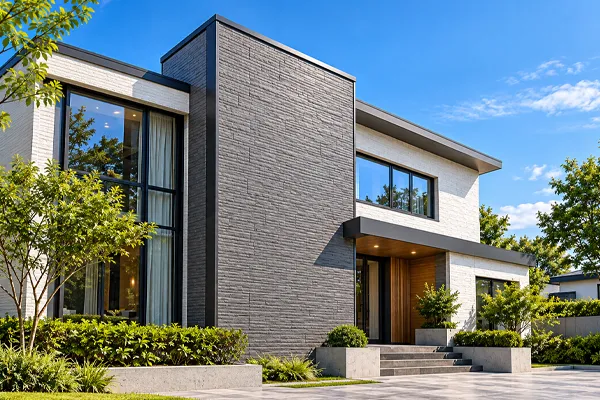
In residential construction, they can be used for house exteriors, villas, apartment buildings, garden houses, and renovation projects.
In commercial architecture, they can create attractive façades for:
- Hoteles
- Edificios de oficinas
- Restaurantes
- Retail buildings
- Showrooms
- Apartment hotels
- Complejos comerciales
For prefab and modular construction, an insulated decorative panel can combine several functions into one building component.
Fuqiang’s current website specifically highlights decorative metal wall panels and 500mm metal carved panels for building projects, alongside insulated panel systems for residential, commercial, industrial, and modular applications.
Typical applications
| Tipo de proyecto |
Typical Requirement |
| Villas |
Decorative appearance + insulation |
| Houses |
Lightweight exterior wall system |
| Prefab homes |
Fast installation + low weight |
| Renovation |
Appearance upgrade + practical installation |
| Hoteles |
Architectural appearance + durability |
| Edificios comerciales |
Modern façade design |
| Modular buildings |
Factory-friendly panel construction |
This makes embossed products more than a decorative material. When correctly configured, they can become part of a complete building-envelope system.
Why Are Embossed Metal Panels Suitable for Exterior Walls?
Exterior walls have to do several jobs at the same time.
They need to protect the building, support the desired appearance, withstand outdoor conditions, and, in an insulated system, help control heat transfer.
A decorative metal wall panel can provide a clean finished surface while an insulated construction adds thermal performance behind it.
For exterior applications, buyers should consider:
- Recubrimiento superficial
- Metal material
- Espesor
- Weather exposure
- Diseño de juntas
- Aislamiento
- Drainage
- Installation method
- Local climate
The surface finish matters because outdoor exposure can affect the appearance of the material over time.
A suitable coating can help protect the metal surface from environmental exposure. However, coating selection should match the actual project conditions rather than relying on a generic “outdoor use” description.
For projects requiring insulation, an integrated PU system can provide additional thermal performance. Fuqiang’s PU range is described as combining rigid polyurethane insulation with metal facings for industrial, commercial, cold-storage, modular, and architectural projects.
Proveedor de paneles metálicos gofrados en China: cómo elegir el panel metálico de pared adecuado
How Should You Choose Panel Thickness and Surface Finish?
There is no single thickness that is correct for every project.
Thickness should be selected according to the panel structure, building application, insulation requirements, span, installation system, and local engineering requirements.
For a purely decorative metal sheet, the design may be different from an insulated sandwich panel. A panel used for a residential exterior may have completely different requirements from one used for a large commercial façade.
Consider these factors:
1. Building location
A coastal project may require stronger attention to corrosion protection than an inland project.
2. Climate
Temperature, humidity, rainfall, sunlight, and wind exposure can influence material selection.
3. Panel structure
A decorative surface mounted over an existing wall is different from an insulated composite panel.
4. Appearance
The pattern and finish should match the architectural concept.
5. Maintenance
A façade that is difficult to access should generally be designed with long-term maintenance in mind.
Fuqiang currently supports customization across thickness, length, color, surface pattern, and joint profile across its panel product lines. The website lists thickness customization from 16mm to 200mm across all panel types, with project-specific dimensions and finishes available.
Embossed Metal vs. Flat, Perforated, and Other Metal Products
Not every decorative metal surface needs to be embossed.
The right surface depends on what the project needs.
| Surface Type |
Main Characteristic |
Typical Purpose |
| Embossed |
Raised texture |
Decoration and visual depth |
| Flat |
Smooth surface |
Minimalist appearance |
| Perforated |
Openings through the sheet |
Ventilation and decorative screening |
| Ribbed |
Repeated linear profile |
Appearance and rigidity |
| Textured |
Surface pattern |
Decorative effect |
A designer may choose to perforate a metal sheet when airflow or visual screening is needed. That is a different requirement from creating a solid textured façade.
Likewise, a flat plate may be more appropriate for a simple modern building, while an embossed surface can provide a warmer or more detailed appearance.
The decision should follow the project’s purpose.
For exterior façades, consider the entire wall system rather than looking at the surface pattern alone.
Can Embossed Metal Panels Be Customized?
Yes. Customization is one of the most important considerations when purchasing architectural metal products.
A project may require a specific color, texture, dimension, thickness, or connection system. A distributor may also want a particular appearance for its local market.
Possible customization areas include:
- Panel length
- Espesor del panel
- Surface color
- Patrón
- Textura
- Joint profile
- Material del núcleo
- Embalaje
- OEM requirements
For example, a villa project may need a wood-grain finish, while a hotel project may require a stone-like façade.
A commercial developer may also request custom metal patterns to create a distinctive building identity.
However, customization should be confirmed before production. The manufacturer needs to evaluate tooling, raw materials, production capability, minimum order requirements, and lead time.
Fuqiang’s current company information states that OEM and ODM services are available, including customized sizes, colors, patterns, thicknesses, packaging, and joint profiles.
What Should You Look for in an Embossed Metal Panel Manufacturer?
Choosing a manufacturer is just as important as choosing the surface design.
Two products may look similar in photographs while having different substrate quality, coating systems, insulation cores, dimensional accuracy, or production consistency.
When evaluating a supplier, ask for information about:
Raw Materials
Confirm the type and specification of the metal, coating, and insulation.
Equipos de producción
Ask whether the company has dedicated production equipment and whether it can maintain consistent output.
Quality Control
Check how the manufacturer handles:
- Incoming material inspection
- Production monitoring
- Dimensional checks
- Finished-product inspection
- Packaging inspection
Personalización
Confirm whether the factory can produce your required pattern, size, thickness, color, and connection design.
Export Capability
For international orders, also consider:
- Export packaging
- Carga de contenedores
- Documentation
- Shipping coordination
- Communication during production
ISO 9001:2026 is the current edition of ISO 9001. ISO describes it as a globally recognized quality-management standard covering processes for consistently meeting customer and applicable requirements and continually improving the quality-management system.
An ISO certificate should not replace product inspection, but a structured quality-management system can be one useful factor when evaluating a factory.
Why Choose Fuqiang as Your Embossed Metal Panel Supplier?
Shandong Fuqiang Environmental Protection Materials Co., Ltd. is a China-based manufacturer providing factory-direct insulated building-envelope solutions for global construction projects.
Fuqiang currently operates three large-scale manufacturing facilities in Shandong, with more than 100 professionals and automated production lines. Its product portfolio includes PU sandwich panels, rock wool sandwich panels, PU edge-sealed rock wool panels, decorative metal wall panels, double-skin PU panels, and panel trims and accessories.
For buyers looking specifically for decorative metal solutions, Fuqiang’s current website highlights 500mm metal carved panels as part of its factory-direct product offering. The company positions these products for distributors, contractors, and building projects worldwide.
Our approach is to look at the complete project rather than only the decorative surface.
For example, we can discuss:
- Required panel dimensions
- Surface pattern
- Color
- Insulation requirements
- Application environment
- Quantity
- Embalaje
- Installation accessories
This matters because an exterior façade is a system. The metal products, insulation, joints, trims, and installation method all need to work together.
How Do Embossed Metal Panels Support Modern Architecture?
Modern architecture often combines simple building forms with carefully selected materials.
A textured façade can add visual depth without making the building look overly complicated.
This is particularly useful for:
- Villas
- Hoteles
- Residential communities
- Prefab houses
- Edificios comerciales
- Proyectos de renovación
For example, wood-grain panels can create a warm residential appearance, while stone or brick textures can provide a more traditional architectural character.
A clean embossed surface can also work well with glass, concrete, steel frames, and other modern materials.
The goal is not to make every wall heavily textured. Good design uses texture where it adds value.
Proveedor de paneles metálicos gofrados en China: cómo elegir el panel metálico de pared adecuado
Are Embossed Metal Panels a Sustainable Building Material?
Sustainability should be evaluated across the entire product life cycle rather than through one material feature.
Metal can be recycled, and steel is widely used in construction because it can be recovered and reused at the end of a building’s life.
Fuqiang also positions energy-efficient insulated panels as part of its sustainable building-material strategy. Its website states that its steel face materials are recyclable and that some panel systems are designed for disassembly and reuse in modular or temporary structures.
For projects using insulated panels, energy performance is another important consideration. A well-designed building envelope can reduce heat transfer and help lower heating and cooling loads over its service life.
Therefore, a sustainable metal solution should be considered together with:
- Material durability
- Insulation performance
- Building energy use
- Service life
- Recyclability
- Installation waste
- Potential reuse
The right product is the one that fits the project’s complete environmental and performance goals.
How Should International Buyers Order Embossed Metal Panels?
For an overseas project, good preparation can make the purchasing process much easier.
Before contacting a factory, prepare as much information as possible.
Project Information
Provide:
- Tipo de edificio
- Ubicación del proyecto
- Exterior or interior application
- Approximate wall area
- New construction or renovation
Product Information
Specify:
- Panel type
- Core requirement
- Surface pattern
- Color
- Espesor del panel
- Panel width
- Panel length
Commercial Information
Also provide:
- Estimated quantity
- Delivery destination
- Preferred shipping port
- Packaging requirements
- Required delivery schedule
A clear specification allows the manufacturer and supplier to prepare a more useful quotation.
Fuqiang’s contact process specifically asks buyers for information such as application, project dimensions, core material, panel thickness, steel finish, accessories, quantity, destination, and project documents when requesting a quotation.
For large projects, we also recommend confirming samples before mass production when the surface appearance is an important part of the project.
Final Takeaways
- Embossed metal panels combine a textured metal surface with architectural decoration.
- They can be used for exterior and interior building applications.
- Steel, aluminum, and stainless steel offer different material characteristics.
- The right thickness, coating, texture, and panel structure should be selected according to the project.
- Embossed surfaces can create wood, stone, brick, and other decorative effects.
- Insulated versions can combine façade appearance with thermal performance.
- They are suitable for villas, houses, prefab buildings, hotels, commercial projects, and renovation.
- Buyers should evaluate the complete panel system rather than surface appearance alone.
- Check raw materials, production capability, quality control, customization, and export support before choosing a manufacturer.
- For international B2B projects, provide dimensions, application, quantity, destination, and technical requirements when requesting a quotation.
- Fuqiang provides factory-direct decorative metal and insulated panel solutions for contractors, distributors, developers, prefab companies, and international buyers.
An embossed metal panel is a metal product with a raised or patterned surface created through a forming process. It can be used as a decorative surface or integrated into an insulated wall system.
Steel, aluminum, and stainless steel can all be formed into textured products. The appropriate material depends on the project's environment, weight requirements, appearance, corrosion exposure, and budget.
Yes. They can be used for exterior façades when the metal, coating, thickness, joints, and complete panel structure are properly selected for the project conditions.
Yes. Decorative metal panels can provide wood, stone, brick, and other visual effects for villas, houses, prefab buildings, and residential renovation projects.
Yes. Decorative metal surfaces can be integrated with insulation to create an insulated composite panel. Fuqiang offers decorative metal wall panels and PU insulated panel systems for different building applications.
Yes. Fuqiang supports customized panel dimensions, colors, patterns, thicknesses, joint profiles, and packaging across its product range. OEM and ODM services are also available.


 13 de octubre de 2026