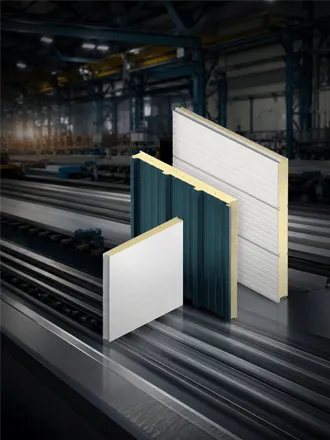
Choosing an exterior wall system is rarely just about appearance. Contractors must balance design, insulation, installation speed, weather exposure, maintenance, and budget. When these needs are handled by separate materials, projects become more complex. Embossed metal wall panels offer a simpler way to combine decorative cladding with insulation in one coordinated wall system.
Embossed metal wall panels are decorative insulated exterior panels with a profiled or textured metal surface and an insulation layer. They can be used for house exterior decoration, prefabricated homes, residential renovation, villas, modular buildings, guesthouses, hotels, cafés, and selected commercial projects where appearance, insulation, lightweight construction, and efficient installation are important.
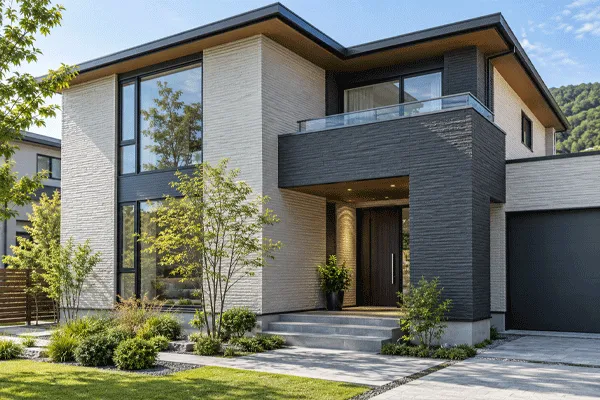
Embossed Metal Wall Panels for House Exteriors, Prefab Homes, Renovations, Villas and Hotels
For contractors, architects, developers, and distributors, the main question is not simply whether an embossed panel looks attractive. The real question is whether the panel system fits the building structure, climate, installation method, thermal requirements, architectural style, and project budget.
At Shandong Fuqiang Environmental Protection Materials Co., Ltd., we manufacture sandwich panels and insulated building-envelope products in China for international construction projects. In our experience, successful panel selection starts with the building application—not with color alone.
What Are Embossed Metal Wall Panels?
Embossed metal wall panels are exterior or interior wall panels with a shaped metal face that creates a visible pattern or texture. Depending on the product design, the surface can imitate architectural finishes such as brick, stone, horizontal siding, geometric lines, or other decorative wall patterns.
For building-envelope applications, the decorative metal surface is commonly combined with an insulation layer. This creates a panel that can perform two jobs at the same time:
Exterior decoration + thermal insulation
These products may also be described in international markets as:
- paneles metálicos de pared con relieve
- insulated metal wall panels
- decorative insulated wall panels
- metal carved wall panels
- exterior decorative metal panels
- insulated exterior cladding
- metal siding panels with insulation
The exact construction, core material, thickness, coating, dimensions, joint design, and installation system should always be confirmed for the specific product and project.
An embossed surface should not be confused with a structural masonry wall. The panel is normally part of the building-envelope system, while the wall structure, framing, substrate, waterproofing details, fasteners, and other components must be designed according to the building.
This distinction matters. A successful façade is a complete system, not just a visible surface.
The Whole Building Design Guide notes that exterior wall assemblies need to consider exterior finishes, insulation, water management, air movement, joints, and other envelope components together.
Why Are Embossed Metal Wall Panels Popular for House Exterior Decoration?
A house façade strongly affects how people perceive the entire property. Yet traditional exterior decoration can involve several separate steps: insulation, base treatment, mortar, coatings, tiles, brickwork, or decorative finishes.
For many residential projects, embossed insulated metal wall panels reduce the number of separate visible and insulation layers that must be coordinated on site.
This makes them especially interesting when the project needs both a decorative finish and an insulated wall upgrade.
Decorative flexibility
One of the main advantages is visual choice.
Different embossed patterns can create very different architectural styles:
| Exterior Style |
Possible Panel Appearance |
Typical Application |
| Modern residential |
Horizontal-line texture |
Detached houses, villas |
| Traditional-inspired |
Brick-look surface |
Rural houses, guesthouses |
| Natural architectural style |
Stone-look texture |
Villas, façades, commercial buildings |
| Minimalist |
Fine textured finish |
Modular homes, cafés |
| Mixed façade |
Two or more colors/patterns |
Residential and hotel projects |
A light-colored horizontal panel can make a house appear cleaner and more contemporary. Dark panels can be used around lower walls, entrances, balconies, or architectural sections to create contrast.
Architects can therefore use the panels not only as insulation materials but also as design elements.
Integrated insulation
The second benefit is practical.
Instead of treating exterior decoration and wall insulation as completely unrelated tasks, an insulated embossed panel combines them within one factory-produced product.
The U.S. Department of Energy identifies continuous exterior insulation as an important strategy for reducing thermal bridging in high-performance building envelopes. Actual thermal results, however, depend on the entire wall assembly, insulation material, thickness, joints, fasteners, and local climate—not simply on the decorative panel surface.
For buyers, this means the correct question is not:
“Is this panel insulated?”
It is:
“What panel specification and complete wall assembly are suitable for my project?”
How Are Embossed Metal Wall Panels Used in Prefabricated and Modular Homes?
Prefab and modular construction requires materials that can fit a repeatable, controlled, and efficient building process.
Heavy or highly site-dependent exterior systems may slow assembly. By comparison, lightweight panel-based exterior systems can work well with prefabricated houses when the support structure and connection method are properly designed.
Las aplicaciones típicas incluyen:
- prefabricated houses
- modular houses
- integrated housing
- temporary or permanent accommodation buildings
- holiday cabins
- staff accommodation
- small commercial modules
- modular offices
For prefab manufacturers, panel dimensions are particularly important.
A panel that fits the module size can reduce unnecessary cutting and help create a cleaner exterior layout. Contractors should therefore coordinate panel length, wall dimensions, window positions, door openings, external corners, base details, and roof transitions before production.
This is where factory customization becomes useful.
At Fuqiang, we work with B2B customers on project-based panel requirements, including dimensions, colors, surface options, accessories, packing, and shipment planning according to the specific order.
For modular manufacturers, early coordination is usually more valuable than simply purchasing a standard panel and modifying everything on site.
Embossed Metal Wall Panels for House Exteriors, Prefab Homes, Renovations, Villas and Hotels
Are Embossed Metal Wall Panels Suitable for House Renovation?
Yes. Residential exterior renovation is one of the most practical applications for insulated embossed metal wall panels, provided the existing structure is suitable for the proposed installation system.
Older houses often have several problems at once:
The façade may look dated. Exterior finishes may be inconsistent. Insulation may no longer meet the owner’s expectations. Repairing the old surface with another wet construction process may also take significant time.
An exterior panel renovation can provide another option.
A typical concept looks like this:
Existing House
↓
Wall Condition Assessment
↓
Supporting / Fixing System
↓
Insulated Metal Wall Panels
↓
New Exterior Appearance
The important step is the second one.
Before renovation begins, contractors should inspect the existing wall condition, moisture problems, flatness, structural support, window details, roof edges, drainage, and fixing points.
Simply covering a damaged wall does not solve the original problem.
Water management is especially important. Building-envelope guidance emphasizes that exterior cladding must work with drainage, flashing, water-resistant layers, windows, doors, roof interfaces, and other details to manage rainwater correctly.
A useful renovation example
Consider an older rural house with a traditional roof.
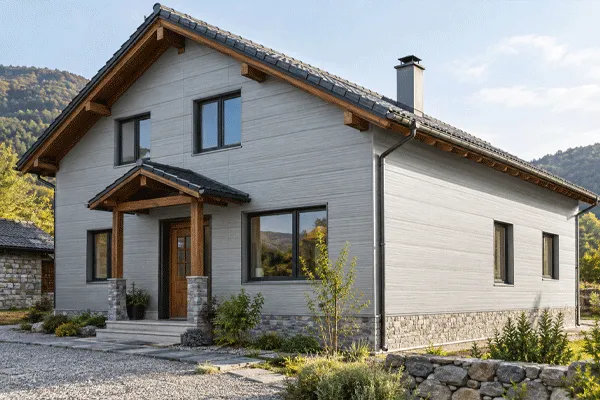
The owner may want to preserve the roof shape and architectural character but modernize the exterior walls. Horizontal embossed metal wall panels in a light color can create a simple contrast:
Traditional Roof + Modern Insulated Exterior Wall
The house keeps its basic character while gaining a cleaner façade.
This approach can work for rural homes, detached houses, old villas, pension buildings, guesthouses, and other low-rise renovation projects.
Why Are Embossed Metal Wall Panels Suitable for Villas and Residential Projects?
Villa projects often require more architectural detail than basic industrial buildings.
The exterior must look intentional.
Windows, balconies, roof lines, entrance areas, columns, lower-wall sections, and garden-facing façades all affect the final design. Because embossed metal wall panels are available in different textures and colors, designers can divide the façade into visual zones.
Por ejemplo:
| Area |
Possible Design Choice |
| Main exterior walls |
Light horizontal embossed panels |
| Ground-floor section |
Dark brick-look panels |
| Entrance area |
Stone-look decorative panels |
| Balcony wall |
Contrasting color |
| Side elevation |
Matching horizontal siding pattern |
This allows a villa to avoid the appearance of one large flat surface.
For developers, there is another advantage: factory-produced surfaces help maintain visual consistency across multiple buildings.
This can be useful for housing developments, holiday villas, rental properties, townhouse projects, and residential communities where several units share the same architectural language.
Still, consistency should not mean repetition without planning. Architects should consider panel direction, joints, corner details, window proportions, and color transitions early in the design.
Small details often determine whether the completed façade looks professional.
How Can Hotels, Guesthouses and Commercial Buildings Use Embossed Metal Wall Panels?
Hotel renovation creates a different set of priorities.
A hotel façade is part of the customer experience. It needs to look clean and intentional, but owners may also want to limit long construction periods and complicated site work.
Embossed exterior wall panels can be considered for projects such as:
Hotels → Guesthouses → Resorts → Pensions → Cafés → Restaurants → Small Commercial Buildings
The panels can be especially useful when the objective is to give an existing building a new visual identity without completely changing its structural form.
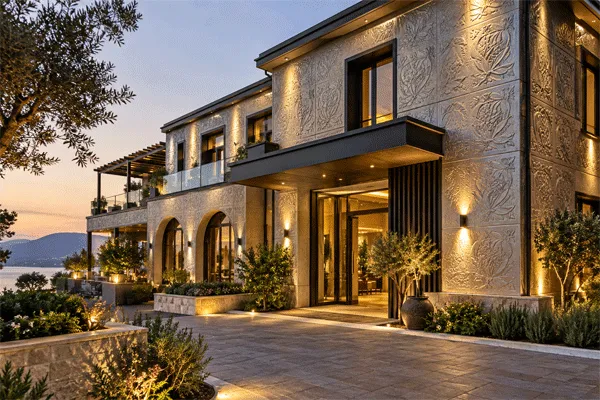
A hotel may use wood-inspired or stone-inspired architectural colors around the entrance, while guestroom blocks use a simpler horizontal finish. A guesthouse may use brick-look panels to create a warmer residential appearance.
For commercial developers, this flexibility helps connect the façade to the brand or building concept.
However, hotel and commercial projects often have more demanding requirements than small houses. Designers may need to verify:
- fire requirements
- local building codes
- façade height
- wind loads
- fixing systems
- moisture management
- thermal performance
- corrosion environment
- maintenance access
- project-specific approvals
These items should be confirmed before final material selection.
How Do Embossed Metal Wall Panels Compare With Brick, Stone and Traditional Finishes?
There is no single exterior material that is best for every project.
Brick, stone, stucco, render systems, fiber cement, metal cladding, and insulated panels all have appropriate applications.
The better approach is to compare them according to the project’s actual priorities.
| Factor |
Embossed Insulated Metal Panels |
Traditional Brick / Masonry |
Decorative Coating / Render |
| Decorative finish |
Factory-produced |
Traditional masonry look |
Flexible colors |
| Insulation integration |
Can be integrated |
Usually separate |
Usually separate |
| Peso |
Generally lightweight |
Más pesado |
Relatively light |
| Instalación |
Panel-based |
Labor-intensive masonry work |
Multiple preparation stages |
| Pattern options |
Multiple embossed styles |
Brick-dependent |
Mainly surface finish |
| Renovation suitability |
Good for many panel-overcladding concepts |
May require more structural consideration |
Common renovation option |
| Factory customization |
Strong |
Limited |
Color-oriented |
| Wet construction |
Reduced |
Usually higher |
Usually required |
This table is not a performance guarantee. Actual construction time, cost, durability, insulation, and maintenance depend on the wall system, labor market, climate, specifications, and installation quality.
That is why contractors should avoid selecting façade materials from appearance alone.
The better question is:
Which wall system solves the most project requirements with the least unnecessary complexity?
For many low-rise residential, prefab, renovation, villa, and commercial projects, insulated embossed metal panels can be a strong candidate.
What Should Contractors and Architects Check Before Specifying Exterior Metal Wall Panels?
This is one of the most important steps in the purchasing process.
A panel supplier cannot evaluate a project accurately from one façade image.
Before requesting a quotation, contractors should prepare basic project information.
Building information
Provide:
- Ubicación del proyecto
- Tipo de edificio
- New construction or renovation
- Wall height
- Approximate exterior wall area
- Existing wall or framing structure
- Required insulation level
- Preferred surface pattern
- Preferred colors
- Panel dimensions or architectural drawings
- Window and door locations
- Corner and trim requirements
- Local code or fire requirements
- Shipping destination
Climate must also be considered.
Hot-humid, cold, coastal, rainy, and high-wind environments place different demands on building envelopes. Moisture-control guidance stresses the importance of coordinating insulation, vapor control, water management, and wall-layer location according to climate.
Wind exposure is another factor. FEMA guidance notes that exterior wall coverings can suffer wind damage when they are not properly installed or rated for the applicable design wind pressure.
So the fastening system matters just as much as the visible panel.
Good material + poor installation = poor wall performance.
Embossed Metal Wall Panels for House Exteriors, Prefab Homes, Renovations, Villas and Hotels
What Details Matter Most During Installation?
Exterior panel installation looks simple from a distance, but the quality of the small details determines the quality of the finished building.
Contractors should pay particular attention to:
Base → Corners → Windows → Doors → Joints → Roof Interfaces → Flashings
A neat field of wall panels can still fail visually or functionally if corners are poorly finished or water can enter around windows.
Panel layout
Before installation, establish panel direction and joint lines.
For horizontal embossed metal wall panels, contractors should check whether the panel joints align naturally with windows, balcony lines, floor levels, and façade divisions.
Avoid very narrow cut pieces around openings whenever possible.
Openings and transitions
Windows and doors are critical because they interrupt the continuous wall surface.
Correct flashing, trims, sealants, and drainage details should be designed for the chosen system. Water should be directed outward rather than trapped behind the façade.
Accessories
Depending on the wall system, projects may require:
- external corner trims
- internal corner trims
- base trims
- window trims
- door trims
- joint covers
- flashing profiles
- edge closures
- other customized metal accessories
For importers and contractors, ordering panels without planning the accessories can cause delays later.
A complete material schedule is usually more efficient than buying only the main wall panels.
What Should Building Material Distributors and Importers Look for in a Supplier?
A distributor thinks differently from a homeowner.
One house may need only one color and one panel pattern. A distributor must think about repeat orders, product consistency, packaging, stock strategy, local customer preferences, container loading, and long-term supply.
The supplier therefore needs to support more than manufacturing.
Important B2B questions include:
| Purchasing Question |
Why It Matters |
| What panel sizes are available? |
Determines local project suitability |
| Can lengths be customized? |
Helps reduce cutting and waste |
| What colors and textures are available? |
Supports different market segments |
| Are trims available? |
Enables a complete wall solution |
| How are panels packed? |
Important for export transport |
| Can OEM requirements be discussed? |
Useful for distributors and brands |
| Can production support repeat orders? |
Important for market development |
| How are specifications confirmed? |
Reduces purchasing errors |
International buyers should also send clear product requirements before asking for final pricing.
“Send me your cheapest wall panel” rarely leads to the right product.
A better inquiry is:
“We need insulated embossed exterior wall panels for villa renovation projects. The preferred finish is horizontal texture, the project is located in ___, approximate quantity is ___ m², and we need matching external corner and window trims.”
That gives the manufacturer enough information to start a useful technical and commercial discussion.
Why Work With a Factory-Direct Sandwich Panel Manufacturer?
For project buyers, price matters. But specification control matters more.
An exterior façade may remain on a building for years. Buying an incorrect panel thickness, finish, dimension, or accessory can create costs far beyond the original material price.
At Shandong Fuqiang Environmental Protection Materials Co., Ltd., our role is to support overseas buyers who need factory-direct insulated building-envelope products for residential, commercial, industrial, prefab, cold-storage, and other construction applications.
Our target is not simply to sell a panel.
We aim to help contractors, developers, distributors, prefab companies, and importers coordinate key purchasing details such as:
- product type
- panel dimensions
- surface pattern
- color
- insulation requirements
- project quantity
- accessories
- packaging
- shipment planning
- OEM or project-specific requirements
For an architect, this means more design flexibility.
For a contractor, it means better material coordination.
For a distributor, it means a clearer product supply structure.
For an international importer, it means communicating directly with the manufacturing side rather than adding unnecessary layers between the project and the factory.
If you are planning a villa, prefabricated house, residential renovation, hotel, guesthouse, commercial façade, or other building-envelope project, sending drawings, dimensions, application details, and target specifications at the beginning will make the selection process much faster.
Key Things to Remember
- Embossed metal wall panels combine architectural appearance with an insulated panel format.
- They can be considered for house exterior decoration, rural-house renovation, villas, prefab homes, modular buildings, guesthouses, hotels, cafés, and selected commercial projects.
- Brick-look, stone-look, horizontal-line, and other textures allow designers to create different façade styles.
- Renovation projects require inspection of the existing wall before installation.
- Thermal performance depends on the complete wall assembly, not only the visible panel.
- Water management, flashing, joints, fasteners, windows, corners, and roof transitions must be planned carefully.
- Contractors should coordinate panels and accessories as one system.
- Importers and distributors should evaluate customization, repeat supply, packaging, dimensions, and OEM requirements—not price alone.
- Early communication with a factory helps reduce specification errors and unnecessary site cutting.
- Shandong Fuqiang Environmental Protection Materials Co., Ltd. provides factory-direct sandwich panels and customized insulated building-envelope solutions for international B2B construction projects.
For a new house, renovation, villa, prefab building, hotel, or commercial façade project, the most useful first step is simple: send the building application, drawings, dimensions, target finish, quantity, and project location. From there, the appropriate embossed metal wall panel specification can be discussed around the actual project rather than a generic product list.
Preguntas frecuentes
Can embossed metal wall panels be used on old houses?
Yes, they can be considered for many exterior renovation projects. The existing wall or supporting structure should first be inspected to confirm its condition, fixing method, flatness, moisture condition, and suitability for the proposed panel system.The panel should not simply hide structural or moisture problems.
Are embossed metal wall panels suitable for villas?
Yes. Villas are one of the common architectural applications because embossed panels can combine decorative façade design with insulation. Different colors and textures can be used around entrances, balconies, lower-wall sections, and other architectural features.Final specifications should match the villa's structure, climate, and design requirements.
Can these panels be used for prefab and modular houses?
Yes. Their lightweight, panelized form makes them suitable for many prefabricated and modular building concepts.Prefab manufacturers should coordinate wall dimensions, panel lengths, corner details, window openings, and connection systems with the supplier before production.
Do embossed metal wall panels provide insulation?
Insulated versions include an insulation core and can contribute to the thermal performance of the wall assembly.However, total thermal performance depends on the core material, thickness, joints, fasteners, structural components, thermal bridges, and complete wall design. Buyers should specify their project requirements rather than judging performance only by panel thickness.
Can embossed panels replace brick or stone?
They can provide a brick-look, stone-look, or other textured appearance, but they are not the same construction system as masonry.They are an alternative exterior cladding solution for projects where lighter weight, insulation integration, factory-produced finishes, and panel installation are desirable.
What information should I provide when requesting a quotation?
For the fastest response, provide the project country, building type, new-build or renovation status, approximate quantity, required panel thickness, preferred pattern and color, wall dimensions, accessory requirements, and destination port.Architectural drawings or façade elevations are especially helpful for project-based orders.


 September 16, 2026