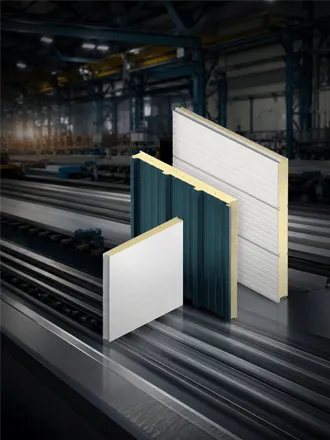
Choosing a sandwich panel factory by price alone can create costly problems later. The wrong core, coating, thickness, or joint may lead to poor insulation, installation delays, or failed project requirements. A reliable China supplier should help you match the panel system to the building before production begins.
A reliable sandwich panel factory in China should provide stable production, clear material specifications, customizable wall and roof solutions, export packaging, and project-based technical support. Buyers should compare core material, insulation performance, fire requirements, steel facing, thickness, joint design, manufacturing control, and delivery capability—not just the unit price.
Guide des usines chinoises de panneaux sandwich : comment choisir des fabricants et des fournisseurs de panneaux sandwich et des matériaux de construction
What Is a Sandwich Panel and Why Is It Used as a Building Material?
A panneau sandwich is a prefabricated building component made from outer facing materials bonded to an insulating core. In many building applications, coated steel sheet forms the outer surfaces, while PU, PIR, EPS, rock wool, or another core material provides insulation and structural separation.
The basic structure is simple:
Exterior Metal Facing
        ↓
Insulation Core
        ↓
Interior Metal Facing
This combination can create a relatively lightweight building material for walls, roofs, partitions, warehouses, industrial buildings, prefabricated structures, cold rooms, and other envelope applications.
The Metal Construction Association describes insulated metal panels as rigid insulation sandwiched between coated metal facings. Factory-controlled production can help maintain uniform core thickness and consistent insulation performance.
For international contractors and importers, the main value is integration. Instead of sourcing exterior cladding, insulation, and an interior facing as completely separate elements, an insulated sandwich panel may combine several functions in one prefabricated unit.
However, not every panel is suitable for every project. A cold room panel, decorative wall panel, roof panel, cleanroom panel, and industrial facade panel can have very different requirements.
Which Different Types of Sandwich Panels Should Buyers Compare?
The first step is to understand the common core categories.
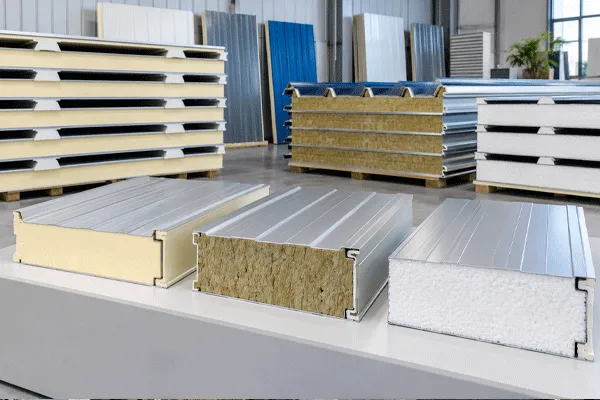
Among different types of sandwich panels, buyers frequently encounter PU, PIR, EPS, and mineral-wool-based products. Each category has different thermal, fire, acoustic, weight, cost, and application characteristics.
Common Sandwich Panel Core Options
| Core Type |
Common Strength |
Typical Applications |
| PU |
Strong thermal insulation per thickness |
Walls, roofs, cold rooms |
| PIR |
Thermal performance with enhanced fire behavior compared with conventional PUR formulations |
Commercial and industrial envelopes |
| PSE |
Léger et économique |
Prefabricated buildings, basic walls and roofs |
| Laine de roche |
Fire and acoustic-focused applications |
Industrial walls, partitions, selected facades |
| Glass Wool |
Lightweight fibrous insulation |
Selected wall/roof systems |
| Honeycomb |
Structural/lightweight panel applications rather than conventional foam insulation |
Specialized panels |
A PU sandwich panel uses polyurethane-based insulation. Because polyurethane foam can provide low thermal conductivity, it is often considered where strong heat insulation is required without excessive wall thickness.
A PIR panel uses polyisocyanurate-based foam. PU and PIR are related materials, but their formulations and tested fire performance are not identical. Buyers should review the actual product’s declared properties and test reports rather than assume that every foam panel performs the same.
An EPS sandwich panel uses expanded polystyrene. EPS can be useful where economical, lightweight construction is a priority, but its thermal and fire characteristics differ from PU/PIR and mineral wool systems.
A panneau sandwich en laine de roche uses mineral fiber insulation. ROCKWOOL notes that stone wool has non-combustible characteristics and is widely used where fire and acoustic performance are important. The exact fire resistance, however, must be verified for the complete tested wall or roof assembly—not assumed from the core material alone.
PU Sandwich Panel, PIR, EPS, or Rock Wool: Which Is Better?
There is no universal “best” sandwich panel.
The correct choice depends on what your project needs.
For example, a temperature-controlled warehouse may prioritize thermal insulation. A factory with strict fire requirements may prioritize tested fire performance. A prefab project may focus on weight, installation speed, and budget.
A simple decision framework is:
Choose based on the project priority
Thermal priority
Consider PU or PIR systems with suitable declared thermal properties.
Fire priority
Review tested mineral wool or other compliant systems according to the local building code and required fire classification.
Budget-sensitive construction
An EPS system may be considered where its properties satisfy the project requirements.
Acoustic priority
A wool sandwich panel, particularly mineral-wool-based systems, may offer useful sound insulation and sound absorption characteristics depending on the tested assembly.
Cold-chain construction
A PU sandwich or PIR system is often considered for cold storage because insulation continuity and joint sealing are important.
A responsible supplier should not simply tell every buyer that one panel is “the best quality.” Professional selection begins with the building.
At Shandong Fuqiang Environmental Protection Materials Co., Ltd., our B2B project approach starts by identifying the application, climate, building type, dimensions, target market, and insulation requirements before discussing the panel configuration.
What Should You Check in PU and Polyurethane Sandwich Panels?
For a polyurethane sandwich panel, do not stop at the word “PU.”
Ask what the complete panel consists of.
A quotation should make clear:
- Core type
- Épaisseur du panneau
- Metal facing material
- Épaisseur de l’acier
- Coating or finish
- Joint structure
- Largeur du panneau
- Longueur
- Density or relevant declared core properties where applicable
- Données thermiques
- Fire-related documentation where required
- Emballage
Insulation performance is tied to material properties and total construction. MCA technical guidance notes that rigid polyurethane and polyisocyanurate foam can provide relatively high R-values per unit thickness compared with several common insulation materials, although actual values depend on the specific product.
This is why a polyurethane sandwich panel can be attractive when usable interior space matters.
A wall with stronger insulation performance at a given thickness may help reduce the depth required compared with some lower-performing insulation types, but whole-building performance also depends on joints, connections, windows, thermal bridges, and installation.
In other words:
Good insulation is a system property, not only a core-material label.
How Do Rock Wool Sandwich Panels Differ From Foam Panels?
A rock wool sandwich panel is often considered when fire or acoustic requirements are especially important.
Rock wool is a type of mineral wool produced from mineral raw materials. Its fibrous structure can also contribute to useful acoustic characteristics.
For industrial buildings, workshops, commercial projects, and certain partitions, this can be valuable.
However, buyers should separate three concepts:
- Core material behavior
- Panel product classification
- Complete wall or roof assembly performance
They are not the same thing.
A rock wool sandwich panel must still be evaluated according to its facing, adhesive system, joints, fasteners, thickness, orientation, and tested construction.
The same applies to a glass wool or glasswool sandwich system.
A reputable supplier should therefore provide project-relevant documentation when fire or acoustic performance is part of the specification.
For international procurement, phrases such as “fireproof” or “100% fireproof” are too broad unless they correspond to a recognized test or classification.
Use measurable requirements instead.
What Thickness Should a Sandwich Panel for Wall and Roof Use?
Thickness is one of the most common questions sent to sandwich panel manufacturers.
But a number alone does not tell you whether a panel is suitable.
Buyers often search for products such as:
- 50mm sandwich panel
- 75mm sandwich panel
- 100mm sandwich panel
These may be common thickness references in the market, but the correct thickness depends on the insulation, span, structural design, climate, application, and core.
For example, the thermal performance of a 100mm EPS panel should not be assumed to equal that of a 100mm PU, PIR, or rock wool panel.
Likewise, the appropriate roof panel thickness can be affected by loads and support spacing in addition to thermal needs.
MCA notes that insulated metal panels must be designed for loads such as wind and, for roof applications, live, dead, and snow loads. The panels are generally enclosure components rather than primary axial load-bearing walls.
So instead of asking:
“How much is your 75mm panel?”
A better B2B inquiry is:
“We need panels for a 4,000 m² warehouse in Germany. Please recommend suitable wall and roof configurations based on our insulation, fire, span, and project requirements.”
That gives the factory enough context to discuss the real panel system.
How Should You Choose a Sandwich Panel for Wall Applications?
A sandwich panel for wall should be selected according to both performance and appearance.
For industrial walls, buyers may prioritize speed and economy. For commercial projects, surface finish and joint appearance can become more important. For prefabricated houses, panel weight and modular dimensions may matter.
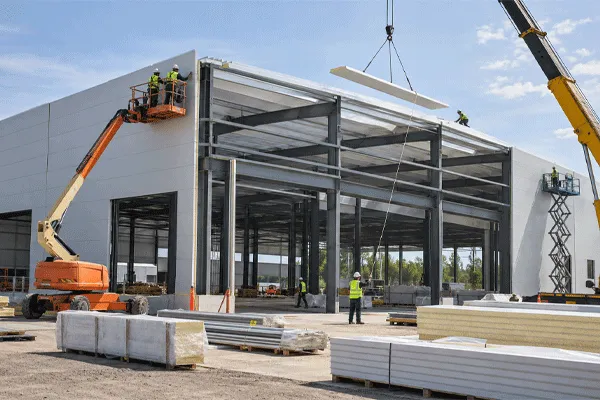
A sandwich wall panel may use horizontal or vertical installation depending on the building design and system.
Important wall specifications include:
| Élément |
What to Confirm |
| Âme |
PU, PIR, EPS, rock wool, etc. |
| Épaisseur |
Based on project performance |
| Facing |
Coated steel or specified metal sheet |
| Profile |
Flat, lightly profiled, embossed, etc. |
| Couleur |
Project specification |
| Joint |
System-specific |
| Installation direction |
Horizontal / vertical |
| Accessories |
Corners, flashings, trims |
| Performance au feu |
Required test/classification |
| Thermal value |
Required project performance |
For decorative projects, wall cladding can also be designed around architectural appearance.
The facing can use different profiles or colored steel sheets, while trims coordinate around doors, windows, corners, and bases.
A sandwich wall cladding panel therefore should not be purchased as an isolated board. It belongs to a complete facade system.
Guide des usines chinoises de panneaux sandwich : comment choisir des fabricants et des fournisseurs de panneaux sandwich et des matériaux de construction
What Makes a Sandwich Roof Panel Different?
Roof panels face conditions that wall panels do not.
They must address rainfall, drainage, roof slope, wind uplift, and—depending on the location—snow and maintenance loads.
That is why a sandwich roof product normally has a profile and joint configuration specifically designed for roofing.
A typical panel for wall and roof inquiry should still treat the two products separately.
The project team should confirm:
- Roof slope
- Support spacing
- Longueur du panneau
- Wind load
- Snow load where applicable
- Fastening method
- Système de joint
- Flashing
- Ridge detail
- Eave detail
- Pénétrations
- Required insulation performance
An insulated roof panel should not be selected only because it visually matches the wall panel.
The actual structural and water-management requirements differ.
For contractors buying roofs and walls together, coordinated colors and trims can create a cleaner finished building while separate technical specifications protect performance.
Which Sandwich Panels Work for Cold Rooms and Storage Rooms?
A cold room places high demands on insulation continuity and air/vapor control.
Temperature differences across the envelope can be significant, so joints, corners, penetrations, and doors require careful attention.
PU and PIR room panel systems are widely associated with refrigerated and temperature-controlled construction because their foam cores can provide strong thermal performance at relatively compact thicknesses.
For a cold-storage project, buyers should confirm:
- Operating temperature
- Internal and external temperature
- Humidité
- Wall thickness
- Ceiling construction
- Floor interface
- Joint d'étanchéité
- Door openings
- Contrôle de la vapeur d’eau
- Hygiene requirements
A cold-room panel is not simply a normal wall panel with more foam.
The complete enclosure must maintain temperature and minimize uncontrolled air and moisture movement.
This is also why the installation team matters.
Poor sealing at a corner or door can undermine even a panel with excellent thermal insulation properties.
For temperature-controlled facilities, factory panel quality and site installation quality must work together.
What About Cleanroom Sandwich Panels?
A cleanroom sandwich panel serves a different market.
Cleanroom contractors may require smooth, cleanable surfaces and carefully controlled joints for pharmaceutical, electronics, food, laboratory, or other controlled-environment projects.
Depending on the application, the panel may need to coordinate with:
- Systèmes de plafond
- Doors
- Windows
- Pass boxes
- HVAC
- Lighting
- Service penetrations
- Coving
- Floor systems
The correct core again depends on the project.
PU, PIR, EPS, rock wool, and other configurations can serve different needs, but the cleanroom classification, fire requirements, hygiene requirements, and local standards should determine the final specification.
For international buyers, the safest approach is to provide the project specification rather than asking simply for a generic “cleanroom panel.”
How Can You Evaluate Sandwich Panel Production in a China Factory?
Choosing between suppliers in China requires more than comparing quotation sheets.
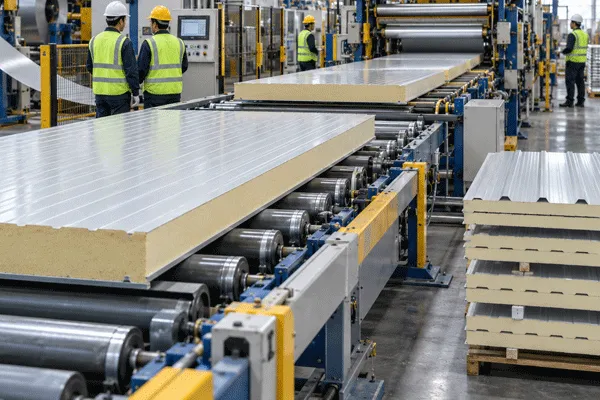
Ask how the factory controls sandwich panel production.
A serious evaluation can cover:
Raw Materials
What core and facing materials are specified? Are the coating, steel, adhesive, and insulation clearly documented?
Production Control
How are dimensions, bonding, surface appearance, panel thickness, and profiles checked?
Finished Panel
Are edges, joints, surfaces, and dimensions inspected?
Emballage
How are finished panels protected against scratches, edge damage, moisture, and transport movement?
Export Capability
Can the factory prepare long panels and accessories for containerized international shipping?
For B2B projects, consistent quality usually matters more than receiving a slightly lower quotation from a supplier that cannot hold the same specification across different batches.
A professional factory should also distinguish between a confirmed specification and an assumption.
If an item has not been agreed, mark it:
To be confirmed.
That simple habit reduces purchasing misunderstandings.
Guide des usines chinoises de panneaux sandwich : comment choisir des fabricants et des fournisseurs de panneaux sandwich et des matériaux de construction
What Should International Buyers Ask a China Sandwich Panel Supplier?
When contacting a China sandwich panel factory, send enough project information for an accurate review.
Do not send only:
“Please quote sandwich panels for sale.”
That forces the factory to guess.
Instead, prepare a clear RFQ.
Recommended Sandwich Panel RFQ
Project: Warehouse / factory / cold room / prefab building / cleanroom
Country: ___
Wall area: ___ m²
Roof area: ___ m²
Core: PU / PIR / EPS / rock wool / To be confirmed
Panel thickness: ___ / To be confirmed
Steel facing: ___
Color: ___
Panel length: ___
Fire requirement: ___
Thermal requirement: ___
Quantity: ___
Accessories: Required / Not required
Drawings: Attached / Not available
Delivery schedule: ___
This helps the supplier determine whether your requested configuration is suitable and commercially practical.
For custom projects, also send elevations, section drawings, and door/window positions when available.
A customized sandwich panel order becomes much easier when manufacturing decisions are tied to actual project drawings.
How Can You Compare Sandwich Panel Manufacturers Beyond Price?
Price is important. It just should not be the only comparison.
When evaluating professional sandwich panel manufacturers, compare like with like.
A quotation using thinner steel, a different coating, lower-performing insulation, or different packaging is not directly comparable with a higher-specification offer.
Use a comparison table:
| Comparison Item |
Supplier A |
Supplier B |
Supplier C |
| Âme |
|
|
|
| Épaisseur |
|
|
|
| Steel facing |
|
|
|
| Coating |
|
|
|
| Largeur du panneau |
|
|
|
| Données thermiques |
|
|
|
| Fire documentation |
|
|
|
| Accessories |
|
|
|
| Packing |
|
|
|
| Delivery |
|
|
|
A competitive price only has meaning when the specifications are equivalent.
The lowest unit cost may become expensive if panels arrive damaged, trims are missing, dimensions do not match drawings, or a technical requirement has not been met.
For contractors and importers, total project risk matters more than one quotation line.
Why Work With a Factory-Direct Sandwich Panel Manufacturer and Supplier in China?
Large projects often need more than a product catalogue.
They need stable manufacturing, coordinated specifications, accessories, export packaging, and project communication.
Shandong Fuqiang Environmental Protection Materials Co., Ltd. is positioned as a China-based sandwich panel manufacturer providing factory-direct insulated building-envelope solutions for international construction projects. Its target B2B customers include contractors, architects, developers, distributors, prefab companies, industrial facility owners, cold-storage contractors, cleanroom contractors, commercial developers, and international importers.
For these buyers, the purchasing process may involve:
Drawings → Panel Selection → Technical Confirmation → Samples → Quantity Confirmation → Production → Inspection → Export Packing → Shipping
The value of working factory-direct is not simply eliminating an intermediary.
It is the ability to coordinate the building material specification with the actual project.
For example, a distributor may need standard repeatable SKUs. A cold-room contractor needs insulation continuity. A prefab company may prioritize lightweight construction. A project developer may need exterior appearance and energy performance.
Those are different purchasing problems.
The factory should respond accordingly.
Illustrative B2B Project: Selecting Panels for a Prefabricated Warehouse
Consider an international contractor planning a prefabricated warehouse.
The structural frame uses a steel structure, and the buyer initially asks for the lowest-cost panel.
After project review, the sourcing team identifies five questions:
- What thermal performance is required?
- What local fire requirements apply?
- What are the wall and roof support spans?
- Which exterior color and coating are specified?
- How will panels be packed and unloaded at the site?
The buyer then compares an EPS sandwich wall option with PU/PIR and rock-wool-based alternatives.
Instead of choosing purely by unit price, the contractor evaluates:
thermal performance + fire requirements + structural suitability + installation + total landed cost
The final product selection is then tied to the actual project specification.
This is a much safer procurement method than selecting a generic sandwich panel made in China from a catalogue without understanding what is inside it.
Key Things to Remember
- A sandwich panel combines facing materials with an insulating core to create a prefabricated wall, roof, or partition component.
- PU, PIR, EPS, rock wool, and other cores serve different thermal, fire, acoustic, and budget requirements.
- Do not select a panel based only on labels such as 50mm, 75mm, or 100mm.
- A PU sandwich panel can provide strong insulation performance at relatively compact thickness, while actual performance must be confirmed from product data.
- A rock wool system can be useful where fire and acoustic requirements are important, but the complete panel assembly must still meet project requirements.
- Wall and roof panels need different structural and installation considerations.
- Cold-room and cleanroom projects require more detailed joint, sealing, hygiene, and enclosure planning than ordinary building walls.
- Compare sandwich panel manufacturers using equivalent specifications rather than unit price alone.
- Send drawings, dimensions, quantities, target country, insulation requirements, and fire requirements with your RFQ.
- A reliable sandwich panel manufacturer and supplier should help convert project requirements into a clear production specification.
- For international procurement, factory control, accessory coordination, export packing, and specification consistency are as important as the panel itself.
- Shandong Fuqiang Environmental Protection Materials Co., Ltd. supports global B2B buyers seeking factory-direct insulated panel and customized building-envelope solutions for industrial, commercial, prefab, cold-storage, and other construction projects.
FAQ
What information should I send to a sandwich panel factory?
Send the project country, application, wall and roof areas, panel dimensions, core preference, thickness, steel facing specification, colors, fire requirements, thermal requirements, drawings, quantity, and delivery schedule. If some details are unknown, mark them To be confirmed.
Is a PU sandwich panel better than an EPS sandwich panel?
Not in every application. PU sandwich products generally offer stronger thermal insulation per thickness, while EPS can provide a more economical lightweight option. The correct choice depends on insulation, fire, budget, and project requirements.
When should I choose a rock wool sandwich panel?
A rock wool sandwich panel is commonly considered where fire and acoustic properties are important. The final selection should be based on tested panel-system performance and the applicable building code.
Can sandwich panels be used for both walls and roofs?
Yes, but a wall panel and roof panel are not necessarily interchangeable. Roof products must address water drainage, slope, wind uplift, support spacing, and other roof-specific loads.
Les panneaux sandwich peuvent-ils être personnalisés ?
Project-based customization may include dimensions, facing colors, profiles, core type, thickness, and accessories, depending on production feasibility and order requirements. Buyers should send drawings and specifications for factory review.
How do I compare sandwich panel suppliers in China?
Compare the complete specification: core material, insulation performance, panel thickness, steel facing, coating, joints, fire documentation, accessories, packing, lead time, and export support. Do not compare unit price alone.



 24 septembre 2026