

견적 받기
24시간 이내에 답변드리겠습니다. 긴급한 경우 WhatsApp/WeChat(+86 13789803607)으로 연락하시거나 +86 13789802672로 직접 전화해 주세요.
*고객님의 기밀을 존중하며 모든 정보는 보호됩니다.
귀하의 문의에 답변하기 위한 목적으로만 귀하의 정보를 사용하며, 원치 않는 이메일이나 홍보 메시지는 절대 보내지 않습니다.
 October 23, 2026
Choosing the right metal panel is not simply about appearance. The wrong material, thickness, finish, or profile can create problems with installation, durability, and project cost. For contractors and distributors, working with a capable manufacturer helps turn a panel specification into a practical building solution.
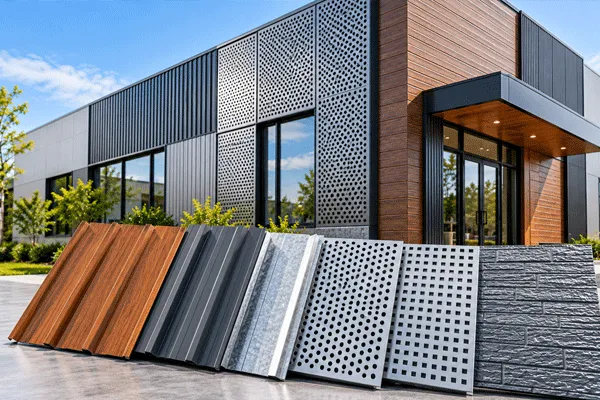
Embossed and perforated metal panels can be used for exterior walls, architectural façades, siding, screening, ceilings, and selected industrial applications. The right panel depends on the metal type, thickness, profile, surface finish, perforation or embossing pattern, installation method, and project environment.
Embossed & Perforated Metal Panels for Architectural, Industrial and Roofing Applications
A metal panel is a formed or fabricated sheet product designed for a specific building or industrial application. Depending on the manufacturing process, the surface can remain flat, be formed into ribs, receive an embossed texture, or be perforated with a controlled pattern.
An embossed metal panel uses forming pressure to create a raised or recessed pattern on the metal surface. This process can give a flat sheet more visual depth and create a distinctive architectural finish. Embossing is often selected when the project needs a textured surface rather than a completely smooth appearance.
A perforated design takes a different approach. Instead of changing only the surface texture, manufacturers create controlled openings through the sheet. A perforated metal panel can therefore provide both visual interest and functional openings, depending on the design.
These products can be manufactured from materials such as galvanized steel, aluminum, and stainless steel. The final specification should be based on the application, required durability, environmental exposure, and design requirements.
Embossing changes the surface geometry of a metal sheet. A flat metal surface can become textured, patterned, or three-dimensional, giving the finished panel a stronger visual character.
For architectural projects, this is particularly useful when designers want the building façade to have depth without using heavy traditional materials. Different patterns can be used to create subtle textures or stronger decorative effects.
The pattern can also work with different finishes. A dark finish may emphasize a deep texture, while a lighter surface can create a more understated appearance. The final result depends on the metal, pattern depth, coating, lighting, and viewing distance.
The purpose of emboss processing should be defined before production. If the main objective is architectural decoration, appearance and pattern consistency may be the priority. If the panel also has a structural role, the engineer must determine the appropriate material and profile separately.
Perforated metal is made by creating a series of openings in a sheet using a controlled perforation process. Hole shape, size, spacing, and open area can all influence the final appearance and function.
A perforated panel can be used in a wide variety of applications. Architectural projects may use it as a façade screen, balcony element, decorative wall, ceiling feature, or enclosure. Industrial projects may use perforated components where controlled airflow, screening, or separation is required.
The word perforate describes the manufacturing process, but the final product should be specified by its actual dimensions and performance requirements.
For example, a project specification may need to define:
| Parameter | Example Requirement |
|---|---|
| Metal type | Aluminum or steel |
| Sheet thickness | Project-specific |
| Hole shape | Round, square, slot, etc. |
| Hole diameter | Project-specific |
| Hole spacing | Project-specific |
| Open area | Based on application |
| Surface finish | Coated, painted, or other |
| Panel size | Project-specific |
| Edge treatment | Based on installation |
Because every project can have different requirements, buyers should not simply ask for “perforated panels.” A complete specification makes quotation and production much more accurate.
Embossing and perforation are two different fabrication methods.
With embossing, the metal remains substantially continuous while the surface is formed into a pattern. With perforation, openings are created through the sheet.
| Feature | Embossed Metal | Perforated Metal |
|---|---|---|
| Main process | Surface forming | Hole forming |
| Surface appearance | Textured or raised | Open pattern |
| Main design value | Texture and depth | Pattern and transparency |
| Typical use | Façades, wall decoration | Screens, façades, ventilation applications |
| 맞춤 제작 | Pattern and depth | Hole shape, size and spacing |
| Visual effect | Solid surface | Open or semi-transparent surface |
For some projects, the two approaches can even be considered together. An architect may want a textured metal surface in one façade zone and a perforated section in another.
The best solution depends on the design objective. A solid wall panel may be more appropriate when weather protection and enclosure are priorities, while perforated products can be considered where controlled openings are part of the design.
There is no universal “best” metal. The appropriate material depends on the building environment, budget, finish requirements, and intended service conditions.
Steel is widely used for building panels because it provides a practical combination of strength, availability, and cost. Depending on the specification, steel can be galvanized or coated for additional surface protection.
Aluminum is lightweight and can be attractive for façade and decorative applications where reducing panel weight is important.
Stainless steel may be selected for projects where corrosion resistance, appearance, and long-term surface performance are important. The specific grade should be selected according to the project environment.
The material decision should also consider the required thickness, panel dimensions, fixing system, and expected loads.
For example, a decorative façade does not necessarily require the same specification as a structural roof component. A contractor should provide the intended application before asking a manufacturer for a quotation.
Yes. Metal roofing and siding are common categories of building-envelope products, but the panel profile and construction need to match the application.
A metal roofing system must be designed for roof conditions, including drainage, weather exposure, support spacing, fasteners, overlaps, and project-specific loads. A wall cladding system has different requirements.
Common formed profiles include ribbed and corrugated designs. A corrugated panels system may be selected for its familiar appearance and efficient coverage, while ribbed profiles can provide a different visual and installation configuration.
Commercial projects may also use products such as an R panel or PBR panel, depending on the local construction system and manufacturer specification.
For a roof project, the buyer should provide:
The same principle applies to siding panels. Wall applications should be evaluated based on the wall structure, exposure, appearance, and installation method.
Embossed & Perforated Metal Panels for Architectural, Industrial and Roofing Applications
An industrial building often places greater emphasis on durability, installation efficiency, maintenance, and project cost than a purely decorative façade.
Factories, workshops, warehouses, and other large buildings may require metal roofing, wall cladding, insulation systems, or combinations of these products.
For an industrial project, panel selection should begin with the building function. A warehouse may require a straightforward exterior system, while a production facility may have additional requirements related to temperature, moisture, chemical exposure, fire performance, or hygiene.
The panel itself is only one part of the building envelope.
A practical selection process is:
This approach helps prevent a common purchasing mistake: choosing a panel based only on its appearance or unit price.
The surface finish affects both appearance and the expected performance of the metal product.
For exterior applications, the coating needs to be selected according to the environment. Factors such as sunlight, moisture, temperature changes, pollution, and coastal exposure can affect the long-term appearance of coated surfaces.
A suitable finish also contributes to the architectural design. The same embossed pattern can look completely different with a matte, gloss, metallic, wood-grain, or solid-color surface.
For architectural projects, buyers should confirm:
A high-quality finish should also remain consistent from panel to panel. This is especially important for large façades where small differences can become visible across a broad surface.
For this reason, requesting a physical sample before production is a practical step for large orders.
Yes. Customization is often important for architectural metal products because every project has different dimensions and design requirements.
A manufacturer may be able to customize the panel according to the available production process, tooling, materials, and project quantity. Depending on the product, customization may include:
A custom metal solution should start with a drawing or clear specification whenever possible.
For example, an architect may provide a façade elevation showing the desired panel arrangement. The manufacturer can then review the panel dimensions, pattern direction, joints, corners, and accessories before production.
This is more reliable than selecting a standard product first and attempting to adapt it to the building later.
A reliable supplier should provide more than a product price.
For B2B buyers, the supplier’s ability to understand project requirements can be just as important as the manufacturing price. Contractors and distributors need consistent specifications, predictable production, suitable packaging, and clear communication.
When evaluating a manufacturer, consider:
Can the factory manufacture the required panel type, material, thickness, finish, and profile?
Can the manufacturer manufacture project-specific dimensions or patterns when required?
Does the supplier have a defined process for checking dimensions, appearance, coating, and finished products?
Can the products be protected properly during transportation and handling?
Can the supplier understand drawings, dimensions, material specifications, and project requirements?
Can the manufacturer support the required quantity and project timeline?
For international B2B buyers, these questions are particularly important. A low quotation has little value if the final product does not match the approved specification.
Modern architecture often combines function with visual identity. Metal provides designers with a flexible surface that can be formed, coated, embossed, perforated, and fabricated into different configurations.
A façade can use a solid metal surface for enclosure and a perforated section for visual screening. An embossed area can then add texture and depth.
This creates a wide range of design possibilities without requiring many different metal products.
The final aesthetic should always support the building rather than becoming decoration for its own sake.
Good design balances appearance with functionality, maintenance, installation, and durability.
A retrofit project often starts with an existing building that needs a visual or functional upgrade.
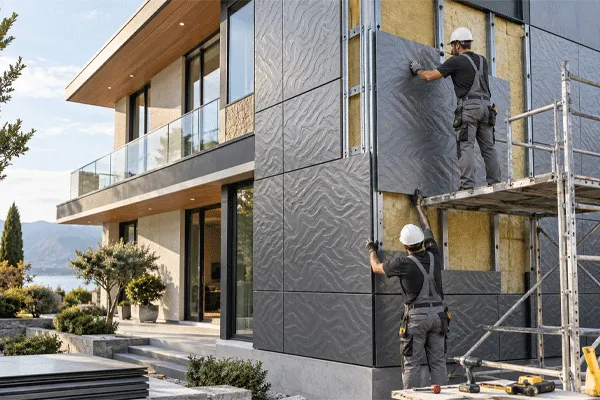
Older commercial and industrial buildings may have worn façades, outdated finishes, or damaged exterior surfaces. Metal cladding can be considered as part of an upgrade strategy when the existing structure and proposed fixing system are suitable.
Before installation, the contractor should inspect the existing substrate. The wall condition, moisture, structural capacity, fixing locations, and drainage should all be considered.
For a renovation, the panel may be selected primarily for appearance. In another project, the new wall system may also need insulation.
This distinction is important. A decorative metal sheet is not automatically an insulated wall system. If the project requires thermal insulation, the building envelope should be designed as a complete system.
The same principle applies to industrial roofs. Replacing or upgrading an existing roof requires an assessment of the supporting structure and existing conditions before selecting new metal roof panels.
A professional metal panel manufacturer should understand that B2B panel orders are project-based rather than simple retail purchases.
At Shandong Fuqiang Environmental Protection Materials Co., Ltd., our core business focuses on factory-direct insulated building-envelope solutions for global construction projects. Our customers include construction contractors, project developers, building-material distributors, prefab and modular building companies, industrial facility owners, and international B2B buyers.
Our broader product focus includes insulated sandwich panels, decorative 금속 벽 패널, PU panels, rock wool panels, roof systems, and related accessories.
For a customized metal panel project, we recommend that customers provide the application, drawings, dimensions, material preference, thickness, surface finish, quantity, destination, and other project requirements. This allows our team to evaluate the requirement before confirming the appropriate product configuration.
The goal is simple: match the panel to the building instead of forcing the building to match a standard panel.
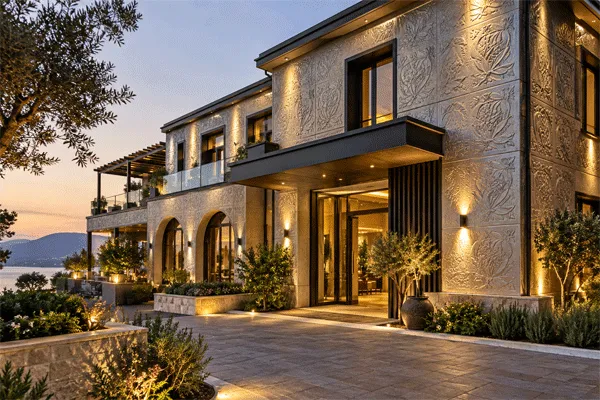
Embossed & Perforated Metal Panels for Architectural, Industrial and Roofing Applications
Whether you are looking for an embossed product, perforated sheet, exterior wall system, or metal roofing solution, a complete inquiry makes the quotation process much faster.
Project information
Panel information
Quantity information
Technical information
Shipping information
For international importers and distributors, drawings and reference samples can be especially useful when a customized specification is required.
A complete inquiry helps the manufacturer review fabrication, production feasibility, packaging, and delivery requirements before issuing a quotation.
Embossed and perforated metal panels give architects, contractors, and developers more ways to combine appearance and practical building requirements. Embossing adds texture and visual depth, while perforation creates controlled openings that can support specific architectural or functional purposes.
For exterior projects, the selection should go beyond appearance. Metal type, thickness, profile, coating, finish, dimensions, installation method, and environmental conditions all influence the final result.
For industrial and commercial buildings, the panel must also work with the supporting structure and overall building-envelope design. For renovation projects, the existing substrate must be assessed before a new cladding system is selected.
For international B2B buyers, working directly with an experienced manufacturer can simplify customization, technical communication, production coordination, and export packaging.
At Shandong Fuqiang Environmental Protection Materials Co., Ltd., we work with contractors, developers, distributors, prefab building companies, and international buyers to provide factory-direct insulated and decorative panel solutions for different construction applications.
An embossed metal panel is a metal sheet or panel with a raised or recessed surface pattern created through forming. It can be used to add texture and visual depth to architectural and decorative applications.
A perforated metal panel contains controlled openings through the sheet. Depending on its design and specification, it can be used for architectural façades, screens, partitions, decorative elements, and selected industrial applications.
Yes, suitable products can be used for exterior wall applications when the material, coating, thickness, fixing method, and supporting structure are appropriate for the project environment.
Neither material is universally better. Steel may be preferred for certain building applications because of its strength and cost characteristics, while aluminum can be useful where lower weight is important. The selection should follow the project's actual requirements.
Customization may include dimensions, thickness, patterns, finishes, colors, profiles, and other details depending on the manufacturer's production capability and the project quantity. Drawings and samples are recommended for customized orders.
Fuqiang is a China-based sandwich panel manufacturer focused on factory-direct insulated building-envelope solutions. Its broader product range includes insulated sandwich panels, decorative metal wall panels, PU panels, rock wool panels, roof systems, and panel accessories for international construction projects.
24시간 이내에 답변드리겠습니다. 긴급한 경우 WhatsApp/WeChat(+86 13789803607)으로 연락하시거나 +86 13789802672로 직접 전화해 주세요.
*고객님의 기밀을 존중하며 모든 정보는 보호됩니다.
귀하의 문의에 답변하기 위한 목적으로만 귀하의 정보를 사용하며, 원치 않는 이메일이나 홍보 메시지는 절대 보내지 않습니다.