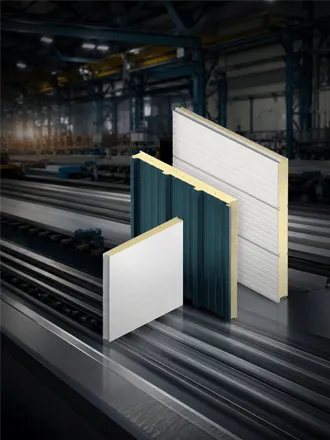
Choosing a villa façade by appearance alone can create problems later. The wrong panel, finish, thickness, or joint detail may look good in a sample but perform poorly on the building. A well-planned embossed metal wall cladding system balances visual character, durability, insulation, and installation needs.
Embossed metal wall panels are exterior cladding products with a formed surface pattern that adds depth and architectural character to villa façades. For residential projects, buyers should compare profile, surface finish, insulation needs, panel thickness, installation details, weather resistance, and custom color options before selecting a system.
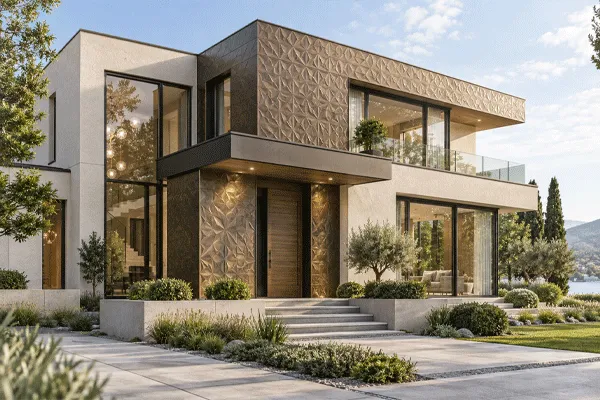
Embossed Metal Wall Panels for Villa Exterior Wall Cladding: Design, Performance & Installation Guide
What Are Embossed Metal Wall Panels for Villa Exterior Design?
An embossed exterior panel uses a shaped surface rather than a completely flat face. During manufacturing, equipment can emboss a controlled pattern into the facing material, creating visible depth and a more textured appearance. Depending on the product construction, the facing may use coated steel, aluminum, or another suitable exterior-grade material.
For villa projects, this surface treatment can help a simple façade gain more character without relying on heavy stone or complicated decorative masonry. An embossed metal wall surface may imitate a refined geometric pattern, a subtle natural texture, or another architectural effect while keeping the building envelope visually clean.
It is important, however, to distinguish between different products sold under similar names. A single-skin metal sheet, an insulated sandwich panel, and a rainscreen cladding panel do not perform the same role. The architect, contractor, or importer should confirm the full assembly before specifying it.
| Product Type |
Main Role |
Insulation |
Typical Villa Use |
| Single-skin metal cladding |
Exterior decorative skin |
Separate insulation needed |
Façade renovation or rainscreen |
| Insulated metal wall panel |
Cladding + insulation |
Integrated |
Exterior wall envelope |
| Decorative sandwich panel |
Decorative facing + insulation |
Integrated |
Villas and residential projects |
| Metal accent panel |
Local decorative element |
Depends on assembly |
Entryway, balcony, feature wall |
At Shandong Fuqiang Environmental Protection Materials Co., Ltd., we approach these inquiries as building envelope projects, not simply as orders for decorative sheets. The surface appearance matters, but the wall assembly, dimensions, insulation requirement, joints, accessories, and installation conditions matter just as much.
Why Use Embossed Metal Instead of Smooth Exterior Wall Panels?
A smooth façade creates a clean, modern look. An embossed surface adds shadow, visual depth, and texture. Neither approach is automatically better; they create different architectural results.
For a villa, embossed surfaces can help break up a large exterior wall without adding many separate decorative components. Light hits raised and recessed areas differently throughout the day, so the façade gains subtle variation even when one color is used.
This can be useful for projects where the design aims to look modern but not completely plain.
The main visual differences are:
- Flat surface: simple and restrained
- Smooth metal surface: modern and precise
- Embossed texture: more depth and visual movement
- Deep profile: stronger shadow lines
- Mixed façade materials: more contrast between zones
An architect may use an embossed panel on the main villa volume and combine it with glazing, stone, stucco, timber-look elements, or another compatible façade material.
This gives more design freedom without turning the exterior into excessive decoration.
The Metal Construction Association notes that metal walls are used for both aesthetics and performance and can support a wide range of architectural approaches, including insulated and rainscreen assemblies.
How Can Embossed Metal Wall Cladding Improve a Villa’s Appearance?
A villa exterior must usually work from two viewing distances.
From far away, people see proportion, color, roofline, windows, and major façade divisions. Up close, they notice the finish, joints, corners, surface quality, and small construction details.
That is where an embossed surface adds value.
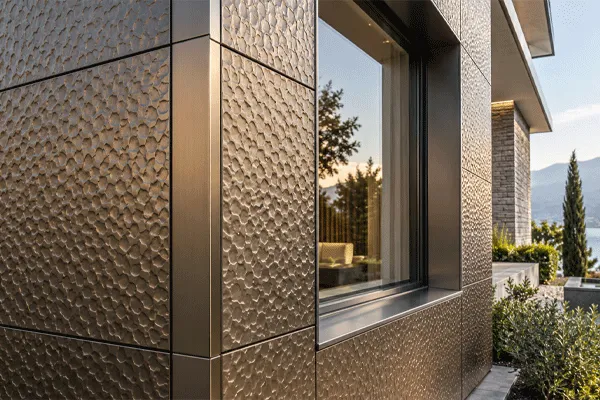
The pattern creates a controlled 3D effect. It can make a simple wall feel more deliberate without requiring highly complex forms. When the depth is modest, the result can remain elegant and minimalist rather than decorative in an excessive way.
Four common villa façade directions
| Architectural Direction |
Suitable Panel Approach |
Visual Result |
| Modern minimalist villa |
Fine emboss + neutral color |
Quiet, refined |
| Contemporary luxury villa |
Deeper emboss + contrasting trims |
Stronger architectural identity |
| Natural-style residence |
Soft texture + wood/stone combination |
Warm exterior |
| Urban townhouse/villa |
Vertical profile + dark finish |
Taller, sharper appearance |
A vertical panel orientation can visually emphasize building height. Horizontal layouts can make the façade appear wider.
Embossing can also be used only as an accent. For example, a project may place it around the entrance, upper story, balcony zone, or garage volume instead of covering every exterior surface.
This is often more effective than treating the entire villa like oversized wall art.
Good façade design does not depend on adding more patterns. It depends on using texture where it supports the architecture.
For designers collecting ideas and inspiration for embossed façade surfaces, platforms such as Pinterest can help establish a visual direction. You may also save ideas about embossed metal façades to a mood board, but the final specification should come from actual samples and project requirements rather than reference images alone.
What Performance Should an Exterior Metal Wall System Provide?
Appearance brings attention to a façade. Performance determines whether the building envelope works over time.
For a villa exterior, the cladding assembly must be coordinated with water control, air control, insulation, structural support, joints, flashings, and openings.
The Whole Building Design Guide explains that exterior cladding should be considered part of a broader moisture-management assembly. Residential cladding normally works with a water-resistive barrier and properly detailed flashings, because some rainwater can pass behind the outer cladding layer.
This means buyers should not ask only:
“Is the metal waterproof?”
A better question is:
“How is the complete wall system designed to control rainwater?”
Depending on the construction method, this may involve:
- Exterior cladding
- Sealed or open joints
- Flashing
- Drainage space
- Water-resistive layer
- Insulation
- Substructure
- Interior wall assembly
For a rainscreen application, the Metal Construction Association explains that the cavity behind the cladding helps drainage and drying.
For an insulated metal wall assembly, the construction logic can be different. Therefore, the correct detail must match the actual product, climate, wall structure, and local code.
Should Villa Projects Use Insulated Metal Wall Panels?
If the product combines an exterior decorative facing with insulation, it can perform more functions than decorative cladding alone.
An insulated metal wall assembly may help combine the exterior skin and thermal layer into a more integrated construction approach. This can be attractive for projects where faster enclosure and a cleaner construction sequence are important.
However, insulation should never be selected only by panel thickness.
The design team should consider:
- Required thermal value
- Insulation material
- Local climate
- Joint configuration
- Thermal bridges
- Openings and corners
- Wall support structure
- Local energy requirements
The Metal Construction Association notes that attachment methods and thermal bridging can materially affect exterior wall energy performance, even when insulation is present.
That is an important point for residential buyers.
A thicker panel does not automatically guarantee better whole-wall efficiency if metal connections or poorly detailed joints allow significant heat transfer.
For this reason, contractors should evaluate the complete assembly rather than comparing products by one number.
When Shandong Fuqiang supports an international villa project, we recommend that buyers provide the intended wall construction, climate, dimensions, and insulation requirements early. This makes it easier to determine whether a decorative insulated solution or another façade assembly is more appropriate.
Embossed Metal Wall Panels for Villa Exterior Wall Cladding: Design, Performance & Installation Guide
Steel or Aluminum: Which Metal Is Better for Villa Wall Panels?
Both coated steel and aluminum can be used in architectural cladding, but the correct choice depends on the product design and project requirements.
Steel can offer strong structural characteristics and is widely used in exterior panel production. Aluminum is naturally lighter and is also common in façade systems where low weight, corrosion considerations, or specific architectural finishes are important.
A simple comparison is useful:
| Factor |
Coated Steel |
Aluminum |
| Weight |
Higher |
Lower |
| Strength |
High |
Good relative to weight |
| Exterior use |
Common with suitable coating |
Common |
| Formability |
Suitable for many profiles |
Very good |
| Cost |
Project-dependent |
Project-dependent |
| Surface options |
Wide range |
Wide range |
| Corrosion performance |
Depends strongly on coating and environment |
Good natural corrosion resistance |
Do not select the material only because one is described as more durable.
Real durability also depends on the coating, cut edges, fastening method, salt exposure, pollution, moisture, maintenance, and installation quality.
A coastal villa, for example, may need different corrosion considerations from a house located inland.
The correct material specification should therefore be matched to the site’s environmental exposure.
How Do Profile, Embossed Texture, Thickness, and Finish Affect the Design?
Four specifications have a strong influence on the final result:
profile + texture + thickness + finish
The profile defines the larger shape of the surface. The embossing creates smaller-scale visual variation. Panel thickness relates to the exact product construction and performance requirements, while the surface finish controls color, gloss, and visual character.
For a villa, these factors must work together.
Example specification logic
Modern villa
- Fine emboss
- Low-gloss finish
- Neutral gray
- Narrow joint appearance
Warm residential villa
- Natural textured surface
- Cream or earth tone
- Coordinated trim
- Moderate panel width
Contemporary dark façade
- Linear or subtle emboss
- Charcoal finish
- Vertical layout
- Contrasting window frames
The same embossed pattern can look completely different when the style and color change.
A dark color tends to emphasize shadows. A light finish can make the pattern softer.
For architects, this is why physical samples are important. A small digital image cannot fully show how the surface responds to daylight.
If the buyer needs a specific spec, the inquiry should define:
- Panel width
- Panel length
- Total thickness
- Facing material
- Surface color
- Embossing pattern
- Coating requirement
- Joint style
- Insulation requirement
- Corner and trim details
If any item is not yet decided, it should be marked To be confirmed rather than guessed.
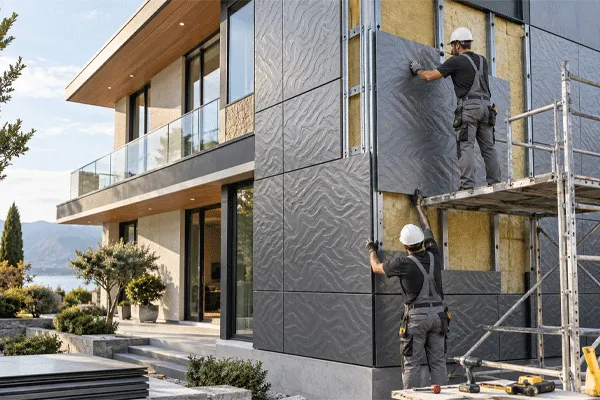
How Should Embossed Metal Wall Panel Installation Be Planned?
Good installation protects both appearance and building-envelope performance.
Metal cladding is manufactured with controlled dimensions, but the building itself may have tolerances. The supporting wall or substructure must therefore be checked before panels are installed.
Important details include:
- Starting line and level
- Substructure spacing
- Panel orientation
- Fastening method
- Joint spacing
- Internal and external corners
- Door and window interfaces
- Bottom flashing
- Roof-to-wall transitions
- Drainage details
The Whole Building Design Guide emphasizes that water management around windows, penetrations, laps, and flashings is critical. It also notes that exterior coverings should generally be treated as water-shedding components rather than assuming the outer surface alone provides complete waterproofing.
This matters especially for a villa because façades have many interruptions: large windows, balconies, entance canopies, lights, pipes, terraces, and roof junctions.
The detail around these transitions often determines real-world performance.
Contractors should therefore request drawings or installation guidance for compatible trims and connections rather than improvising every junction on site.
Can Embossed Metal Panels Replace Masonry, Stucco, or Traditional Decoration?
Sometimes they can replace part of a conventional façade system, but the comparison must be made carefully.
Masonry, stucco, stone, and metal each create different structural, moisture, labor, and aesthetic conditions.
One major advantage of many metal systems is their relatively lightweight construction compared with thick masonry finishes. This can be useful in villa projects where designers want a modern façade without adding heavy decorative material.
Metal can also create crisp lines that are difficult to achieve with some wet-applied finishes.
However, it should not be presented as a universal replacement.
| Façade Material |
Key Character |
| Embossed metal panel |
Lightweight, precise, textured |
| Stone |
Heavy, natural appearance |
| Brick/masonry |
Traditional mass and texture |
| Stucco |
Continuous surface |
| Timber-look cladding |
Warm visual character |
A strong villa façade often mixes materials instead of forcing one product onto every surface.
For example, embossed panels might frame an entryway, while stone is used at the base and glazing opens the living areas toward a patio or garden.
This approach allows the beauty of each material to support a different architectural zone.
The same material can sometimes continue onto a soffit or selected ceiling area when the actual product and fixing system are approved for that use, but this should be confirmed for the specific assembly rather than assumed.
Embossed Metal Wall Panels for Villa Exterior Wall Cladding: Design, Performance & Installation Guide
How Do Architects Use Embossed Panels Without Making a Villa Look Too Industrial?
This is one of the most important design questions.
Metal is often associated with factories and warehouses, but its architectural use is much broader. The difference comes from scale, pattern, color, joint layout, and how it interacts with the rest of the property.
For residential work, restraint usually helps.
A fine embossed texture, warm neutral color, and carefully aligned joints can produce a sophisticated result without making the house look like an industrial building.
Consider this simple visual hierarchy:
Primary Villa Volume
        │
        ├── Smooth / simple main façade
        │
        ├── Embossed panel feature zone
        │
        ├── Glass openings
        │
        └── Stone / timber / stucco accent
This gives the embossed surface a clear purpose.
Rather than using the most dramatic pattern available, an architect can ask:
- Where should the eye focus?
- Which wall receives the most daylight?
- Which façade is visible from the street?
- Should the surface emphasize height or width?
- Which adjacent material creates the right contrast?
These decisions create a more coherent aesthetic.
A subtle panel may deliver more sophisticate visual character than a deep pattern used everywhere. In practical writing, “sophisticated appearance” is the more natural expression.
How Much Strength and Resistance Does an Exterior Panel Need?
Exterior wall panels face wind, temperature changes, impact during handling, and long-term exposure.
The required strength depends on the complete construction, including panel geometry, material gauge, support spacing, fasteners, building height, and local wind conditions.
A panel’s maximum span should therefore come from engineering information for the exact system rather than from a generic assumption.
Similarly, impact resistance depends on the actual facing and construction.
A villa at ground level may experience accidental contact from furniture, tools, landscaping equipment, or other everyday activities. Higher façade zones have different priorities, such as wind pressure and weather exposure.
For every international project, the contractor or builder should check local structural and code requirements.
The appropriate resistance values cannot be determined from appearance alone.
This is also why a high-quality surface sample is not enough for specification approval. Buyers may also need technical data, installation details, project-specific engineering, or testing documents depending on the market.
How Can Buyers Customize Embossed Metal Wall Panels for a Villa Project?
Customization is especially useful when exterior cladding must fit an architectural concept rather than a standard industrial building.
Depending on manufacturing capability and order conditions, buyers may need to customize items such as:
- Cor
- Surface finish
- Emboss pattern
- Panel width
- Panel length
- Facing material
- Insulation configuration
- Thickness
- Joint appearance
- Corner trims
- Window trims
- Base flashings
- Packaging
Not every combination is technically or commercially practical. This is why early communication matters.
A useful villa inquiry should include:
| Information |
Why It Matters |
| Architectural drawing |
Helps calculate surfaces and details |
| Elevation drawings |
Shows panel orientation |
| Total area |
Supports quantity planning |
| Wall dimensions |
Helps determine panel lengths |
| Desired color |
Guides sample confirmation |
| Insulation requirement |
Affects panel construction |
| Target country |
Helps review project requirements |
| Installation method |
Helps coordinate details |
| Delivery schedule |
Supports production planning |
At Shandong Fuqiang Environmental Protection Materials Co., Ltd., our role as a China-based sandwich panel manufacturer is to help contractors, developers, distributors, architects, and importers translate these requirements into a practical factory-direct panel solution.
For international orders, export packaging and accessory coordination should also be discussed before production. Long decorative panels require careful packing so that finished surfaces and panel edges are protected during transportation.
Illustrative Villa Project: From Flat Façade to Embossed Metal Accent
Consider a two-story contemporary villa with white exterior walls, large windows, and a simple rectangular form.
The original façade is visually clean but lacks a focal point.
Instead of adding heavy stone across the entire property, the design team introduces embossed cladding on the upper entrance volume and one side elevation.
The concept becomes:
Main wall: light neutral finish
Feature zone: charcoal embossed cladding
Orientation: vertical
Windows: dark frames
Entrance: matching trim
Landscape: simple garden planting
The darker textured surface creates more visual impact without changing the basic architecture.
At the same time, the project team reviews the wall assembly, corner trims, window interfaces, attachment method, and weather-control details before ordering.
That is the key lesson.
Exterior decoration should be designed as part of the building envelope—not added after the technical decisions are finished.
Perguntas frequentes
Are embossed metal wall panels suitable for outdoor villa facades?
Yes, an exterior-grade panel can be used for outdoor villa cladding when its material, coating, fixing system, joints, and complete wall assembly are suitable for the project's environment and code requirements. Buyers should confirm the exact product specification instead of assuming every decorative metal panel is intended for exterior use.
What is the difference between embossed and flat metal panels?
A flat panel has a relatively even surface, while manufacturers emboss patterns into another type to create raised and recessed areas. This changes the appearance and the way light and shadow move across the façade.
Can embossed wall panels include insulation?
Some systems combine decorative metal facings with an insulation layer, while others are cladding-only products. If thermal insulation is required, confirm the complete panel construction, insulation material, thickness, joints, and thermal performance before ordering.
Can I customize the color and embossed pattern?
Customization may be available depending on the product, manufacturing process, order quantity, and project specifications. Buyers should provide target colors, architectural references, quantities, and required dimensions for factory review.
Are metal wall panels difficult to install?
Installation complexity depends on the panel system and building geometry. Straight walls are generally easier than façades with many windows, corners, balconies, and penetrations. Good layout planning and compatible flashing details are important.
Is an embossed façade suitable for a minimalist villa?
Yes. A minimalist project does not require completely smooth surfaces. A subtle emboss, restrained color, simple joint layout, and limited use on selected façade zones can create visual depth while keeping the architecture clean.


 September 21, 2026