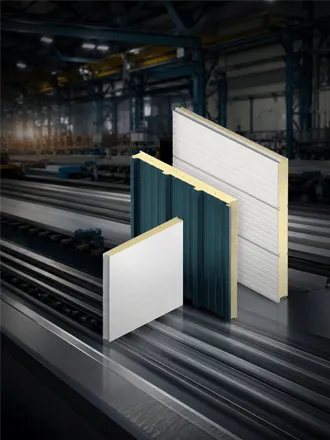
When choosing insulated sandwich panels for a building project, many buyers focus only on price and thickness. However, different sandwich panels are designed for different applications.
Rock wool sandwich panels, polyurethane (PU) sandwich panels, and PU-edge rock wool sandwich panels each have their own advantages in terms of fire safety, thermal insulation, structural performance, moisture resistance, weight, installation and cost.
Choosing the right panel before construction can improve building safety, energy efficiency and long-term durability.
Quick Selection Summary
| Project Priority |
Recommended Panel |
Why |
| Fire safety |
Rock Wool Sandwich Panel |
Excellent fire resistance |
| Thermal insulation + lightweight construction |
Painel sanduíche de PU |
Excellent thermal insulation and low panel weight |
| Fire safety + improved edge sealing |
PU-Edge Rock Wool Panel |
Rock wool core with enhanced PU edge sealing |
1. Rock Wool Sandwich Panels
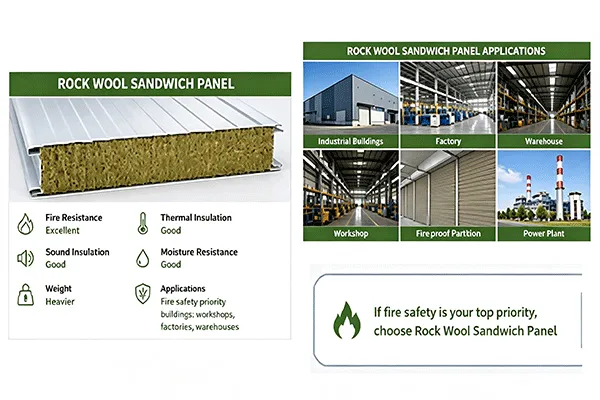
Rock wool sandwich panels use rock wool as the insulation core between two metal sheets.
Main Advantages
Excellent Fire Resistance
The biggest advantage of rock wool panels is their excellent fire resistance. Rock wool is an inorganic insulation material and is widely used in projects where fire safety is a major consideration.
They are particularly suitable for:
- Industrial buildings
- Factories
- Warehouses
- Workshops
- Fire-sensitive buildings
- Buildings with strict fire-safety requirements
Good Thermal Insulation
Rock wool provides good thermal insulation and can help reduce heat transfer between the interior and exterior of a building.
Good Sound Insulation
The fibrous structure of rock wool also provides good acoustic performance. Therefore, rock wool panels can be considered for buildings where reducing noise is important.
Recommended Applications
Factories, workshops, warehouses, industrial buildings and fire-sensitive projects.
If the main requirement of the project is fire safety, rock wool is often a preferred option.
2. PU Sandwich Panels
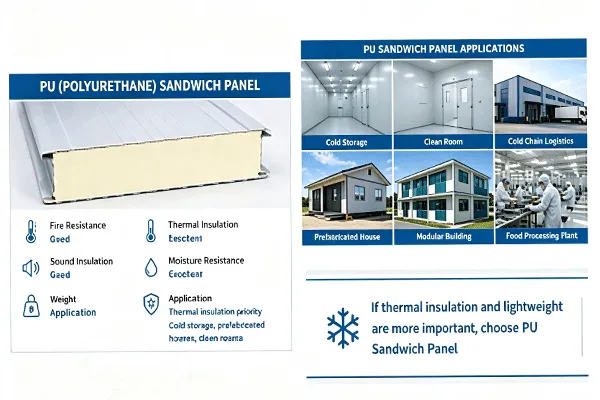
PU sandwich panels use rigid polyurethane foam as the insulation core. Compared with traditional insulation materials, PU provides excellent thermal insulation with relatively low thickness.
Main Advantages
Excelente isolamento térmico
One of the biggest advantages of PU panels is their high thermal insulation performance. This makes them suitable for buildings where maintaining a stable indoor temperature is important.
Typical applications include:
- Cold storage
- Refrigerated warehouses
- Food processing facilities
- Temperature-controlled buildings
- Prefabricated houses
- Commercial buildings
Lightweight
PU panels are relatively lightweight, which can make transportation and installation easier. This can help reduce installation time and labor costs.
Good Moisture Resistance
PU foam has a closed-cell structure, which provides good resistance to moisture absorption. This makes PU sandwich panels particularly suitable for applications where moisture control is important.
3. PU-Edge Rock Wool Sandwich Panels
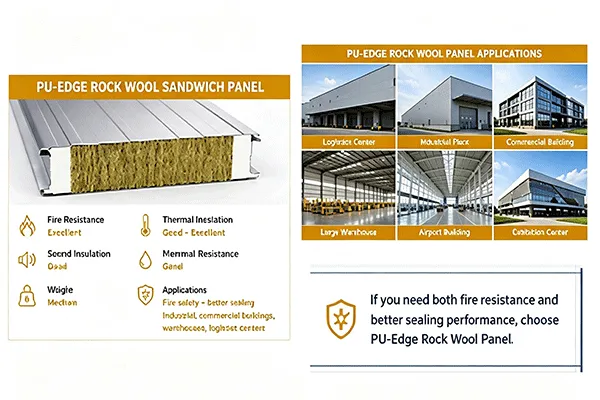
PU-edge rock wool panels combine two different insulation concepts. The main insulation core is rock wool, while the panel edges use PU material to improve the edge connection and sealing performance.
This design aims to combine the fire-resistant characteristics of rock wool with the sealing and connection advantages of PU.
Main Advantages
Improved Edge Sealing
The PU edge can help improve the connection between adjacent panels. This can reduce potential gaps during installation and improve the overall sealing of the wall or roof system.
Fire Safety + Sealing Performance
The rock wool core provides strong fire-resistant characteristics, while the PU edge improves connection and sealing performance.
This makes the product particularly interesting for projects that require a balance between fire safety, insulation, sealing and installation performance.
4. Comparison of the Three Types
| Feature |
Rock Wool Panel |
Painel sanduíche de PU |
PU-Edge Rock Wool Panel |
| Main Core |
Rock Wool |
Polyurethane |
Rock Wool + PU Edge |
| Fire Resistance |
Excellent |
Good, depending on system |
Excellent |
| Thermal Insulation |
Good |
Excellent |
Good–Excellent |
| Sound Insulation |
Good |
Good |
Good |
| Moisture Resistance |
Good with proper system |
Excellent |
Good |
| Weight |
Relatively Heavy |
Lightweight |
Relatively Heavy |
| Edge Sealing |
Standard |
Good |
Enhanced |
| Installation |
Standard |
Fast |
Standard |
| Typical Cost |
Medium |
Medium–High |
Medium–High |
| Best Feature |
Fire Safety |
Thermal Insulation |
Fire Safety + Edge Sealing |
Note: Actual fire rating and thermal performance depend on the complete panel system, core density, thickness, steel sheet, joints and applicable testing standards.
There is no single panel that is best for every project. The correct choice depends on the project environment and performance requirements.
Choose Rock Wool When Fire Safety Is the Priority
Rock wool panels are a strong choice when the project has strict fire-safety requirements. Typical applications include large factories, industrial workshops, warehouses, manufacturing facilities and buildings with high fire-safety requirements.
Priority: Fire Safety
Choose PU When Thermal Insulation Is the Priority
PU sandwich panels are a good choice when the project needs excellent thermal insulation with relatively low panel weight. Typical applications include cold rooms, cold storage, food processing plants, refrigerated warehouses, prefabricated buildings and temperature-controlled facilities.
Priority: Thermal Insulation + Lightweight Construction
Choose PU-Edge Rock Wool When You Need Both Fire Safety and Better Sealing
PU-edge rock wool panels can be considered when the project requires a combination of high fire resistance, good insulation, improved panel joint sealing and reliable connection performance.
They can be particularly suitable for industrial and commercial projects where both fire safety and building envelope performance are important.
Priority: Fire Safety + Sealing Performance
6. Thickness Is Also Important
Selecting the correct core material is only the first step. Panel thickness also affects insulation performance, weight and project cost.
Thinner Panels
- Lower material consumption
- Lower weight
- Easier transportation
- Suitable for applications with moderate insulation requirements
Thicker Panels
- Better thermal insulation
- Better overall building envelope performance
- Suitable for colder or hotter climates
- More suitable for temperature-controlled buildings
Panel thickness should be selected according to the building’s climate, application, insulation requirements and local building regulations.
7. Don’t Choose Panels Based on Price Alone
A cheaper panel is not necessarily the more economical choice. When comparing different suppliers, buyers should consider:
- Core Material— Confirm whether the core is PU, rock wool or another insulation material.
- Core Density— Different densities can result in different mechanical and thermal performance.
- Panel Thickness— Thickness directly affects thermal insulation and weight.
- Steel Sheet Thickness— The thickness and quality of the metal skin affect durability, rigidity and corrosion resistance.
- Fire Performance— Always check the actual fire test results and certification required by your project.
- Joint Design— The connection between panels can significantly affect air tightness, water resistance and overall building performance.
- Manufacturing Quality— Consistent panel dimensions and stable production quality are important for efficient installation.
8. A Simple Selection Guide
| If Your Project Needs… |
Consider… |
| Maximum fire safety |
Painéis sanduíche de lã de rocha |
| Excellent thermal insulation and lightweight construction |
PU Sandwich Panels |
| Fire safety together with improved edge sealing |
PU-Edge Rock Wool Panels |
| Cold storage or temperature-controlled construction |
PU Sandwich Panels are commonly considered |
| Industrial buildings with strict fire requirements |
Rock Wool Sandwich Panels are commonly considered |
| Fire performance and improved joint sealing |
PU-Edge Rock Wool Panels |
9. The Right Panel Depends on the Project
Choosing a sandwich panel should never be based on one specification alone.
The best solution should consider: Building Type + Climate + Fire Requirements + Thermal Insulation + Moisture Conditions + Installation Method + Budget
At Shandong Fuqiang Environmental Protection Materials Co., Ltd., we provide different insulated sandwich panel solutions for industrial, commercial, residential and prefabricated building projects.
We can help customers select the appropriate rock wool, PU or PU-edge rock wool sandwich panel according to their project requirements.
Tell us your building type, panel thickness, quantity and destination country, and our team can recommend a suitable panel solution for your project.
Perguntas frequentes
What is the main difference between rock wool, PU and PU-edge rock wool sandwich panels?
Rock wool panels prioritize fire resistance, PU panels prioritize thermal insulation and lightweight construction, and PU-edge rock wool panels combine a rock wool core with PU edges to improve sealing and connection performance.
Which sandwich panel should I choose when fire safety is the top priority?
Rock wool sandwich panels are often a preferred option when the project has strict fire-safety requirements, including factories, workshops, warehouses and other fire-sensitive industrial buildings.
Which sandwich panel is commonly considered for cold storage?
PU sandwich panels are commonly considered for cold rooms, cold storage, refrigerated warehouses, food processing facilities and other temperature-controlled buildings because of their high thermal insulation performance
Why choose a PU-edge rock wool sandwich panel?
A PU-edge rock wool panel can be considered when a project needs the fire-resistant characteristics of rock wool together with improved panel joint sealing and connection performance.
How does sandwich panel thickness affect performance?
Panel thickness affects thermal insulation, weight and project cost. Thicker panels generally provide better insulation and building envelope performance, while thinner panels reduce weight and material consumption.
What should buyers compare besides price?
Buyers should compare core material, core density, panel thickness, steel sheet thickness, fire performance, joint design and manufacturing quality. Actual performance should be evaluated according to the complete panel system and project requirements.



 August 13, 2026