Types of Exterior Wall Panels for Commercial Buildings
News, Industry Insights & Updates from Fuqiang
Types of Exterior Wall Panels for Commercial Buildings
August 25, 2026
Equipe Técnica e de Aplicações da Shandong Fuqiang
Corporate technical and product application guidance | Updated August 25, 2026
Exterior wall panels for commercial buildings are not one product category. Contractors usually compare decorative metal panels, insulated PU sandwich panels, rock-wool panels and other cladding assemblies by substrate, core, finish, joints, support, weather exposure and maintenance. The correct choice follows the building brief and wall detail, not the panel name alone.
This comparison uses Fuqiang’s published product data and documented Australia house and warehouse project. Project pages describe application outcomes but do not publish universal energy savings, installation-time reductions or weather guarantees, so those claims still require project-specific evidence.
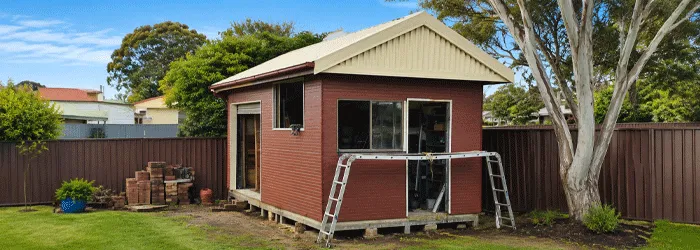
The completed Australia house and warehouse project shows an exterior decorative wall-panel application with a wood-style finish.
Four exterior wall-panel families to compare
Panel family
Best-fit decision
Checks before ordering
Decorative metal wall panel
Architectural appearance, finish consistency and façade customization
Face metal, coating, pattern, openings, trims, support and replacement plan
PU sandwich panel
Insulation per millimeter for warehouses and general envelopes
Core density, thickness, thermal data, joint, steel face and fire documents
Rock-wool sandwich panel
Projects where fire or acoustic requirements drive the core choice
Classification scope, thickness, density, facing, joints and tested assembly
Decorative PU sandwich panel
Insulated wall with a stone, brick, marble or wood-style finish
Pattern sample, effective width, core, coating, trims and color consistency
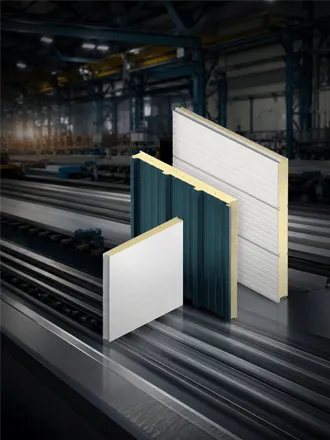
Fuqiang’s catalog lists a double-sided steel PU sandwich panel at 1000 mm effective width, 50–200 mm thickness, 0.3–0.8 mm steel facing, approximately 42 kg/m³ PU density and thermal conductivity of 0.019–0.023 W/(m·K). It lists a fire-resistant rock-wool wall panel at 950 mm effective width, 50–200 mm thickness options, approximately 0.043 W/(m·K) thermal conductivity and sound insulation of at least 30 dB. These values belong to the named product lines and should not be transferred to another construction without confirmation.
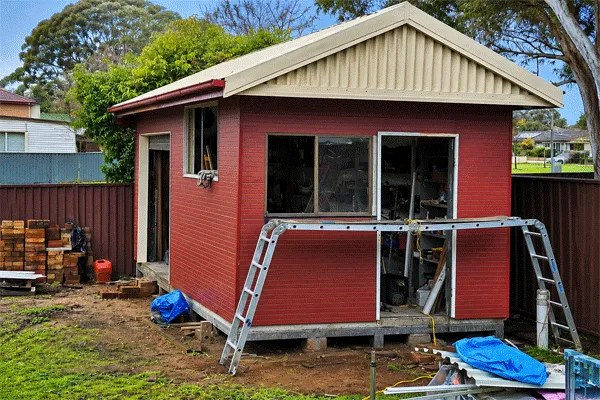
Installation-stage evidence highlights why substrate tolerance, openings, joints and trims must be resolved before the wall is closed.
Match the panel to exposure and building use
Record site location, wind design basis, rainfall, coastal or industrial exposure, wall height, humidity, impact risk, internal temperature and maintenance access. A warehouse in a high-exposure location may need different coatings, joint details and inspection provisions from a sheltered commercial elevation.
For façades, the visual finish may be a primary driver, but the panel still needs a defined weather-management strategy. Review bases, parapets, eaves, corners, openings, penetrations, flashings, closures and drainage paths as a connected set.
Five decisions that change the specification
Substrate and support. Confirm rails, girts, brackets, fasteners, tolerances and movement assumptions.
Core or backing. Select PU, rock wool or another backing based on thermal, fire, acoustic and thickness constraints.
Finish and coating. Approve a physical sample and record color, texture, gloss, coating and replacement reference.
Joints and accessories. Include corners, trims, flashings, closures, sealants, fasteners and transitions to other materials.
Openings and services. Freeze doors, windows, louvers, vents, equipment supports and penetrations before production.
Australia project context
Fuqiang’s documented Australia house and warehouse exterior wall-cladding project used exterior decorative metal wall panels with a wood-style finish. The published case reports improved weather resistance and durability together with reduced maintenance requirements, but it gives no numerical KPI. Treat it as an application reference, not a universal performance guarantee.
For a commercial building, the project lesson is practical: a finish decision must be coordinated with the wall section, opening details, support, installation sequence and maintenance plan.
Advantages and tradeoffs
Decorative panels can create a consistent architectural identity and repeatable factory finish. PU panels can provide a lower published thermal-conductivity range per millimeter than the listed rock-wool line. Rock wool can be preferred where fire or acoustic requirements outweigh the need for a thinner wall.
Each option has limits. Decorative face sheets do not establish insulation or fire performance by themselves. PU and rock-wool claims depend on exact thickness, joints and tested configuration. Custom patterns and trims can also add lead time, so approval dates should be linked to production and delivery planning.
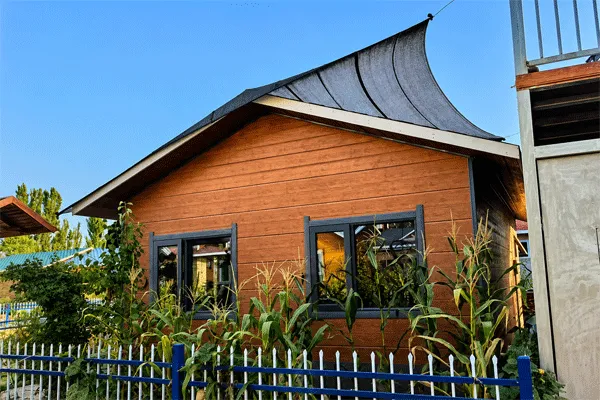
A second documented façade application shows how decorative metal panels can be adapted to a different building form and finish brief.
Common comparison mistake
Do not compare only price per square meter or the face pattern. Compare the complete wall package: panel construction, joints, trims, flashings, fasteners, support, openings, evidence, packaging, installation responsibilities and future replacement.
Questions buyers often ask
Which exterior wall panel is best for a warehouse?
The answer depends on exposure, thermal target, fire strategy, support structure, finish, openings and maintenance access. Start with the wall section and project conditions, then compare PU, rock wool and decorative assemblies.
Are decorative metal panels insulated?
Some decorative panels are insulated sandwich constructions, while others are decorative faces or cladding sheets over a separate backing wall. Confirm the complete build-up and thermal evidence for the offered product.
Does a thicker panel always perform better?
Not automatically. Thickness affects thermal and geometric properties, but performance also depends on core, density, facings, joints, support and installation. Compare the exact tested or calculated configuration.
What exterior panel finish needs the least maintenance?
Maintenance depends on coating, exposure, joints, access and cleaning procedures. Ask for the finish specification and care instructions instead of treating a decorative pattern as a maintenance guarantee.
What should be included in a commercial wall-panel quotation?
Provide elevations, sections, openings, substrate details, site exposure, finish references, required documents, quantities, delivery destination and schedule. Request a separate list of panels, trims, flashings, closures, fasteners, sealants, drawings and exclusions.
Equipe Técnica e de Aplicações da Shandong Fuqiang supports product configuration, production coordination and application review for insulated sandwich panels, decorative metal wall systems, roof panels and customized components. Individual team-member credentials are not publicly disclosed.
Perguntas frequentes
Which exterior wall panel is best for a warehouse?
The answer depends on exposure, thermal target, fire strategy, support structure, finish, openings and maintenance access. Start with the wall section and project conditions, then compare PU, rock wool and decorative assemblies.
Are decorative metal panels insulated?
Some decorative panels are insulated sandwich constructions, while others are decorative faces or cladding sheets over a separate backing wall. Confirm the complete build-up and thermal evidence for the offered product.
Does a thicker panel always perform better?
Not automatically. Thickness affects thermal and geometric properties, but performance also depends on core, density, facings, joints, support and installation. Compare the exact tested or calculated configuration.
What exterior panel finish needs the least maintenance?
Maintenance depends on coating, exposure, joints, access and cleaning procedures. Ask for the finish specification and care instructions instead of treating a decorative pattern as a maintenance guarantee.
What should be included in a commercial wall-panel quotation?
Provide elevations, sections, openings, substrate details, site exposure, finish references, required documents, quantities, delivery destination and schedule. Request a separate list of panels, trims, flashings, closures, fasteners, sealants, drawings and exclusions.



 August 25, 2026