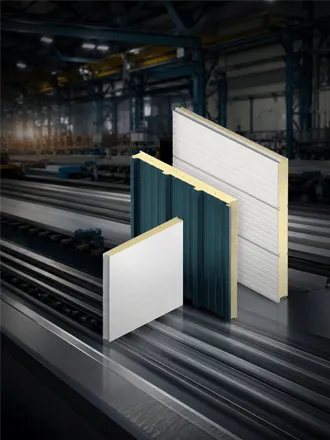
When purchasing insulated metal wall panels, price is often one of the first factors buyers consider. However, choosing the lowest-priced product does not necessarily result in the lowest overall project cost.
Differences in steel sheet thickness, raw material quality, insulation core structure, and manufacturing consistency can significantly influence panel performance during transportation and installation.
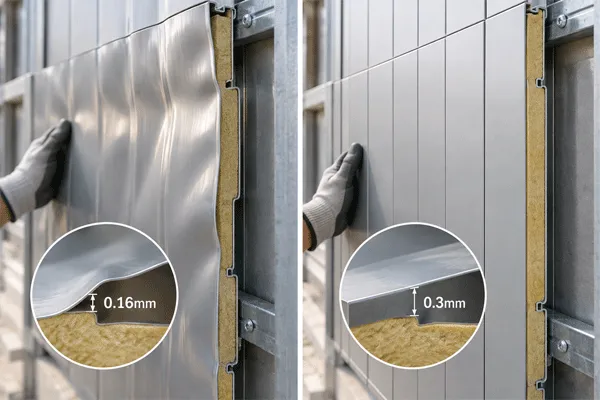
An Australian designer experienced this firsthand after purchasing decorative metal wall panels with a 0.16mm steel substrate from another supplier. Although the initial quotation was attractive, quality and appearance issues became apparent during installation, creating additional project expenses.
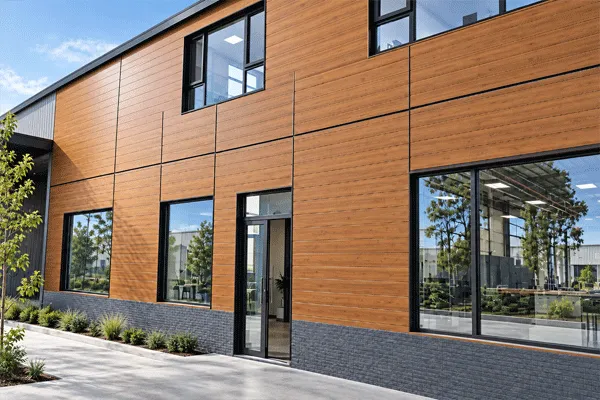
The designer subsequently approached Shandong Fuqiang Environmental Protection Materials Co., Ltd. and selected our 500mm-wide insulated decorative metal wall panels with a 0.3mm Al-Zn coated steel facing.
This experience highlights an important consideration for international buyers: evaluating metal wall panel quality requires looking beyond the initial purchase price.
0.3mm vs. 0.16mm Metal Wall Panels: Why Quality Matters
1. The Australian Project: When Low-Cost Wall Panels Became a Problem
The designer initially purchased insulated decorative wall panels from a different supplier.
Before installation, the panels appeared satisfactory. However, during installation, some panels exhibited quality and appearance issues that affected the overall wall finish.
These problems introduced several unexpected challenges:
- Additional labour for removing and replacing affected panels.
- Increased material and installation expenses.
- Potential disruption to the construction schedule.
- Concerns about product consistency and long-term performance.
- Difficulty achieving the desired architectural appearance.
For overseas projects, replacing installed building materials can be particularly expensive. Replacement costs may include not only the panels themselves but also additional labour, transportation, and potential project delays.
After encountering these issues, the client reconsidered the original purchasing decision and began prioritising material specifications, manufacturing quality, and product consistency over the lowest quotation.
The client eventually selected Fuqiang’s 500mm decorative metal wall panels as an alternative for the project.
2. 0.3mm vs. 0.16mm Steel Sheets: What Is the Difference?
One of the most important factors affecting decorative metal wall panel quality is the thickness of the steel facing.
Although two panels may have similar colours, textures, and surface patterns, their underlying material specifications can differ considerably.
In this Australian customer’s experience, the original panels used a 0.16mm steel substrate, while the subsequently selected Fuqiang panels featured a 0.3mm Al-Zn coated steel facing.
Steel Thickness Comparison
| Parameter |
Previous Supplier’s Panel |
Fuqiang Panel |
| Steel Sheet Thickness |
0.16mm |
0.3mm |
| المادة |
Not specified |
Al-Zn Coated Steel |
| Decorative Surface |
Metal Wall Panel Finish |
Embossed Decorative Finish |
| Panel Width |
Not confirmed |
500mm Effective Width |
| Insulation Core |
Not confirmed |
Rigid PU Foam |
| Backing Layer |
Not confirmed |
0.06mm Reinforced Aluminum Foil |
| Project Experience |
Installation and Appearance Issues Reported |
Selected as Replacement Product |
Why Does Steel Sheet Thickness Matter?
A thicker steel facing can provide several practical advantages when other relevant material and manufacturing conditions are comparable.
Improved Rigidity
Steel facing thickness influences the stiffness of the decorative surface. An appropriately specified steel sheet can help the panel maintain its intended profile during handling and installation.
Better Resistance to Handling Deformation
Thin metal facings may be more susceptible to local deformation under certain handling, loading, or installation conditions. Suitable material thickness can improve resistance to these issues.
More Consistent Decorative Appearance
Wall cladding projects require visually consistent surfaces, particularly when panels are installed across large areas.
Stable facing materials, appropriate forming processes, and consistent manufacturing help maintain the intended decorative finish.
Greater Confidence During Installation
Selecting panels with appropriate steel specifications can reduce material-related uncertainty for contractors working on residential, commercial, and prefabricated building projects.
However, thickness alone does not determine overall panel quality. Steel grade, coating specification, panel construction, bonding quality, fixing arrangements, and manufacturing control must also be considered.
3. Why Fuqiang Uses 0.3mm Al-Zn Coated Steel
For the decorative metal wall panel configuration discussed in this article, Fuqiang uses a 0.3mm Al-Zn coated steel facing.
The steel sheets are produced in partnership with Shinmade, with material selection and quality control forming part of Fuqiang’s production process.
Al-Zn coated steel combines a steel substrate with an aluminium-zinc alloy coating, providing corrosion protection for suitable construction applications.
In addition to material thickness, several other factors influence the reliability of a metal wall panel:
- Steel substrate quality and consistency.
- Metal coating specification.
- Surface coating and decorative finish.
- Manufacturing and forming accuracy.
- Product handling and storage conditions.
- Finished panel inspection.
For importers and project contractors, these details are worth confirming before placing an order.
A product quotation should identify the actual steel specifications rather than describing the facing material only as a decorative metal sheet.
4. The Role of the Polyurethane Insulation Core
Steel sheet thickness is important, but it represents only one part of an insulated decorative panel.
The insulation core also influences the panel’s overall performance.
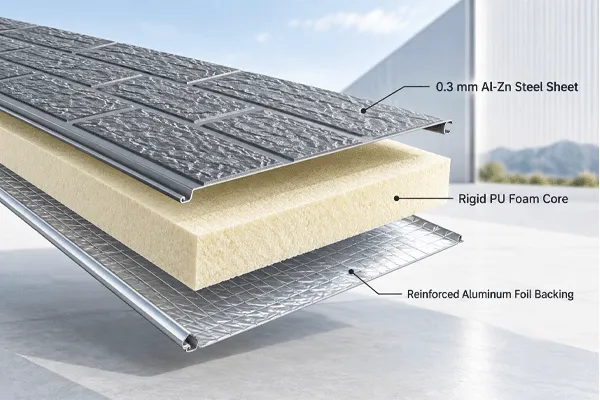
Fuqiang’s metal carved panel configuration incorporates a rigid polyurethane (PU) foam core manufactured using a controlled high-pressure foaming process.
The PU core is designed to provide an integrated insulated structure while maintaining a relatively lightweight panel format.
Key Considerations for PU Core Quality
Thermal Insulation
Polyurethane foam is widely used in insulated building panels because of its thermal insulation properties. Actual thermal performance depends on core density, thickness, formulation, and the complete panel assembly.
Structural Consistency
A controlled foaming process helps maintain core uniformity and supports consistent panel manufacturing.
Moisture Performance
Core formulation, panel joints, backing materials, and installation details all influence the moisture performance of the completed wall system.
Panel Bonding
The bond between the metal facing, insulation core, and backing layer is another important factor in overall product reliability.
For buyers comparing ألواح البولي يوريثان العازلة, asking only about panel thickness is insufficient. The core material, manufacturing process, and complete panel structure should also be reviewed.
5. Why Choose 500mm-Wide Decorative Metal Wall Panels?
Another consideration in the Australian customer’s purchasing decision was panel width.
Fuqiang’s selected decorative wall panels feature a 500mm effective width, providing a wider coverage format than commonly available 383mm panels.
When comparing effective widths under identical conditions, a 500mm panel offers approximately 30.5% more coverage width per panel.
Advantages of the 500mm Panel Format
Greater Coverage Per Panel
Wider panels can reduce the number of individual pieces required for a comparable wall area.
Potentially Fewer Panel Joints
Depending on panel orientation and wall dimensions, the wider format may reduce the number of joints across the installation surface.
Simplified Installation Planning
Using fewer individual panels may help contractors simplify panel allocation, handling, and installation planning.
Container Loading Considerations
For international buyers, panel dimensions should also be evaluated against packaging arrangements and container-loading requirements.
A 500mm panel format may offer logistical advantages in suitable loading configurations, although actual container utilisation depends on panel length, thickness, packaging, order quantity, and container dimensions.
Ultimately, panel width should be selected according to the project’s wall layout, installation method, architectural requirements, and shipping conditions.
6. The Hidden Costs of Choosing Inferior Metal Wall Panels
A lower initial quotation may appear attractive, particularly when purchasing large quantities of building materials.
However, the purchase price represents only one part of the total project cost.
When wall panels do not meet the required quality or performance expectations, additional expenses can quickly accumulate.
| Potential Cost |
Impact on the Project |
| Material Replacement |
Purchasing additional panels |
| Removal and Reinstallation |
Increased construction labour |
| International Shipping |
Additional freight and handling costs |
| Construction Delays |
Potential disruption to project schedules |
| Material Waste |
Disposal of unsuitable or damaged panels |
| Appearance Issues |
Additional finishing or corrective work |
| Project Management |
Extra coordination between suppliers and contractors |
For overseas contractors and building material importers, these risks deserve particular attention because correcting material-related problems after international delivery may involve significant additional expense.
0.3mm vs. 0.16mm Metal Wall Panels: Why Quality Matters
Purchase Price vs. Total Project Cost
When comparing quotations, buyers should consider the total cost of obtaining, delivering, and installing a suitable product.
A useful purchasing principle is:
The lowest initial price is not always the most economical long-term solution.
Selecting an appropriate material specification from the beginning can help reduce avoidable procurement and installation risks.
7. How to Identify High-Quality Decorative Metal Wall Panels Before Buying
Before purchasing decorative metal wall panels from any supplier, contractors and importers should compare the complete product specifications.
The following checklist can help identify potential differences between seemingly similar products.
Metal Wall Panel Quality Checklist
| Inspection Item |
What Buyers Should Confirm |
| Steel Facing Thickness |
Actual substrate thickness and specification |
| Steel Material |
Steel grade, supplier, and material consistency |
| Metal Coating |
Coating type and specified coating weight |
| تشطيب السطح |
Pattern, colour, coating quality, and available samples |
| PU Core |
Density, formulation, and production process |
| Panel Bonding |
Bonding consistency between panel layers |
| Backing Material |
Material type and thickness |
| Effective Width |
Actual installation coverage width |
| Panel Thickness |
Available thickness options and tolerances |
| طول اللوح |
Standard and customised lengths |
| Accessories |
Compatible trims, corners, and installation materials |
| Quality Control |
Raw material and finished product inspection |
| Technical Documentation |
Product specifications and relevant test information |
| Packaging |
Protection during handling and international shipping |
Five Questions to Ask Your Supplier
Before confirming an order, consider asking:
- What is the actual steel sheet thickness, and how is it measured?
- Can you provide details of the steel substrate and coating specification?
- What are the PU core specifications and manufacturing process?
- Can you supply physical samples and relevant technical information?
- How do you inspect finished panels before packaging and shipment?
These questions are particularly important for international wholesale orders, where material-related problems may be difficult and expensive to resolve after delivery.
8. Fuqiang’s Standard 500mm Decorative Metal Panel Structure
For buyers evaluating insulated decorative metal wall panels, understanding the complete panel construction helps ensure that the product matches the intended application.
The configuration discussed in this Australian customer experience includes three primary material layers.
Product Structure
| Parameter |
Specification |
| المنتج |
Decorative Metal Insulated Wall Panel |
| Surface Layer |
0.3mm Al-Zn (Galvalume) Steel Sheet |
| تشطيب السطح |
Embossed Decorative Metal Finish |
| Core Material |
Rigid Polyurethane (PU) Foam |
| Core Production |
High-Pressure Foaming Process |
| Backing Layer |
0.06mm Reinforced Aluminum Foil |
| Effective Width |
500mm |
| Thickness Options |
10mm / 16mm / 20mm / 25mm |
| الطول |
Customised to Project Requirements |
| Decorative Patterns |
Multiple Finishes Available |
The decorative facing, PU core, and reinforced aluminium foil backing form an integrated panel structure designed for suitable building wall applications.
Available configurations and technical requirements should be confirmed with Fuqiang before ordering.
9. Lessons from the Australian Customer’s Experience
The Australian designer’s purchasing experience demonstrates why product specifications should be evaluated alongside price.
The initial purchase appeared economical, but installation-stage quality problems created additional expenses and uncertainty.
After reconsidering the project’s material requirements, the customer selected Fuqiang’s 500mm decorative metal wall panels with a 0.3mm Al-Zn steel facing.
The experience offers several useful lessons for international buyers:
- Do not compare decorative wall panels based on appearance and price alone.
- Confirm the actual steel facing thickness before ordering.
- Evaluate the insulation core and complete panel construction.
- Request samples and relevant technical specifications.
- Consider potential replacement and installation costs.
- Select materials according to the project’s actual requirements.
While no single material specification guarantees success in every application, a clearer understanding of product quality can support better procurement decisions.
For contractors, distributors, and project developers, reliable material specifications and manufacturing consistency are essential considerations when selecting a long-term supplier.
0.3mm vs. 0.16mm Metal Wall Panels: Why Quality Matters
10. Looking for a Reliable Decorative Metal Wall Panel Manufacturer?
Shandong Fuqiang Environmental Protection Materials Co., Ltd. manufactures insulated decorative metal wall panels and sandwich panel solutions for international construction projects.
For the product configuration featured in this article, we offer:
- 500mm effective panel width.
- 0.3mm Al-Zn coated steel facing.
- Rigid PU insulation core.
- Controlled high-pressure foaming process.
- 0.06mm reinforced aluminium foil backing.
- Multiple decorative surface patterns.
- Customisable panel lengths.
- Factory-direct supply and project quotation support.
Whether you are sourcing panels for residential houses, villas, commercial buildings, prefabricated structures, or renovation projects, our team can help review your requirements and identify suitable product specifications.
Request Product Samples & Factory-Direct Quotations
Contact Fuqiang with your project drawings, preferred panel thickness, decorative finish, estimated quantity, and destination country.
Our team can provide product information, available configurations, and quotations based on your purchasing requirements.
الأسئلة الشائعة
Is a 0.3mm steel sheet better than a 0.16mm steel sheet for metal wall panels?
A 0.3mm steel facing generally offers greater rigidity and resistance to handling deformation than a 0.16mm facing when other material conditions are comparable. However, overall panel quality also depends on steel grade, coating specifications, insulation core, bonding quality, and manufacturing consistency.
Why do low-cost metal wall panels sometimes result in higher project costs?
Inferior panels may develop appearance or installation-related problems, potentially requiring material replacement, additional labour, and project delays. For international projects, replacement shipping costs can further increase total expenses. Buyers should compare complete product specifications rather than initial prices alone.
What is the standard structure of Fuqiang's decorative metal wall panels?
The panel configuration featured in this article consists of a 0.3mm Al-Zn coated steel facing, a rigid polyurethane (PU) insulation core, and a 0.06mm reinforced aluminium foil backing. Available panel thicknesses include 10mm, 16mm, 20mm, and 25mm.
What are the advantages of 500mm-wide metal wall panels?
Compared with 383mm panels, a 500mm effective width provides approximately 30.5% greater coverage width per panel. This can reduce the number of panels and joints required for comparable wall areas, potentially simplifying installation planning. Actual results depend on project dimensions and installation conditions.
How can buyers check metal wall panel quality before ordering?
Buyers should confirm the actual steel sheet thickness, steel grade, coating specifications, PU core properties, panel bonding, effective width, and finished product inspection procedures. Requesting physical samples and relevant technical documentation can also help reduce procurement risks.
Can Fuqiang customize decorative metal wall panels for overseas projects?
Yes. Fuqiang offers customizable panel lengths, multiple decorative finishes, and selected product specifications based on project requirements. International buyers can provide their drawings, preferred panel thickness, estimated quantity, and destination country to request product samples and factory-direct quotations.



 October 15, 2026