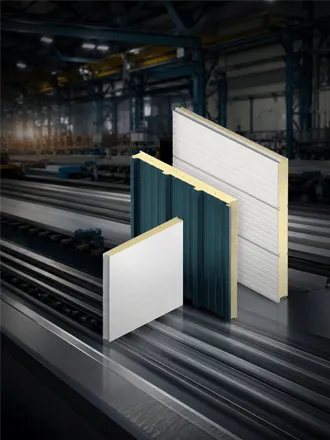
Old hotel façades can look tired, lose thermal performance, and require costly repair work. Traditional renovation methods may also extend construction time and disturb daily operations. Insulated metal wall panels offer another approach by combining a finished exterior surface, insulation, and a coordinated wall system in one renovation solution.
Insulated metal wall panels can be used in hotel renovation and building refurbishment to upgrade exterior appearance, improve insulation, and simplify façade construction. They combine metal skins with an insulated core and can be installed as part of a new exterior envelope over suitable existing structures, subject to project-specific structural, moisture, fire, and code requirements.
Insulated Metal Wall Panels for Hotel Renovation and Building Refurbishment
Why Are Insulated Metal Wall Panels Suitable for Hotel Renovation?
Hotel renovation is different from new construction. The building already exists, guests may still occupy part of it, and the contractor often has limited time to complete noisy or disruptive exterior work.
An insulated metal panel can help simplify this process because several functions can be integrated into one factory-made component. Depending on the selected panel system, the product may provide an exterior weathering surface, an insulated core, and an interior or backing skin within one panel.
The Metal Construction Association describes IMPs as rigid insulation placed between two coated metal facings. It also notes that these factory-produced panels are used in commercial buildings because of their thermal efficiency and installation advantages.
For hotel owners, the attraction is easy to understand. Instead of treating appearance, cladding, and thermal insulation as completely separate renovation tasks, the project team may be able to coordinate them through one exterior wall strategy.
Common hotel renovation goals include:
- Refreshing an outdated façade
- Improving exterior insulation
- Creating a cleaner architectural appearance
- Covering damaged or visually inconsistent existing walls
- Reducing lengthy wet construction processes
- Improving guest comfort
- Supporting future energy-efficiency goals
That makes an insulated metal wall especially relevant for hotels built many years ago but still structurally suitable for continued use.
How Can an Insulated Metal Panel Change an Older Hotel’s Appearance?
A renovation often begins because the property looks old.
Guests see the exterior before they enter the lobby. Dark stains, faded finishes, cracked exterior surfaces, and inconsistent repair areas can make a hotel appear older than it really is.
A new wall panel system can change that impression without requiring the building to be demolished and rebuilt.
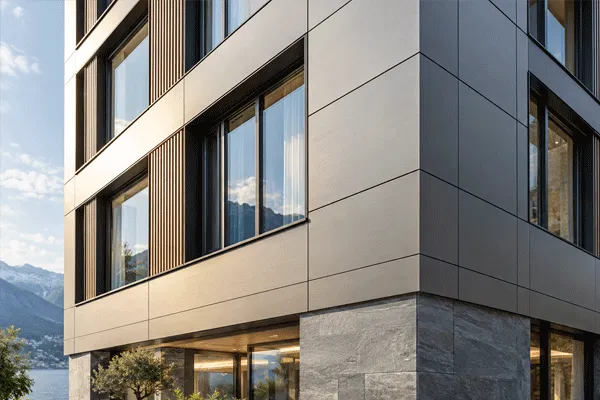
Modern panels can use different surface profiles, coating colors, joint arrangements, and orientations. Some are smooth and restrained. Others may be lightly profiled, corrugated, lined, or finished with an emboss pattern to create more visual interest.
For example, an older six-story hotel could be updated with:
Main façade: light gray insulated wall panels
Entrance zone: darker vertical panels
Window areas: coordinated trim
Ground floor: stone or existing masonry retained
Roofline: matching metal flashing
This approach allows the renovation team to modernize the building without making the façade overly complex.
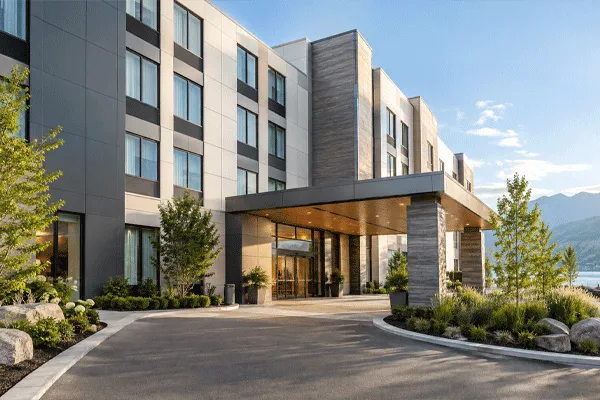
A hotel does not need to look like an industrial facility just because it uses metal. With the right proportions, joint layout, coating, and color, metal panel systems can create a clean architectural finish suitable for hospitality properties.
Can Insulated Metal Panels Be Installed Over an Existing Building?
In some retrofit projects, yes, but the existing wall must be evaluated first.
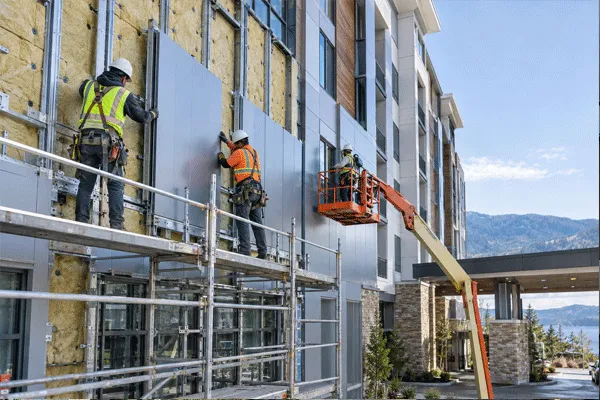
The Metal Construction Association specifically identifies IMP overcladding and reroofing as growing retrofit applications and notes their use for refreshing existing cladding while improving enclosure performance.
That does not mean contractors should simply attach panels to any old façade.
Before panel installation, the project team should check:
- Existing structural condition
- Wall flatness
- Moisture damage
- Existing cladding condition
- Attachment points
- Wind-load requirements
- Window and door positions
- Drainage paths
- Fire-code requirements
- Local building regulations
If the existing surface is uneven, a secondary framing system may be needed.
The new metal wall panel is then attached to the engineered support structure rather than relying on weak or deteriorated finish materials.
This step is important. A renovation product can only perform as well as the wall behind it and the way the complete assembly is designed.
How Do Insulated Wall Panels Improve Thermal Performance in Hotel Renovations?
Hotels use energy continuously.
Guest rooms need heating or cooling. Corridors, restaurants, conference rooms, lobbies, kitchens, and other spaces also add to the building’s energy demand.
The exterior envelope plays an important role in controlling this load.
The U.S. Department of Energy states that walls, roofs, and other opaque-envelope components have a substantial influence on building energy use and highlights retrofits of existing buildings as an important opportunity for energy savings and occupant comfort.
An insulated wall panel typically combines exterior and interior metal facings with a foam core or another specified insulation material.
This continuous factory-produced insulation can reduce the number of separate layers that would otherwise need to be assembled on site.
However, buyers should not compare panels using thickness alone.
Important factors include:
- Insulation type
- Panel thickness
- R-value
- Joint configuration
- Fastening system
- Air leakage
- Thermal bridging
- Window interfaces
- Roof-to-wall connections
- Local climate
The goal should be reliable thermal performance and insulation continuity, not simply selecting the thickest product.
For an operating hotel, improved envelope performance may also contribute to more stable indoor temperatures and better guest comfort.
Insulated Metal Wall Panels for Hotel Renovation and Building Refurbishment
What Is Inside an Insulated Metal Wall Panel?
A typical insulated metal panel is a composite product.
Its basic construction can be illustrated as:
Exterior Metal Skin
        ↓
Insulated Core
        ↓
Interior Metal Skin
The foam core and steel skins work together as a composite assembly.
The MCA explains that many IMPs are created by introducing insulating foam between metal sheets, where the foam expands and bonds to the facings. Other products can use laminated construction methods.
This factory-controlled process can help maintain consistent panel thickness.
Depending on the selected product, insulated metal panels incorporate a finished exterior surface and may also incorporate a finished interior liner.
That is one reason IMPs are useful in renovation projects where contractors want to reduce the number of separate field-installed layers.
For Shandong Fuqiang Environmental Protection Materials Co., Ltd., panel configuration should be determined according to the actual project rather than assumed.
For hotel refurbishment, we recommend confirming:
| Item |
Project Decision |
| Exterior skin |
To be confirmed |
| Interior skin |
To be confirmed |
| Core material |
To be confirmed |
| Panel thickness |
To be confirmed |
| Surface profile |
To be confirmed |
| Coating/color |
To be confirmed |
| Panel length |
Based on drawings |
| Joint method |
Based on selected system |
| Accessories |
Based on façade details |
This avoids promising specifications that have not yet been approved for the project.
Wall Panel or Traditional Façade Renovation: What Changes for the Contractor?
Traditional façade renovation can involve several separate trades.
A contractor may need to repair the existing substrate, install insulation, add a weather-control layer, create a support structure, apply cladding, and then complete exterior finishing work.
A prefabricated wall panel system can reduce some of this field coordination because key components arrive from the factory as finished products.
This is especially useful for hotels where construction time matters.
A shorter exterior construction schedule may help reduce:
- Scaffold time
- Number of façade operations
- Material handling
- On-site finishing
- Weather-sensitive work
- Disruption around entrances and guest areas
MCA retrofit guidance highlights prefabrication and reduced fieldwork as key reasons IMPs are attractive for renovation projects.
That does not mean panels install quickly and easily in every situation.
Complex hotel façades may include:
- Hundreds of windows
- Balconies
- Decorative ledges
- Canopies
- HVAC penetrations
- Signage
- Existing masonry
- Curved zones
These details can require substantial preparation.
The advantage comes from designing the project around a coordinated system rather than solving every wall layer independently on site.
How Should Windows, Joints, and Moisture Be Handled in a Hotel Retrofit?
These are some of the most important details in the whole project.
A façade can look perfect and still fail if water enters around windows, joints, or penetrations.
An IMP assembly must therefore be designed as part of the building envelope.
The Metal Construction Association notes that IMP systems can contribute to the control of air, rainwater, vapor, and heat, but their performance depends on proper panel orientation, joints, connections, and detailing.
For hotel renovation, special attention should go to:
- Window heads
- Window sills
- Window jambs
- External corners
- Internal corners
- Wall bases
- Parapets
- Roof connections
- Mechanical penetrations
- Entrance canopies
A fastener may be visible or concealed depending on the selected system.
Some panel systems locate fasteners within the panel side joint, helping create a cleaner exterior appearance.
But appearance is only one part of the detail.
The connection must also support water management, air sealing, structural attachment, and movement.
This is why drawings should be reviewed before final panel quantities and accessories are confirmed.
Are Insulated Metal Wall Panels Only for Industrial Buildings?
No.
Historically, sandwich panels and insulated metal products have been widely associated with factories, warehouses, and cold storage facilities. Those remain major applications.
But modern IMP systems are also used for commercial, institutional, retail, office, and renovation projects. MCA retrofit guidance specifically discusses applications including offices, healthcare, schools, recreation, retail, and multifamily buildings.
Hotels share several needs with these buildings:
- Large exterior wall areas
- Thermal-control requirements
- Need for durable finishes
- Tight renovation schedules
- Desire for an updated appearance
- Need for predictable construction
The difference is often aesthetic.
A warehouse may use a simple corrugated profile across thousands of square meters.
A hotel may require:
- Cleaner panel joints
- More refined colors
- Smaller façade zones
- Decorative transitions
- Vertical and horizontal combinations
- Custom trim
- Better coordination with glazing and signage
So the same general technology can serve very different architectural goals.
Insulated Metal Wall Panels for Hotel Renovation and Building Refurbishment
Can Insulated Metal Wall Panels Be Used for Hotel Interior Renovation?
Depending on the product and project requirements, insulated panels may also be considered for selected interior areas.
However, they should not automatically be treated as a replacement for every interior wall.
In hotel projects, potential applications could include service spaces, utility zones, back-of-house areas, temperature-controlled rooms, or selected interior partitions where panel properties suit the intended use.
For guest-facing areas, decorative requirements are usually higher.
Lobby walls, corridors, restaurants, and guest rooms may use separate interior decorative materials even when the exterior building envelope uses IMPs.
This distinction is important.
A hotel renovation normally contains several different material systems:
Exterior Envelope
   ├── Insulated metal wall panels
   ├── Windows
   ├── Doors
   └── Flashings

Guest Areas
   ├── Decorative wall finishes
   ├── Flooring
   └── Ceiling systems

Service Areas
   ├── Utility partitions
   ├── Mechanical spaces
   └── Functional wall systems
The best solution is not to force one product into every area.
It is to use each product where its performance and appearance make sense.
What About Insulated Metal Roof Panels During Hotel Renovation?
Some hotel renovations involve more than walls.
Older roof assemblies may also need upgrades because of leakage, poor insulation, or aging exterior materials.
An insulated metal roof system can provide a coordinated option where the existing roof structure and project conditions allow it.
For a combined exterior upgrade, the project may use insulated metal wall and roof systems to create a more consistent building envelope.
This is especially useful for:
- Low-rise hotels
- Resorts
- Motels
- Hotel annexes
- Restaurant buildings
- Spa facilities
- Conference buildings
- Service buildings
A roof panel has different performance requirements from a vertical wall panel.
Roof slope, drainage, snow load, wind uplift, penetrations, waterproofing details, and structural support must all be evaluated.
MCA notes that insulated wall and roof panels are designed for different structural loading conditions and that roof systems must resist loads such as snow, live loads, and wind.
Therefore, metal wall and roof panels should never be treated as interchangeable simply because they look similar.
How Can Panel Profiles and Colors Modernize an Older Hotel?
A renovation should make the hotel look new without making it look temporary.
That means the design team should choose colors and profiles that work with the existing building shape.
For example:
Urban Business Hotel
- Charcoal vertical panels
- Light gray horizontal zones
- Dark window frames
- Minimal decorative trims
Resort Hotel
- Warm beige panels
- Lightly textured surface
- Wood-look accent areas
- Softer transitions around balconies
Budget Hotel Renovation
- Simple flat or lightly profiled panels
- Limited color palette
- Standardized panel widths
- Fewer custom details
Boutique Hotel
- Multiple façade depths
- Selected embossed panels
- Dark metal entrance feature
- Strong lighting coordination
The panel does not create the architecture by itself.
The building design comes from how the panel is divided, where colors change, how windows align, and how corners and entrances are finished.
A clean wall with only two carefully selected colors often looks more modern than a façade with many decorative elements.
For hotel renovation, simplicity can also reduce fabrication and installation complexity.
What Should Hotel Owners and Contractors Check Before Ordering Panels?
A renovation quotation needs more than total square meters.
Existing buildings are rarely perfectly regular. Drawings may also differ from actual site conditions.
Before ordering insulated metal wall panels, collect as much verified information as possible.
Hotel Renovation Checklist
| Information |
Why It Matters |
| Existing façade photos |
Shows current wall condition |
| Architectural elevations |
Defines panel arrangement |
| On-site dimensions |
Confirms actual sizes |
| Building height |
Affects installation and engineering |
| Window dimensions |
Affects cuts and trims |
| Required insulation |
Determines panel construction |
| Target color |
Supports sample approval |
| Panel orientation |
Affects layout |
| Corner details |
Determines accessories |
| Quantity |
Supports production planning |
| Delivery location |
Supports export planning |
| Construction schedule |
Coordinates manufacturing |
Do not calculate the final order only from a rough floor area.
Window openings, corners, waste allowances, panel lengths, and installation direction all affect material quantity.
For international projects, packing is also important.
Long panels must be supported and protected to help reduce edge damage, scratches, and deformation during transport.
How Can Factory-Direct Supply Support Hotel Renovation Projects?
Large renovation projects need stable supply.
A small material difference between batches can become obvious across a large hotel façade, especially when colors and surface profiles are repeated over many floors.
As a China-based sandwich panel manufacturer, Shandong Fuqiang Environmental Protection Materials Co., Ltd. focuses on factory-direct insulated building envelope solutions for global project buyers.
For hotel refurbishment and property renovation, we recommend that contractors and importers involve the manufacturer before the final specification is locked.
This allows the project team to discuss:
- Panel dimensions
- Insulation requirements
- Exterior finish
- Profile selection
- Color
- Quantity
- Accessories
- Export packing
- Delivery sequence
For distributors, repeatable product specifications also matter.
If the same panel system will be used across multiple hotels or renovation projects, keeping the specification stable can simplify future purchasing.
For project developers, the main benefit is coordination.
Rather than sourcing exterior sheets, insulation, trims, and unrelated accessories from many separate sources, a more integrated panel package can simplify procurement.
Example Hotel Renovation Concept
Imagine a 20-year-old roadside hotel with faded exterior render and poor visual consistency.
The concrete structure remains suitable for continued use, but the owner wants to reposition the property.
The renovation goal is:
Improve exterior appearance
Upgrade insulation
Avoid full demolition
Reduce construction disruption
The project team selects an insulated exterior panel approach.
The existing wall is surveyed first. Damaged areas are repaired. A new support system is designed where required.
The façade is then divided into three zones:
Guest-room wings: light gray horizontal wall panels
Entrance tower: dark vertical metal panels
Roofline: matching trim and flashing
The result gives the property a cleaner appearance without completely rebuilding the envelope.
The important point is that this is not just cosmetic cladding.
The renovation is planned around appearance, insulation, air and water management, structural attachment, and installation access.
That is how an exterior product becomes a renovation system.
Key Things to Remember
- Insulated metal panels can suit hotel renovation and building refurbishment projects where the goals include façade renewal and improved insulation.
- A retrofit should start with an inspection of the existing structure and wall condition.
- The wall panel should be considered part of the whole building envelope, not only a decorative exterior skin.
- Panel profile, color, orientation, and joint design can significantly change an older hotel’s appearance.
- Factory-produced insulation can simplify some wall assemblies and reduce field-installed layers.
- Thermal performance depends on the complete assembly, including joints, fasteners, windows, and thermal bridges.
- Hotel renovation requires careful detailing around windows, corners, entrances, parapets, and penetrations.
- Overcladding can reduce the need for full façade removal in suitable projects, but structural and moisture conditions must be verified.
- Insulated wall panel and roof panel products should be selected separately according to their specific performance requirements.
- For international projects, panel lengths, export packing, loading sequence, accessories, and installation planning should be confirmed before production.
- Shandong Fuqiang Environmental Protection Materials Co., Ltd. can support contractors, developers, distributors, and importers with factory-direct insulated panel solutions for hotel renovation, commercial property upgrades, and other refurbishment projects.
Häufig gestellte Fragen
Can insulated metal wall panels be used to renovate an old hotel?
Yes, they can be suitable for some hotel renovation projects. The existing structure and wall condition must first be assessed. Attachment, moisture control, fire requirements, wind loads, and local building codes should be reviewed before finalizing the system.
Do insulated metal panels improve hotel insulation?
An insulated panel contains an insulating core and can contribute to improved envelope thermal performance. Actual project performance depends on the core, thickness, joints, fasteners, thermal bridges, windows, and complete wall assembly.
Can panels cover an existing hotel façade?
Overcladding is possible in many retrofit projects, but the existing wall must be evaluated. A suitable support system and correct flashing and drainage details may be required.
Are insulated metal panels suitable for a modern hotel appearance?
Yes. Modern profiles, colors, concealed connections, and coordinated trims can create a clean architectural appearance. Hotel projects can combine panels with glazing, stone, wood-look materials, signage, and lighting.
Can wall and roof panels be ordered together?
Yes, a project may use both roofing and wall systems. However, roof and wall panels have different performance and installation requirements, so each should be specified for its intended location.
What information should I send for a hotel renovation quotation?
Send building elevations, dimensions, photos of the existing façade, required panel thickness, insulation requirements, color, quantity, project country, expected delivery date, and any available installation drawings.


 September 22, 2026