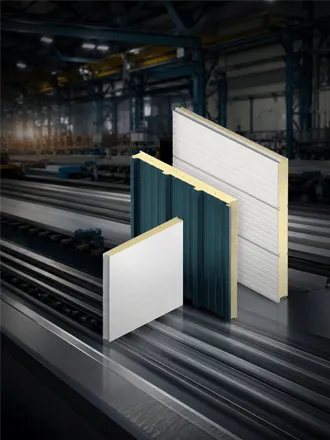
A poorly insulated cold room can waste refrigeration energy, create condensation, and make temperature control harder. The problem is rarely just the refrigeration unit. The walls, ceiling, joints, doors, and insulation system all affect performance. Choosing the right PIR cold room panels early can prevent costly problems later.
PIR cold room panels are insulated sandwich panels designed for cold storage applications, using a polyisocyanurate insulation core to reduce heat transfer and maintain controlled temperatures. The right panel depends on required temperature, panel thickness, thermal conductivity, fire rating, joint design, surface coating, installation conditions, and local requirements.
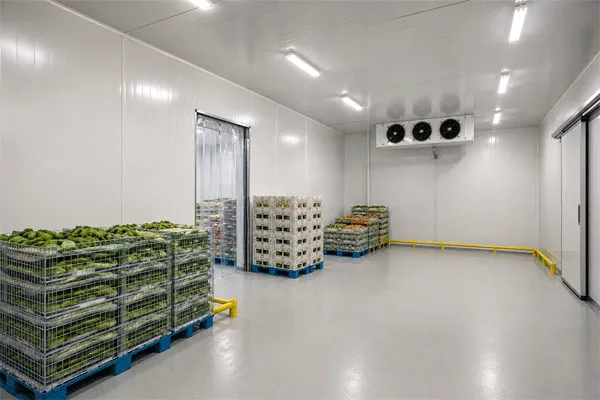
PIR-Kühlraumpaneele für die Kühllagerung: So wählen Sie das richtige Isolierpaneel aus
Why Are PIR Panels Important for Cold Storage?
A cold storage building works differently from a normal warehouse. The refrigeration system must continuously remove heat entering the room from the surrounding environment, products, doors, people, lighting, and equipment. The better the building envelope limits unwanted heat gain, the easier it is for the refrigeration system to maintain the target temperature.
This is why the cold room panel should be considered part of the refrigeration system rather than simply a wall covering. ASHRAE guidance on refrigerated facilities highlights the importance of insulation, vapor control, wall and roof design, and construction quality in low-temperature environments.
For contractors and project owners, this has a practical meaning: a high-quality insulated panel can help protect the temperature-controlled environment, while poor joints or thermal bridging can reduce the benefit of the insulation material.
A well-designed cold storage panel should therefore provide:
- Stable thermal insulation
- Low heat transfer
- Good moisture resistance
- Reliable panel joints
- Suitable mechanical performance
- A durable and cleanable surface
- Compatibility with the refrigeration system
What Are PIR Cold Room Panels?
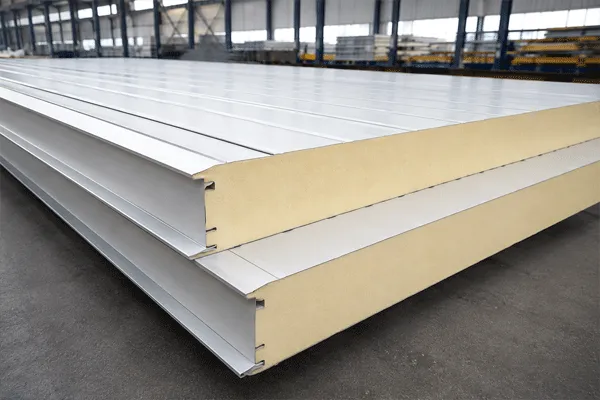
PIR stands for polyisocyanurate, a rigid foam insulation material used in many building and refrigeration applications. PIR foam is a type of closed-cell insulation that can provide a strong balance between thermal performance and panel thickness.
In a typical sandwich panel, the insulation core is placed between two protective metal skins. The core provides the main insulation function, while the outer sheets protect the panel and provide the finished surface.
PIR is related to polyurethane insulation, but the two materials are not identical. In the market, buyers may also encounter PU panels, polyurethane foam, PUR panels, and other foam-based insulation panels. The exact performance depends on the formulation, density, thickness, manufacturing process, and complete panel system.
For a cold storage project, it is better to compare the complete specification instead of choosing a panel simply because it is called PIR.
How Does PIR Insulation Help Cold Rooms?
The main purpose of insulation is to slow heat transfer between the cold interior and warmer surroundings. When the envelope is properly designed, the refrigeration system does not need to remove as much unwanted heat.
The key property to compare is thermal conductivity. In simple terms, lower thermal conductivity generally means the insulation material conducts less heat under comparable conditions. However, buyers should not evaluate thermal performance from a single number alone.
Panel thickness, joints, installation quality, metal connections, doors, corners, and other components can all affect the final result. ASHRAE notes that thermal bridges caused by structural components and metal ties can increase heat gain through refrigerated walls and roofs.
This is particularly important in large cold storage facilities. A panel may have good laboratory insulation properties, but gaps, poor joints, or discontinuous insulation can reduce the performance of the installed system.
PIR vs PU vs EPS: Which Insulation Core Is Better?
Buyers often compare PIR with PU and EPS when selecting panels for cold rooms. There is no universal answer because the best choice depends on the temperature range, project requirements, budget, fire performance requirements, and applicable standards.
| Insulation core |
Typical characteristics |
Common consideration |
| PIR |
Strong thermal performance with a rigid foam core |
Projects requiring high-performance insulation and specific fire-performance requirements |
| PU |
Good thermal insulation and lightweight construction |
Many general cold room and refrigerated applications |
| EPS |
Lightweight expanded polystyrene core |
Cost-sensitive applications where the specification allows it |
| Rock wool |
Mineral-fiber insulation with strong fire-resistance characteristics |
Projects where fire resistance is a major priority |
The U.S. Department of Energy has noted that polyurethane insulation is widely used in walk-in panels, while EPS and polyisocyanurate are also used in the market.
For a cold storage project, the right question is not simply “Is PIR better than EPS?” Instead, ask whether the selected insulation core material meets the required thermal, fire, moisture, structural, and regulatory requirements.
PIR-Kühlraumpaneele für die Kühllagerung: So wählen Sie das richtige Isolierpaneel aus
What Panel Thickness Should You Choose for Cold Storage?
Panel thickness directly affects the insulation system. A thicker panel generally provides more resistance to heat flow when the other variables remain comparable.
However, panel thickness should not be selected by guesswork. The required thickness depends on the target indoor temperature, outdoor climate, panel thermal properties, building size, operating conditions, and applicable design requirements.
The U.S. Department of Energy’s analysis of walk-in coolers and freezers found that manufacturers offer multiple foam insulation thicknesses, including 4-, 5-, and 6-inch options, and that thicker insulation can provide higher thermal resistance.
For contractors planning cold storage, a useful starting point is to define:
- Target room temperature
- Outdoor design temperature
- Required thermal performance
- Wall and ceiling construction
- Floor insulation requirements
- Door opening frequency
- Product loading conditions
- Refrigeration capacity
- Local building requirements
The goal is not to use the thickest cold room panel possible. The goal is to select a panel thickness that provides the required performance without unnecessary material and installation cost.
How Do PIR Cold Room Panels Control Moisture?
Moisture control is one of the most important issues in cold rooms. Warm, humid air can enter through gaps or poorly sealed junctions. When this moisture reaches colder parts of the envelope, condensation, frost, or ice can develop.
This is why cold room installation needs more attention than simply connecting wall panels. Panel joints, corners, ceiling connections, doors, penetrations, and wall-to-floor interfaces all need to be considered.
ASHRAE explains that air and vapor leakage at wall and roof junctions is a major construction concern in refrigerated facilities. Moisture entering the insulation system can condense or freeze and reduce thermal resistance.
A properly designed cold storage panel system should therefore provide good moisture resistance and continuous sealing. The panel itself is only one part of the solution.
What Fire Rating Should Cold Storage Panels Have?
Fire performance is another important consideration when selecting insulated cold storage panels. However, buyers should be careful with general statements such as “PIR is fireproof” or “PIR has a certain fire rating.”
Actual fire rating and fire resistance depend on the complete tested system, including the insulation core, steel sheets, joints, thickness, construction, and applicable testing standard.
For this reason, contractors should request the appropriate test reports and certificates for the specific panel construction rather than relying only on the name of the core material.
Where a cold storage project is part of a larger food-processing, logistics, pharmaceutical, or industrial facility, the panel specification should be coordinated with the building’s overall fire strategy.
What Surface Materials and Coatings Are Suitable?
The outer metal skin protects the insulating core from the surrounding environment and provides the visible surface of the panel. Common options include coated steel and other metal finishes selected according to the application.
A coating should be evaluated according to corrosion conditions, cleaning requirements, humidity, temperature, and the intended service environment.
For food-related cold storage applications, easy cleaning is often important. A smooth, durable surface can help the operator keep the interior hygienic and easy to clean and maintain.
Depending on the project, buyers may consider:
- Galvanized steel
- Coated steel
- Color coated steel plate
- Different coating systems
- Different surface colors
- Different interior and exterior finishes
The appropriate surface should be selected together with the insulation core, joint system, and operating environment.
Where Are PIR Cold Room Panels Commonly Used?
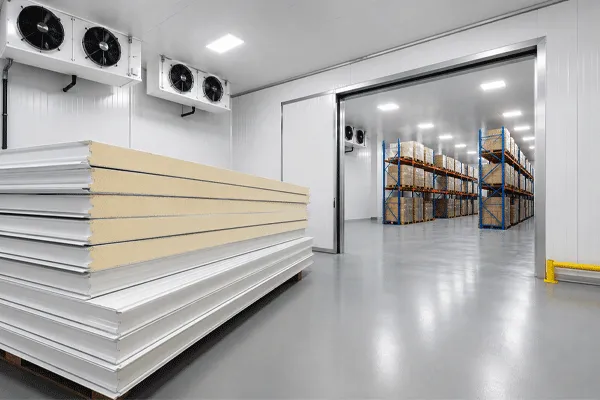
PIR cold room panels can be considered for a broad range of temperature-controlled facilities. Their main purpose is to create an insulated envelope around the refrigerated space.
Typical applications include:
- Food cold storage
- Refrigerated warehouses
- Meat and poultry facilities
- Seafood storage
- Fruit and vegetable storage
- Dairy facilities
- Food processing areas
- Pharmaceutical storage
- Distribution centers
- Walk-in cold rooms
- Temperature-controlled storage
- Freezer rooms
In these cold storage environments, the building envelope must work together with refrigeration equipment. ASHRAE’s current Refrigeration Handbook covers refrigerated-facility design, loads, refrigeration systems, food storage, and low-temperature applications.
This means panel selection should happen early in the project rather than after the refrigeration system has already been specified.
PIR-Kühlraumpaneele für die Kühllagerung: So wählen Sie das richtige Isolierpaneel aus
How Should You Design and Install Cold Storage Panels?
Good cold room insulation depends on continuity. Even a high-performance panel can lose much of its value if the installation creates open joints or unnecessary thermal bridges.
Before construction, contractors should review the complete envelope:
Wall panels → Ceiling panels → Floor insulation → Corners → Joints → Doors → Penetrations → Vapor control
The same principle applies to refrigeration piping. ASHRAE notes that successful insulation systems depend on correct insulation thickness, correct installation, vapor-retarding continuity, and installation quality.
For cold room installation, pay particular attention to:
- Panel joint alignment
- Corner connections
- Ceiling-to-wall joints
- Door frames
- Pipe penetrations
- Electrical penetrations
- Floor-to-wall connections
- Sealing materials
- Vapor control
- Thermal bridging
Good installation is not a minor detail. It is part of the thermal efficiency of the whole building.
How Can PIR Panels Improve Cold Storage Energy Efficiency?
A cold storage facility continuously uses energy for refrigeration. If excessive heat enters the room through walls, roofs, joints, doors, or other building components, the refrigeration system has to remove that additional heat.
That means better insulation can support lower energy consumption, although actual savings depend on the complete building and refrigeration system.
The U.S. Department of Energy emphasizes the importance of insulation and air sealing in reducing unwanted heat transfer through building envelopes.
For a large cold storage project, therefore, it makes sense to evaluate the total lifecycle cost rather than only the initial panel price.
A slightly higher-quality panel may be worthwhile when it provides:
- Better thermal performance
- More reliable joints
- Lower maintenance requirements
- Better moisture control
- Longer service life
- More predictable operating performance
How Should Contractors Select a PIR Cold Room Panel Supplier?
Choosing the right supplier is as important as selecting the right insulation material. Contractors and distributors should look beyond the quotation price and compare the complete product specification.
At Shandong Fuqiang Environmental Protection Materials Co., Ltd., we work with international B2B buyers, contractors, distributors, project developers, and cold storage contractors to select insulated panel configurations according to project requirements.
For a cold storage project, we recommend confirming:
| Item |
What to Check |
| Core |
PIR, PU, EPS or other specified material |
| Thickness |
Required thermal performance |
| Density |
Core and product specification |
| Thermal conductivity |
Declared product performance |
| Steel sheets |
Thickness and material |
| Surface |
Coating and finish |
| Fire performance |
Applicable test results |
| Joint |
Sealing and connection design |
| Dimensions |
Width, length and installation requirements |
| Application |
Chiller, freezer, food, pharmaceutical, etc. |
| Quantity |
Total wall and ceiling requirements |
| Export |
Packaging and container loading |
As a factory-direct manufacturer, we can discuss panel specifications, customized dimensions, surface finishes and export requirements with project buyers before production.
What Should You Check Before Ordering Cold Storage Panels?
Before placing an order, do not send only the requested quantity. A better specification includes the operating conditions and construction requirements.
A practical buyer checklist
- Room temperature: chilled, frozen, or low-temperature application
- Building dimensions: length, width, and height
- Panel thickness: based on thermal requirements
- Core material: PIR, PU, EPS, or another specified material
- Thermal conductivity: according to the selected product
- Fire requirements: based on local regulations and project standards
- Steel thickness: according to project requirements
- Surface finish: suitable for the operating environment
- Joint design: especially important for moisture and air control
- Door locations: consider opening frequency and traffic
- Refrigeration equipment: coordinate with the envelope design
- Installation: confirm panel direction and connection details
- Quantity: calculate walls, ceiling, corners, trims, and accessories
- Shipping: confirm packaging and container loading requirements
This information allows a manufacturer to recommend a more suitable cold storage panel instead of simply quoting a generic product.
Why Choose Fuqiang for Cold Storage Solutions?
At Shandong Fuqiang Environmental Protection Materials Co., Ltd., we focus on practical insulated building envelope solutions for global B2B customers.
Our customers include construction contractors, building material distributors, project developers, industrial facility owners, prefab building companies, and refrigeration contractors.
For cold storage solutions, we understand that the panel is part of a larger system. Product selection needs to consider the insulation core, thickness, surface, joints, installation method, building conditions, and refrigeration requirements together.
Our role is not simply to supply a sandwich panel. We help customers compare configurations and select a suitable insulated solution for the intended application.
For distributors and international importers, we can also discuss customized dimensions, production requirements, packaging, and export arrangements.
Häufig gestellte Fragen
Are PIR cold room panels suitable for cold storage?
Yes. PIR panels can be used for cold storage walls and ceilings where their thermal insulation and other required product characteristics meet the project's specifications.
Are PIR panels better than PU panels for cold rooms?
Not automatically. PIR and PU have different formulations and performance characteristics. The correct choice depends on thermal requirements, temperature, fire-performance requirements, budget, and applicable standards.
Are EPS panels suitable for cold storage?
EPS panels can be used in certain applications when their thermal, fire, structural, and regulatory requirements are acceptable. The project specification should determine whether EPS is appropriate.
How thick should a cold room panel be?
There is no single thickness for every cold room. Required thickness depends on room temperature, climate, thermal performance requirements, panel properties, and project standards.
Does panel installation affect cold storage insulation?
Yes. Poor joints, gaps, penetrations, and thermal bridging can reduce the performance of an otherwise well-insulated panel system. Proper installation and sealing are essential.
Can Fuqiang provide customized cold storage panels?
Yes. Fuqiang can discuss customized panel dimensions, insulation configurations, surface finishes, quantities, packaging, and export requirements according to project needs.



 1. September 2026