

견적 받기
24시간 이내에 답변드리겠습니다. 긴급한 경우 WhatsApp/WeChat(+86 13789803607)으로 연락하시거나 +86 13789802672로 직접 전화해 주세요.
*고객님의 기밀을 존중하며 모든 정보는 보호됩니다.
귀하의 문의에 답변하기 위한 목적으로만 귀하의 정보를 사용하며, 원치 않는 이메일이나 홍보 메시지는 절대 보내지 않습니다.

 August 22, 2026
Shandong Fuqiang Technical & Application Team | Corporate Technical & Product Application Team | Published August 22, 2026
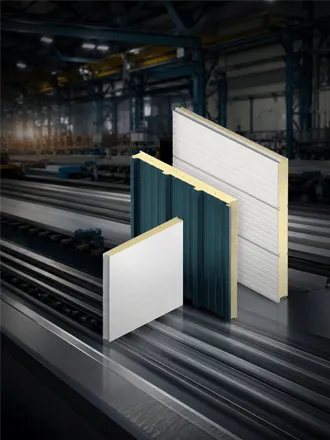
PUF stands for polyurethane foam — it’s the core material inside a sandwich panel, not a separate product category. A “PUF panel” and a “PU sandwich panel” describe the same thing. The comparison worth making isn’t PUF versus sandwich panel; it’s which core — PU, rock wool, or PU edge-sealed rock wool — fits the project.
Core specifications and fire-classification language below reflect what’s published on the corresponding product pages as of August 2026; always request the underlying test report before treating a stated class as documentation.
PUF Panel vs Sandwich Panel: What Buyers Are Really Asking
PUF is shorthand for polyurethane foam, the rigid closed-cell insulation material used as the middle layer in many insulated panels. A sandwich panel, meanwhile, is the umbrella term for the whole assembly: two metal facings bonded to an insulating core, regardless of what that core is made from.
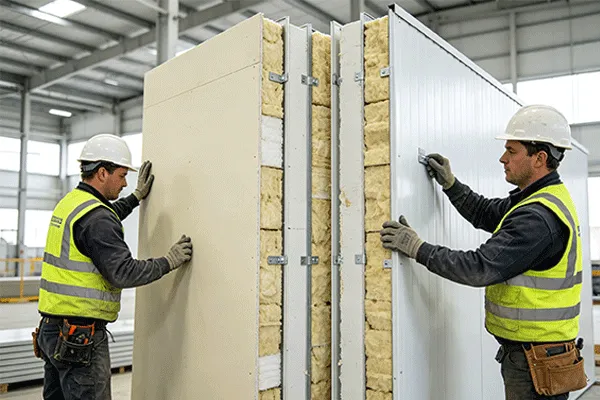
So when an RFQ asks to compare “PUF panels” against “sandwich panels,” it’s comparing an ingredient to the dish. Every PUF panel is a sandwich panel. What actually varies from product to product — and what should drive a buying decision — is which core sits inside that sandwich: polyurethane foam, mineral (rock) wool, or a rock-wool core with its cut edges sealed in PU.
| Attribute | PU Core (양면 강판 PU 샌드위치 패널) | Rock Wool Core (내화성 암면 단열 벽체 패널) | PU Edge-Sealed Rock Wool (PU 가장자리 밀봉 암면 샌드위치 벽 패널) |
| Effective width | 1000 mm | 950 mm | 1000 mm |
| Thickness range | 50–200 mm | 50/75/100/150/200 mm | 50–200 mm (common: 50/75/100 mm) |
| Thermal conductivity | 0.019–0.023 W/(m·K) | ~0.043 W/(m·K) | Not published on this product’s page |
| Sound insulation | Not published on this product’s page | ≥30 dB | Not published on this product’s page |
| Stated fire performance | Not published on this product’s page | A-grade non-combustible performance stated, with a note that classification should be verified per configuration and applicable test standard | Class A fire performance stated |
| Edge protection detail | Standard tongue-and-groove joint | Not specified as an edge-sealing feature | PU material specifically protects the cut rock-wool edges |
| Coating options | Not detailed on this product’s page | Not detailed on this product’s page | PVDF, SMP, HDP, PE |
None of these three rows is a universally correct answer. A distributor fielding a “PUF panel” request usually has a buyer who actually needs one of thermal performance, fire classification or acoustic performance to be the deciding factor, and the table above only resolves once you know which one.
PUF Panel vs Sandwich Panel: What Buyers Are Really Asking
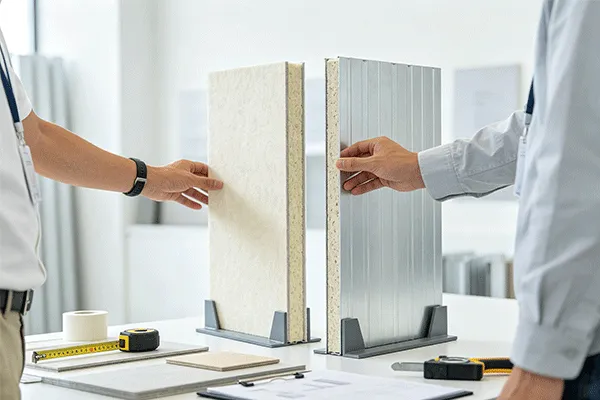
The plain PU core wins on the thermal number. At 0.019–0.023 W/(m·K), it insulates better per millimeter of thickness than the rock-wool figure of roughly 0.043 W/(m·K), which is why it shows up often in cold-storage and general envelope projects where panel thickness is a real cost and space constraint. What it doesn’t offer, at least on Fuqiang’s published page for that line, is a stated fire classification — a buyer who needs a documented fire grade for a code submission should either request that documentation directly or look at one of the rock-wool-core lines instead.
Rock wool flips the trade. The thermal conductivity is roughly double the PU figure, meaning a thicker panel is needed to hit the same insulation value — but the core adds a published sound-insulation figure of 30 dB or better and a melting point stated above 1000°C, alongside the A-grade non-combustible language noted on that product’s page. That combination is why cleanroom, hospital and high-occupancy interior projects lean toward rock-wool cores even at the cost of extra panel thickness.
PU edge-sealed rock wool isn’t a third insulation chemistry sitting between the other two. It’s a rock-wool core, with the same core-driven thermal behavior that implies, modified specifically at the cut edges — where raw mineral wool is more exposed to moisture uptake — with a PU seal. That’s a construction detail addressing one failure point, not a change to the panel’s overall thermal or acoustic character. This line also carries its own stated Class A fire performance, separate from the general rock-wool line’s A-grade language, and the two shouldn’t be treated as interchangeable claims without their own supporting documents.
Compared to comparison charts that line PUF up against “sandwich panel” as if they were two competing product families, the more useful chart for a distributor’s own sales conversation is core-to-core, because that’s the level at which a buyer’s actual requirement gets answered.
Yes. PUF (polyurethane foam) describes the core material; "PU sandwich panel" describes the same product using the same core. They're not two different product types.
On the published product pages referenced here, the rock-wool line and the PU edge-sealed rock-wool line each state a fire grade — A-grade and Class A respectively, each with its own caveat about verifying against the applicable test standard — while the plain PU core line doesn't publish a fire classification at all. Request the supporting report before assuming any of the three.
It means the panel's cut rock-wool edges are protected with PU material to address edge moisture exposure. It's a detail at the edge, not a substitution of the core material itself.
Yes — polyurethane foam. It's the literal name of the insulation material, not an abbreviation for a panel format or brand.
Pricing for all three is quotation-based, set by specification, thickness, coating, quantity and shipping terms. A formal quote follows once the core type and technical requirements are confirmed.
24시간 이내에 답변드리겠습니다. 긴급한 경우 WhatsApp/WeChat(+86 13789803607)으로 연락하시거나 +86 13789802672로 직접 전화해 주세요.
*고객님의 기밀을 존중하며 모든 정보는 보호됩니다.
귀하의 문의에 답변하기 위한 목적으로만 귀하의 정보를 사용하며, 원치 않는 이메일이나 홍보 메시지는 절대 보내지 않습니다.