Shandong Fuqiang Technical & Application Team | Corporate Technical & Product Application Team | Published August 20, 2026
A PU sandwich panel‘s fire rating certifies test results measured under one specific standard, in one specific panel configuration, by one accredited lab — not a general safety guarantee. GB 8624, EN 14509 and ASTM E84 test different properties using different methods, so a supplier’s stated grade only means something once you can see the underlying report.
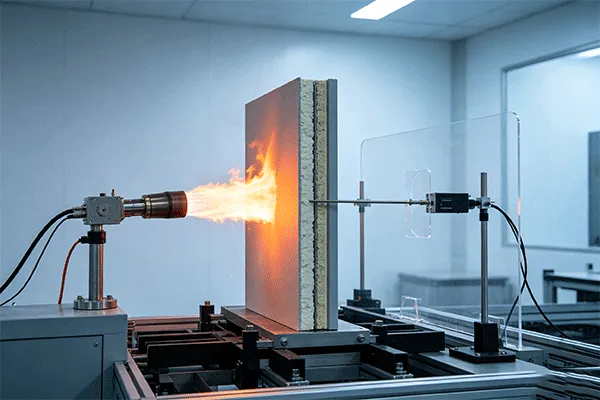
PU Sandwich Panel Fire Resistance: Ratings vs Test Reports
What a Fire Rating Actually Certifies
Two different questions get compressed into one line on most spec sheets. The first is reaction-to-fire: how a material ignites, spreads flame across its surface, and how much smoke it produces. The second is fire resistance: how long a complete assembly — not just the core material — keeps its structural and insulating function when exposed to fire, expressed in minutes.
Most PU core panel datasheets report reaction-to-fire classification. A “B1” or “Class A” label describes how the material burns in a controlled test, not how long a wall built from that panel would hold up in a real fire. Confusing the two leads buyers to assume a reaction-to-fire grade implies a fire-resistance duration it was never tested for.
GB 8624, EN 14509 and ASTM E84: Same Word, Different Tests
| Standard |
What It Measures |
Region |
Panel-Relevant Note |
| GB 8624 |
Classification of burning behavior for building materials and products (grades A, B1, B2, B3) |
China |
Applies to the material or product tested, not automatically to every product line from the same manufacturer |
| EN 14509 (under EU CPR) |
Product standard for self-supporting double-skin metal-faced insulating panels, tied to CE marking and a Declaration of Performance |
EU |
Covers factory-made panels used for roofs, external walls, internal walls, partitions and ceilings |
| ASTM E84 |
Surface burning characteristics — flame spread and smoke developed, via tunnel test |
North America |
A comparative test; its own scope specifically states it should not be used alone to call a material noncombustible |
| ASTM C518 |
Steady-state thermal transmission (heat flow meter method) |
North America |
Measures insulation performance, not fire behavior — often listed on the same datasheet as fire data and mistaken for a related figure |
| ISO 6946 |
Calculation method for thermal resistance and thermal transmittance of building components |
International |
Also a thermal-performance standard, unrelated to fire classification |
The overlap trap is real. Two panels can both say “B1” and still not be interchangeable, because GB 8624’s grade doesn’t map one-to-one onto an EN 14509 Declaration of Performance or an ASTM E84 flame-spread index. A number from one system dropped next to a grade letter from another, on the same comparison sheet, is a mismatch dressed up as a match.
Six Things to Request Before You Specify a Panel
- The exact test report number— not the grade letter alone. A datasheet that says “Class A” with no report number attached is a claim, not documentation.
- The tested panel configuration.Core density, facing thickness and total panel thickness all affect fire behavior; confirm the report covers the configuration you’re actually ordering, not a different thickness in the same product family.
- The issuing laboratory’s identity.An accredited third-party lab (SGS, Intertek, TÜV, or an equivalent national body) carries different weight than an in-house test summary.
- The Declaration of Performance, for EU projects.A “CE” mark on a datasheet is not the DoP itself; request the document that ties the CE mark to a specific product and test result under the Construction Products Regulation.
- Confirmation of scope — material or assembly.Ask whether the cited standard classifies the core material, the finished panel, or a complete wall/roof assembly including fasteners and joints.
- Separate documentation for thermal performance.A thermal conductivity figure tested to ASTM C518 or calculated under ISO 6946 answers an insulation question, not a fire question — don’t accept one report as covering both.
Double-Sided Steel PU Sandwich Panel: Published Specs, Unpublished Fire Data
Fuqiang’s لوح ساندويتش فولاذي مزدوج الجوانب من PU is published with an effective width of 1000 mm, thickness options from 50–200 mm, steel facing between 0.3–0.8 mm, a PU core density around 42 kg/m³, thermal conductivity of 0.019–0.023 W/(m·K), water absorption of 5% or less, and a hidden-screw tongue-and-groove joint system.
What the published page does not include is a fire classification number, certificate, or issuing laboratory for this specific product. That’s a gap worth naming rather than glossing over — treat an unlisted fire grade the same way you’d treat a competitor’s unlisted grade: request the report before assuming a class, rather than inferring one from the general “PU panel” category. Some panels within the same manufacturer’s broader portfolio publish a stated fire grade on their own product pages; that grade belongs to that specific product line and shouldn’t be carried over to a different one without its own documentation, even inside the same catalog.
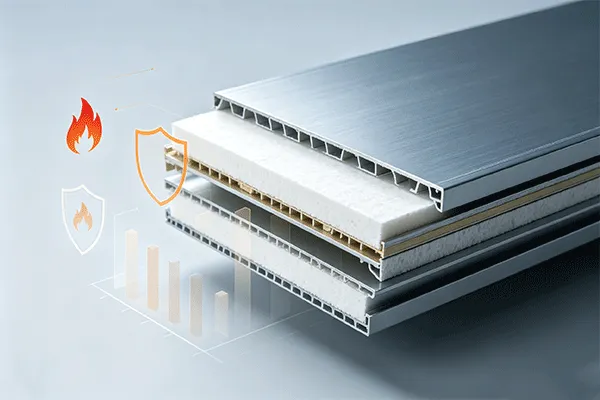
PU Sandwich Panel Fire Resistance: Ratings vs Test Reports
Does a Lower Thermal Conductivity Number Mean Better Fire Performance?
No, and this is the misconception that causes the most spec errors. A PU core’s thermal conductivity — typically in the 0.019–0.023 W/(m·K) range for double-sided steel PU panels — is a heat-transfer figure. It says nothing about ignition, flame spread, or how the panel behaves in a fire test.
There’s a real trade-off buried under that confusion, though. PU cores generally deliver a lower thermal conductivity number than mineral wool cores at comparable thickness, which is why they’re common in cold-storage and general envelope applications. Rock wool cores, by contrast, typically carry a higher fire classification ceiling — a rock-wool-edge-sealed panel line published elsewhere in Fuqiang’s catalog states a Class A fire grade — which is why cleanroom, hospital and high-occupancy projects with strict fire code requirements often specify a mineral-wool core even though it means a thicker panel for the same insulation value. Neither core type is universally “better”; the choice depends on which requirement — thermal performance per millimeter or fire classification ceiling — is driving the project.
Compared to listings that quote a 30–240 minute fire rating with no test-report number or lab attached, the more defensible position for a buyer is to treat any unreferenced grade as provisional until the document arrives, regardless of which manufacturer published it.
الأسئلة الشائعة
Is a "B1" or "Class A" label on a datasheet the same as a certificate?
No. The letter is shorthand for a result obtained under a specific test report. Ask for the report number and the issuing lab before treating the label as verified documentation.
Does a PU sandwich panel's thermal conductivity rating tell me anything about its fire performance?
No. Thermal conductivity, tested to standards like ASTM C518 or calculated per ISO 6946, measures heat transfer. Fire classification is tested separately, under a different standard entirely.
Can ASTM E84 alone prove a panel is non-combustible?
No. ASTM E84 is a comparative surface-burning test, and its own scope notes that it should not be used by itself to describe a material as noncombustible. Noncombustibility claims require a separate test method.
A supplier's roof panel line references GB 8624 Grade B1. Does that apply to their wall panels too?
Not automatically. A classification published for one product line applies to the tested configuration of that product, not to every panel in the same manufacturer's catalog.
Where can I get pricing for the Double-Sided Steel PU Sandwich Panel?
Pricing runs on a quotation basis, set by specification, order quantity, customization, coating and shipping terms. A formal quote follows once technical requirements — including whichever fire documentation your project needs — are confirmed.



 August 20, 2026