

견적 받기
24시간 이내에 답변드리겠습니다. 긴급한 경우 WhatsApp/WeChat(+86 13789803607)으로 연락하시거나 +86 13789802672로 직접 전화해 주세요.
*고객님의 기밀을 존중하며 모든 정보는 보호됩니다.
귀하의 문의에 답변하기 위한 목적으로만 귀하의 정보를 사용하며, 원치 않는 이메일이나 홍보 메시지는 절대 보내지 않습니다.

 2026년 9월 5일
Choosing the wrong insulated panel can lead to poor insulation, noise problems, difficult installation, or serious fire-safety concerns. These risks become costly once construction starts. A 50mm rockwool sandwich panel offers a practical solution for many industrial, commercial, prefab, wall, roof, and partition projects where fire performance and durability matter.
A 50mm rockwool sandwich panel is a metal-faced insulated panel with a 50mm stone wool or rock wool core. It combines thermal insulation, acoustic performance, fire resistance, and fast installation. It is commonly used for factory walls, warehouse partitions, industrial buildings, prefab structures, ceilings, and selected roof systems where buyers need a lightweight and fire-conscious building envelope.
50mm Rockwool Sandwich Panel: Fire-Rated Wall, Roof & Partition Guide
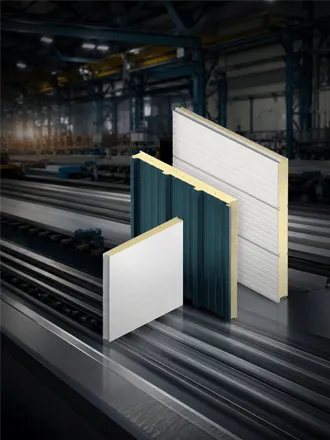
A 50mm rockwool sandwich panel is a factory-made composite building product. It normally consists of two metal sheets bonded to an insulation core made from rockwool, also called stone wool or mineral wool.
The basic construction looks like this:
| Layer | Main Function |
|---|---|
| Exterior metal skin | Weather protection, strength, appearance |
| Adhesive/bonding layer | Connects the facing to the insulation core |
| Rockwool core | Thermal, acoustic, and fire-related performance |
| Interior metal skin | Protection, appearance, structural stability |
| Joint system | Connects adjacent panels and limits air leakage |
The outer facing commonly uses a galvanized or coated steel sheet. Depending on the project, manufacturers may offer pre-painted surfaces, different profiles, colors, coatings, joint structures, and panel lengths.
The 50mm rock wool core creates a lightweight building material that can be installed much faster than conventional masonry walls.
That is one reason insulated sandwich panels are widely considered for prefabricated buildings, factories, workshops, warehouses, equipment rooms, commercial structures, and internal partitions.
At Shandong Fuqiang Environmental Protection Materials Co., Ltd., we approach this type of product as part of a complete insulated building envelope rather than as an isolated sheet of building material. Contractors often need matching wall, roof, flashing, trim, joint, and project-specific panel solutions.
A 암면 샌드위치 패널 combines several materials so each layer performs a different job.
The metal faces protect the building and give the panel physical stability. Between them, the wool core works as an insulation material. Because the layers are bonded into one composite section, the finished panel is relatively light while remaining practical for wall and enclosure construction.
Rockwool is made using mineral-based raw materials. Stone wool is commonly associated with rock such as basalt, which is processed at high temperature and formed into fibrous insulation.
This fiber structure helps the material provide several useful properties:
A denser fibrous structure can also help control sound transmission. This is useful in workshops, equipment areas, industrial production spaces, and partitions where machinery noise may be a concern.
Industry technical data for stone wool products also shows why this material is widely used where both thermal and acoustic performance are required.
A 50mm rockwool panel is often selected when a project needs a balance between panel thickness, construction speed, fire protection, and everyday insulation.
It is not the thickest possible insulated panel. That is important.
For many contractors, however, 50mm provides a practical solution for internal partitions, workshops, warehouse walls, non-freezing industrial areas, prefab structures, equipment rooms, and other spaces where very high thermal resistance is not the only design goal.
A sandwich panel system can also reduce the number of separate construction steps. Instead of installing a wall, adding insulation, and then adding another protective surface, contractors install one prefabricated panel product.
This can reduce labor requirements and simplify construction scheduling.
For international contractors and importers, another advantage is repeatability. Once panel dimensions, joint type, facing, coating, color, packaging, and accessories are confirmed, larger quantities can be prepared around the project’s installation plan.
50mm Rockwool Sandwich Panel: Fire-Rated Wall, Roof & Partition Guide
The thermal performance of a 샌드위치 패널 depends on more than its thickness.
Important factors include:
A 50mm panel can provide useful thermal insulation, but buyers should not assume that every 50mm insulated panel has the same thermal resistance.
For example, PU and PIR foam generally provide stronger thermal performance per unit of thickness than rock wool. Rockwool, however, brings other benefits, especially when fire safety and acoustic performance are important.
| Project Priority | Rockwool | PIR/PU | EPS |
|---|---|---|---|
| Fire-conscious design | Excellent candidate | Good depending on system/classification | Requires careful evaluation |
| Acoustic performance | Strong | Moderate | Moderate |
| High insulation at limited thickness | Moderate | Strong | Moderate |
| Industrial partition | Strong | Strong | Common |
| Very low-temperature cold room | Evaluate thickness carefully | Often preferred | Project dependent |
| Factory/warehouse wall | Strong | Strong | Common |
| Cost-focused basic enclosure | Moderate | Moderate | Often economical |
This is why we recommend looking at thermal performance as part of the entire building system, not simply comparing one number.
Proper joints and installation also matter. Even an insulation core with excellent properties cannot fully compensate for badly sealed panel joints.
Well-designed insulated sandwich construction can support more stable indoor temperatures and may contribute to reduced energy consumption, but actual building performance must be calculated according to climate, structure, HVAC operation, and project design.
Rock wool is widely valued because of its fire-related properties.
Stone wool itself is typically described as non-combustible when tested according to applicable standards. ROCKWOOL, for example, publishes stone wool products classified as non-combustible under recognized ASTM and Canadian test methods.
This is one major reason a rock wool sandwich panel is often considered for industrial buildings, fire partitions, equipment areas, warehouses, manufacturing facilities, and other projects where fire safety plays an important role.
However, there is an important technical distinction:
A non-combustible core does not automatically mean that every complete sandwich panel has the same fire-resistance rating.
The finished panel’s fire resistance or reaction-to-fire classification can depend on:
Terms such as fireproof, fire-rated, and fire resistant should therefore be supported by appropriate project-specific test documents rather than used as vague marketing claims.
For European-oriented projects, fire classification of construction products may refer to standards in the EN 13501 family. Requirements differ by market, so contractors should confirm the local code before ordering.
This detail is especially important for schools, factories, warehouses, clean areas, public buildings, and facilities containing heat-producing machinery.
Wool sandwich panels are versatile because they combine a finished surface, insulation core, and modular installation method.
Typical applications include the following.
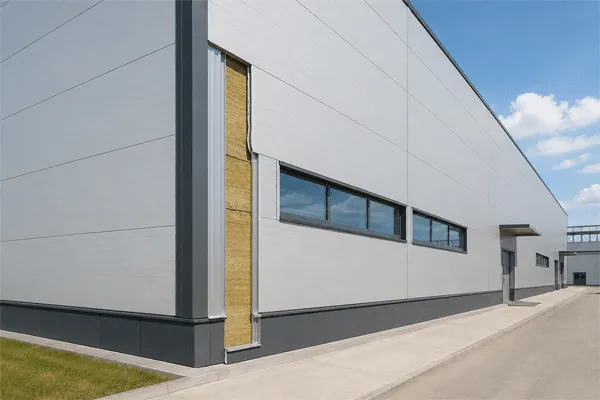
Factories often require strong, easy-to-clean wall systems that can be installed quickly. A rockwool insulated wall panel can be used for production buildings, storage areas, workshops, and equipment rooms.
Warehouse projects may use sandwich wall systems for both exterior walls and internal division.
Where fire protection between different operating zones is important, a rockwool core can be attractive.
Lightweight panel construction matches the needs of prefab and modular systems. Panels can be prepared in suitable lengths before they reach the building site, helping reduce cutting and construction waste.
Decorative exterior walls and internal partitions may use metal-faced panels when developers want a modern appearance combined with insulation.
A smooth metal surface can support easy maintenance, making insulated panels useful in certain clean environments. Cleanroom contractors should still specify joint details, surface finishes, sealing requirements, hygiene standards, and room classification separately.
Rock wool panels can be considered for some cold room applications where fire performance is especially important.
For refrigeration projects, however, panel thickness requires careful calculation. A 50mm panel should not automatically replace thicker PIR or PU insulation in low-temperature refrigerated warehouses.
The final choice depends on required temperature, energy target, condensation control, climate, and operating conditions.
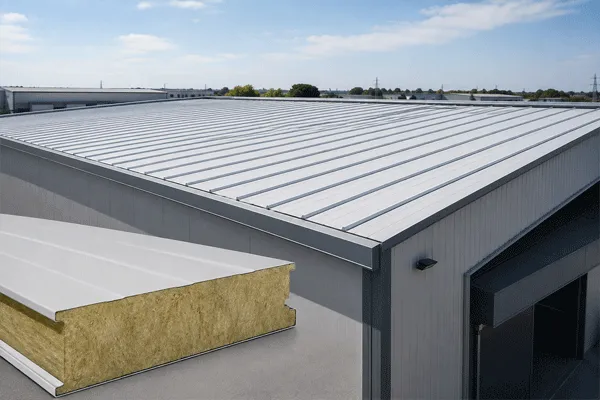
Yes, but the correct panel structure must match the application.
A wall sandwich panel and sandwich roof panels may look similar, but the roof experiences very different loads and weather conditions.
Roof panels must deal with factors such as:
A 50mm panel may be suitable for certain roof structures, but thickness alone does not prove load-bearing capability.
The designer should confirm span, support spacing, metal thickness, panel profile, fasteners, and the required structural performance.
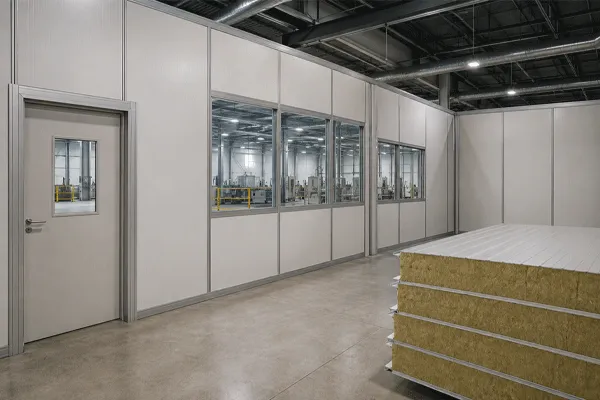
For a partition, the requirements are different. Internal partitions mainly need suitable height capacity, rigidity, surface durability, sound insulation, and sometimes a tested fire barrier.
This makes 50mm wool panels particularly useful for:
In many of these projects, 50mm provides a convenient balance between usable floor space and insulation performance.
There is no single sandwich insulation material that is best for every project.
Professional buyers should compare the core material against the actual design goal.
| Feature | 암면 코어 | PU/PIR Core | EPS / Polystyrene Core |
|---|---|---|---|
| Main strength | Fire and acoustic performance | Thermal efficiency | Cost-effective construction |
| Fire behavior | Strong advantage | Depends on formulation/system | Requires careful selection |
| Thermal efficiency per thickness | Moderate | High | Moderate |
| Sound absorption | Strong | Lower than mineral fiber | Moderate |
| Common applications | Factory, warehouse, partition, industrial walls | Cold storage, commercial buildings, roofs | Basic buildings, partitions, economical projects |
| Core structure | Fibrous mineral material | Rigid foam | Expanded polystyrene |
| Buyer priority | Fire + sound + durability | Energy efficiency | Budget |
A metal sandwich panel with a rock wool core is often a strong choice when a factory owner prioritizes fire performance and noise control.
A PU or PIR insulated sandwich system can be more attractive when thermal efficiency is critical and panel thickness must stay limited.
EPS may suit projects focused strongly on initial cost, depending on local regulations and required performance.
This is especially important for cold storage buyers. A 50mm rockwool insulation panel should not be selected only because it is available. The cold room operating temperature and required U-value or equivalent thermal target must come first.
Good suppliers help buyers compare systems rather than trying to push one material into every application.
Professional sourcing should go far beyond asking for a price list.
Two panels advertised under the same name may differ significantly in construction.
Before comparing quotations, contractors and importers should confirm a consistent specification sheet.
| Specification | Why It Matters |
|---|---|
| Panel thickness | Affects system construction and insulation |
| Core type | Determines key insulation properties |
| Core density | Influences panel performance |
| Metal facing material | Affects strength and durability |
| Steel thickness | Important for rigidity and service life |
| Coating | Affects corrosion resistance and appearance |
| Panel width | Influences layout and quantity |
| Required length | Helps reduce site cutting |
| Joint design | Influences sealing and installation |
| Surface profile | Functional and decorative requirement |
| 색상 | Architectural requirement |
| Fire documentation | Important for compliance |
| Thermal data | Needed for energy calculations |
| Packaging | Important for export transport |
| Accessories | Needed for complete installation |
Do not compare suppliers only by price per square meter.
If one quotation uses thinner steel, a different coating, a lower-density insulation core, or different accessories, the apparent price advantage may not represent the same product.
For international procurement, buyers should also ask how the panels will be protected during loading and transport.
Corner protection, waterproof wrapping, stacking method, bundle dimensions, and container loading all matter because damaged edges can make installation difficult.
50mm Rockwool Sandwich Panel: Fire-Rated Wall, Roof & Partition Guide
Finding sandwich panel manufacturers is easy. Finding a supplier that understands project requirements is harder.
A professional manufacturer should first ask what you are building.
For example:
Is the panel for an exterior wall, internal partition, warehouse roof, refrigerated space, prefab house, clean area, or fire-separated industrial zone?
That question matters because application determines the correct product.
At Shandong Fuqiang Environmental Protection Materials Co., Ltd., we serve global construction projects as a China-based sandwich panel manufacturer providing factory-direct insulated building envelope solutions.
For contractors, developers, distributors, prefab building companies, warehouse operators, and international importers, project support may involve more than selecting a panel thickness.
Buyers often need to coordinate:
Consider an industrial warehouse that needs an external wall, internal fire-conscious partition, and insulated roof.
Using one panel specification everywhere may appear simple, but it may not produce the best result.
A more practical approach may be:
External wall: choose the panel based on climate, wind, durability, appearance, and insulation requirements.
Internal partition: emphasize fire performance, acoustic insulation, rigidity, and space efficiency.
Roof: check thermal needs, weather tightness, span, structural loads, roof slope, and fastener requirements.
This system-based approach can reduce specification mistakes before production begins.
For B2B buyers, that planning support can be more valuable than simply receiving the lowest unit price.
Every building has different constraints.
A warehouse in a hot climate does not have the same requirements as a refrigerated building. A cleanroom does not have the same surface requirements as an agricultural warehouse. A coastal commercial project may also require different corrosion protection from an inland workshop.
That is why the best insulated panel selection starts with project information.
Before we recommend panel products, useful information includes:
With these details, a factory can recommend a more suitable configuration and prepare a clearer quotation.
This also makes OEM and distributor sourcing more efficient. Building material distributors can define the common specifications required in their local market, while project contractors can order panels around individual construction drawings.
Factory-direct sourcing is most valuable when it combines competitive manufacturing with clear technical communication.
It can be suitable for many factory, warehouse, commercial, and industrial wall applications, but there is no universal answer. Climate, required thermal performance, building use, fire requirements, and local energy codes should determine the correct thickness.
It depends on the project. Rockwool is attractive when fire and acoustic insulation are major priorities. PU or PIR can provide better insulation performance at the same thickness, making foam systems popular in temperature-controlled buildings and cold storage.
Yes. Rock wool panels can be manufactured for roof applications, but buyers should use a proper roof panel design rather than assuming a wall panel can be installed on any roof. Structural span, drainage, wind, snow, fasteners, and weather sealing must be checked.
Stone wool insulation is widely available in products tested as non-combustible under recognized standards. However, a complete sandwich panel's declared fire performance depends on the whole panel assembly and relevant testing. Always request documentation that matches your project requirement.
They can be considered for some temperature-controlled applications, especially where fire safety is important. For lower-temperature cold room projects, thicker insulation or PIR/PU panels may provide better energy efficiency. Thermal calculations should determine the final specification.
Yes. Project-based sandwich panel sourcing commonly considers dimensions, panel thickness, profile, facing, coating, color, joint design, accessories, packaging, and quantity. Shandong Fuqiang Environmental Protection Materials Co., Ltd. provides factory-direct and customized insulated building envelope solutions for international B2B projects.
24시간 이내에 답변드리겠습니다. 긴급한 경우 WhatsApp/WeChat(+86 13789803607)으로 연락하시거나 +86 13789802672로 직접 전화해 주세요.
*고객님의 기밀을 존중하며 모든 정보는 보호됩니다.
귀하의 문의에 답변하기 위한 목적으로만 귀하의 정보를 사용하며, 원치 않는 이메일이나 홍보 메시지는 절대 보내지 않습니다.