

견적 받기
24시간 이내에 답변드리겠습니다. 긴급한 경우 WhatsApp/WeChat(+86 13789803607)으로 연락하시거나 +86 13789802672로 직접 전화해 주세요.
*고객님의 기밀을 존중하며 모든 정보는 보호됩니다.
귀하의 문의에 답변하기 위한 목적으로만 귀하의 정보를 사용하며, 원치 않는 이메일이나 홍보 메시지는 절대 보내지 않습니다.
 2026년 8월 29일
Shandong Fuqiang Technical & Application Team
Industrial building-envelope guidance | Updated August 29, 2026
Energy-efficient roof panels reduce heat flow only when the core, thickness, joints, fasteners, air sealing and building use are considered as one assembly. For an industrial roof, compare the calculated U-value, condensation risk, fire requirement, support spacing and coating before choosing a panel. Core conductivity alone cannot predict the building’s energy use.
Write down the indoor setpoint, operating hours, internal moisture load, outdoor design conditions, roof area, support layout and applicable energy or fire rules. A cross-dock warehouse used for eight hours a day has a different roof requirement from a refrigerated production area or a continuously conditioned logistics building.
The roof also has more thermal interruptions than the catalogue core: side laps, end laps, fasteners, purlins, rooflights, smoke vents, penetrations and perimeter details. ISO 6946:2017 provides a method for calculating thermal resistance and transmittance of building components. ASTM C518 describes laboratory measurement of steady-state thermal transmission properties using heat-flow-meter apparatus. Neither reference turns a published core value into a project U-value without an assembly calculation.
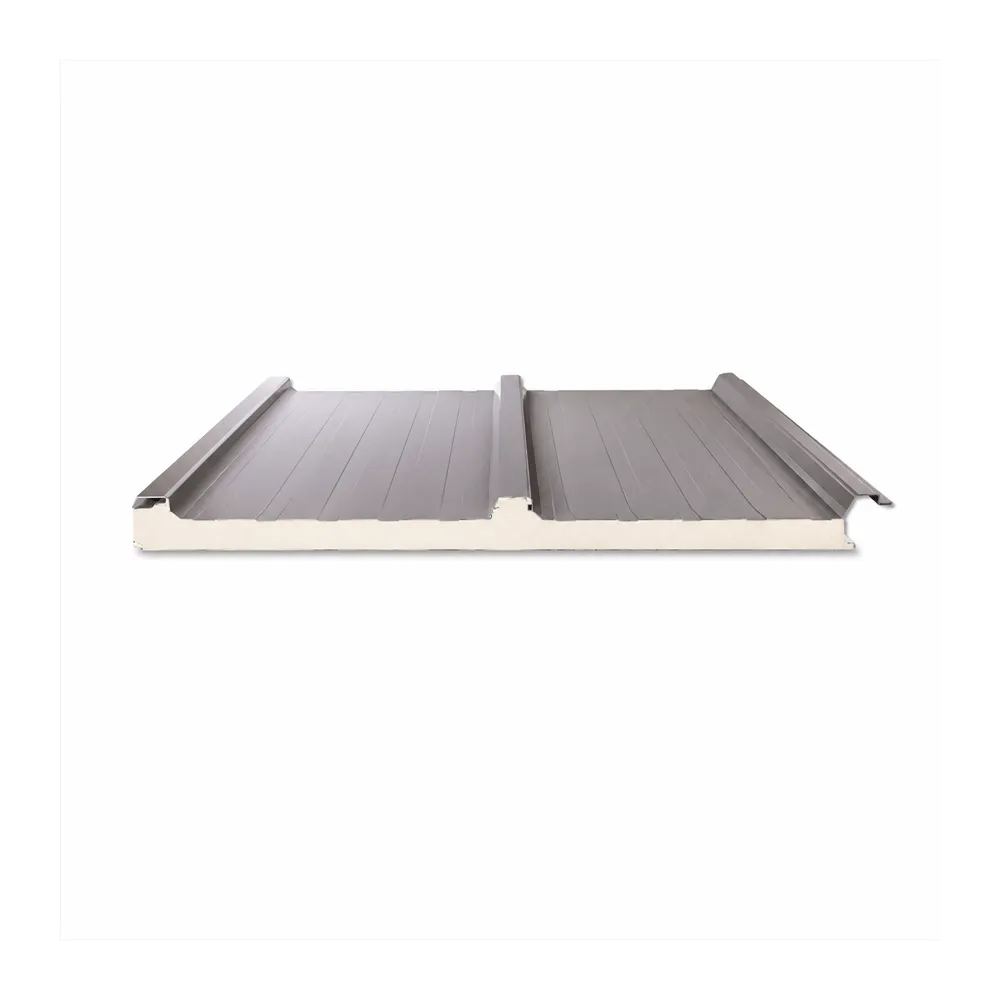
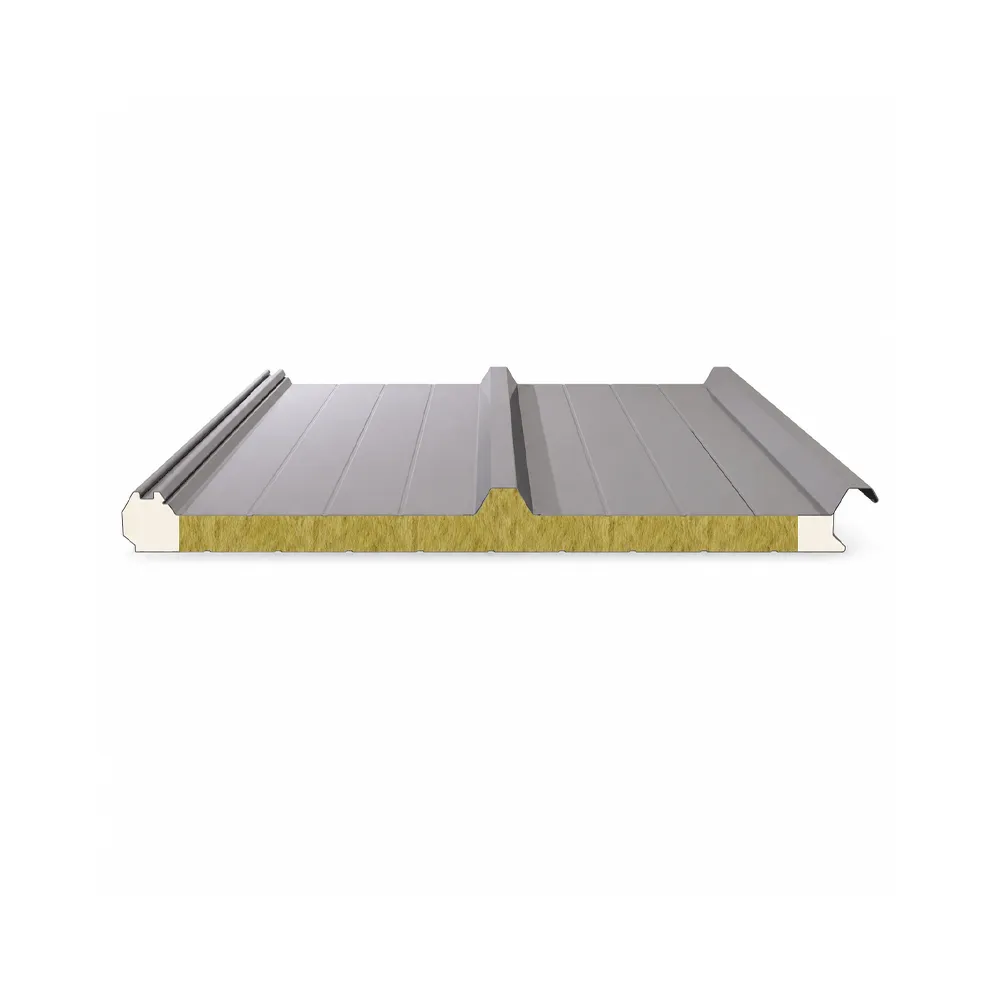
| Decision field | Hidden-fastener PU three-wave roof panel | PU edge-sealed rock wool corrugated roof panel |
|---|---|---|
| Effective coverage | 1000 mm | 1000 mm |
| Published core thickness | Approximately 50–150 mm | 50–150 mm |
| Published steel facing | Approximately 0.4–0.8 mm | Approximately 0.4–0.8 mm |
| Published thermal conductivity | ≤0.023 W/(m·K) | Approximately 0.035–0.041 W/(m·K) |
| Core and edge | PU core; hidden-fastener three-wave profile | Rock wool core with PU-protected edges |
| Published coating options | PVDF, SMP and PE | Custom colour, coating and length |
| Published fire reference | GB 8624 Grade B1 referenced; report number and testing body not published | GB 8624 Grade B1 referenced; report number and laboratory not published |
The PU panel conducts less heat through the core at equal thickness. The rock-wool option answers a different fire and acoustic brief, but it needs more thickness to approach the same core resistance and it is heavier to lift. Request the test report and calculation covering the exact panel configuration before transferring a fire statement or thermal value into a tender.
Warm, moisture-laden indoor air moving toward a cold roof surface can reach its dew point inside a joint or at a metal penetration. That risk rises in food processing, wet production, cold stores and buildings with intermittent heating. Check internal humidity, vapour pressure, liner continuity, joint seals and the temperature at every repeating bridge.
A thicker core does not repair an unsealed ridge or an open end lap. Likewise, adding sealant after installation is not equivalent to a designed air-control layer. The project detail should show which side controls air, how joints connect to walls and how penetrations maintain continuity.
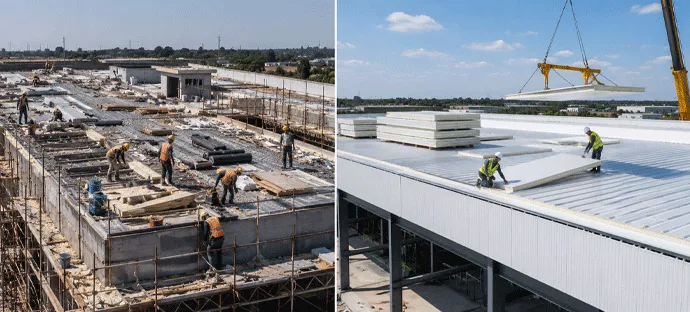
Move beyond the minimum thickness when the building runs long hours, maintains a narrow temperature band, carries a high internal moisture load or has limited future roof access. The business case should use the facility’s actual hours, energy tariff, HVAC efficiency and climate file. Fuqiang’s published project material does not state energy-saving percentages, so a percentage claim needs a project energy model and post-occupancy evidence.
Compared with homeowner cool-roof guides, an industrial decision cannot stop at surface colour. A reflective coating may reduce solar absorption, but the result still depends on insulation, air leakage, roof geometry, dirt accumulation, climate and operating pattern. Model the complete roof rather than assigning a universal saving to one finish.
Fuqiang quotes roof panels on a project basis rather than publishing a price per square metre. Price depends on core, thickness, steel facing, coating, length, quantity, accessories, packaging and shipping terms. Review the roof-panel range, compare the building conditions in the industrial and warehouse application, and send the roof plan through the contact page for a configuration-specific quotation.
At equal thickness, Fuqiang’s published PU roof-panel conductivity of ≤0.023 W/(m·K) is lower than the 0.035–0.041 W/(m·K) range published for the PU edge-sealed rock-wool roof panel. The final comparison still requires an assembly U-value including joints, fasteners and supports.
Calculate thickness from the project U-value, condensation risk, fire strategy, support spacing and indoor operating conditions. Fuqiang publishes approximately 50–150 mm for the two roof-panel lines compared here, but the available steps and structural capacity must be confirmed for the order.
No. Surface colour can affect solar absorption, but climate, dirt, insulation, air leakage, rooflights, operating hours and HVAC efficiency also affect energy use. Use a project model rather than a universal saving percentage.
Request the core-conductivity test report with its method and conditions, the assembly U-value calculation, joint and fastener assumptions, and a condensation analysis for the project’s indoor and outdoor design conditions.
Yes. Roof and wall heat flow, exposure, supports, drainage and fire requirements differ. Specify each assembly separately and coordinate their air, vapour, weather and trim details at the junction.
Shandong Fuqiang Technical & Application Team supports product configuration, production coordination and application review for insulated sandwich panels, decorative metal wall systems, roof panels and customized components. Individual team-member credentials are not publicly disclosed.
At equal thickness, Fuqiang's published PU roof-panel conductivity of ≤0.023 W/(m·K) is lower than the 0.035–0.041 W/(m·K) range published for the PU edge-sealed rock-wool roof panel. The final comparison still requires an assembly U-value including joints, fasteners and supports.
Calculate thickness from the project U-value, condensation risk, fire strategy, support spacing and indoor operating conditions. Fuqiang publishes approximately 50–150 mm for the two roof-panel lines compared here, but the available steps and structural capacity must be confirmed for the order.
No. Surface colour can affect solar absorption, but climate, dirt, insulation, air leakage, rooflights, operating hours and HVAC efficiency also affect energy use. Use a project model rather than a universal saving percentage.
Request the core-conductivity test report with its method and conditions, the assembly U-value calculation, joint and fastener assumptions, and a condensation analysis for the project's indoor and outdoor design conditions.
Yes. Roof and wall heat flow, exposure, supports, drainage and fire requirements differ. Specify each assembly separately and coordinate their air, vapour, weather and trim details at the junction.
24시간 이내에 답변드리겠습니다. 긴급한 경우 WhatsApp/WeChat(+86 13789803607)으로 연락하시거나 +86 13789802672로 직접 전화해 주세요.
*고객님의 기밀을 존중하며 모든 정보는 보호됩니다.
귀하의 문의에 답변하기 위한 목적으로만 귀하의 정보를 사용하며, 원치 않는 이메일이나 홍보 메시지는 절대 보내지 않습니다.