

견적 받기
24시간 이내에 답변드리겠습니다. 긴급한 경우 WhatsApp/WeChat(+86 13789803607)으로 연락하시거나 +86 13789802672로 직접 전화해 주세요.
*고객님의 기밀을 존중하며 모든 정보는 보호됩니다.
귀하의 문의에 답변하기 위한 목적으로만 귀하의 정보를 사용하며, 원치 않는 이메일이나 홍보 메시지는 절대 보내지 않습니다.

 August 26, 2026
Shandong Fuqiang Technical & Application Team | Corporate Technical / Product Application Team | Published: 26 August 2026
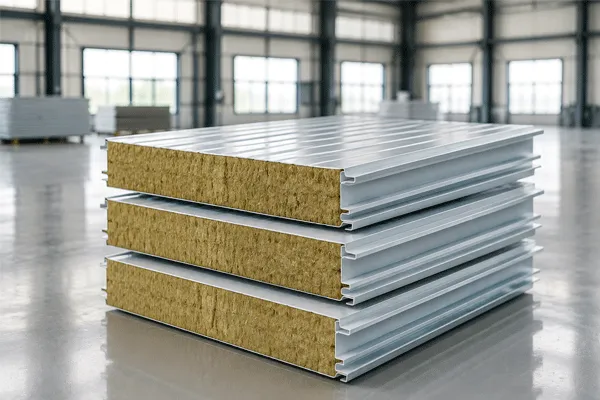
Fuqiang’s fire-resistant rock wool insulated wall panel is produced at 950 mm effective width in five core thicknesses from 50 to 200 mm, with published thermal conductivity near 0.043 W/(m·K) and sound insulation of 30 dB or higher. Every figure in this guide comes from the manufacturer’s own product data.
Rockwool Sandwich Panel Specification Guide for Contractors
Search “rock wool sandwich panel width” and the results contradict each other: 950, 1000, 1120, 1150 and 1180 mm all appear on supplier spec pages, and thermal conductivity is listed anywhere from 0.018 to 0.080 W/(m·K). None of those pages is necessarily wrong. They are describing different things.
Three separate numbers get flattened into one field on most catalogue pages:
The conductivity spread has a different cause. A figure near 0.018–0.023 W/(m·K) is a rigid polyurethane core, not mineral wool. Mineral wool sits in a much narrower band, and where it is quoted at 0.080 the source is usually a loose-fill or low-density product rather than a lamella core bonded into a steel-faced panel. Compared with aggregator listings that reproduce a generic mineral-wool figure across every thickness offered, a manufacturer page should state which core, which configuration and which measurement basis the number refers to.
| Parameter | Published value | Notes for specifiers |
| Effective width | 950 mm | Cover width; use this for area take-off |
| Core thicknesses | 50 / 75 / 100 / 150 / 200 mm | Five standard steps, not a continuous range |
| Core material | Mineral (rock) wool | Lamella orientation to be confirmed per order |
| Thermal conductivity | approx. 0.043 W/(m·K) | Core material value, not a panel U-value |
| Sound insulation | ≥ 30 dB | Configuration-dependent; request the test basis |
| Mineral wool melting point | > 1000 °C | Material property of the wool, not a fire classification |
| Fire performance | Described as A-grade non-combustible | Fuqiang’s own product page states classification must be verified against panel configuration and the applicable test standard. No report number is published |
| Facing steel thickness | Not published on this product page | Confirm before quoting to a client |
| Core density | Not published on this product page | Request in writing; it drives both acoustic and load behaviour |
Two fields in that table are deliberately blank. Facing thickness and core density are the parameters most often invented on competing spec pages, and Fuqiang has not published either for this panel. A contractor building a submittal needs them in writing from the factory rather than copied from a comparable listing.
Fuqiang manufactures two core types. The choice usually comes down to whether the wall assembly has a fire requirement, a thermal requirement, or both.
| Fire-Resistant Rock Wool Wall Panel | PU Edge-Sealed Rock Wool Wall Panel | Double-Sided Steel PU Panel | |
| Effective width | 950 mm | 1000 mm | 1000 mm |
| Thickness range | 50–200 mm (5 steps) | 50–200 mm; commonly 50 / 75 / 100 mm | 50–200 mm |
| Core | 암면 | Rock wool with PU-sealed edges | Rigid PU, approx. 42 kg/m³ |
| Thermal conductivity | approx. 0.043 W/(m·K) | Not separately published | 0.019–0.023 W/(m·K) |
| Facing steel | Not published | Not published | 0.3–0.8 mm |
| Coating options | Confirm per order | PVDF, SMP, HDP, PE | Confirm per order |
| Published fire statement | A-grade non-combustible (verify per configuration) | Class A stated; no certificate number published | Not stated on the product page |
| Joint | Confirm per order | PU protection around wool edges | Hidden-screw tongue and groove |
The practical reading: at equal thickness, the PU panel insulates roughly twice as well per millimetre. If the wall carries a fire requirement, that thermal advantage is not transferable, and the compensation is thickness. A 100 mm rock wool panel and a 50 mm PU panel are not thermal equivalents, and a 200 mm rock wool panel is heavier, harder to handle at height and more expensive to freight than the numbers alone suggest.
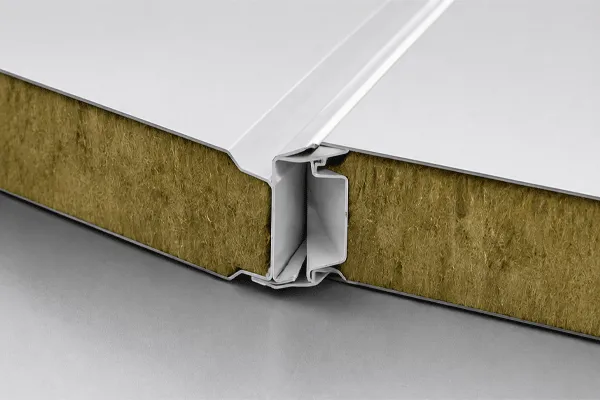
The PU edge-sealed variant exists because the vulnerable point of a mineral-wool panel is the cut edge, where the wool is exposed to moisture and mechanical damage during handling. Sealing the perimeter in PU addresses handling and moisture ingress at the joint, and it changes what sits at the panel edge — which is exactly the region a fire classification test evaluates. Ask for the report that covers the configuration you are buying, not the one that covers the plain panel.
Rockwool Sandwich Panel Specification Guide for Contractors
A core conductivity figure is a material property. The number a building control officer needs is a thermal transmittance for the assembly, and the gap between them is where specifications fail review.
ISO 6946:2017 covers the calculation of thermal resistance and thermal transmittance for building components and elements, and it is the reference that turns a λ value into a U-value. On the measurement side, ASTM C518 describes determination of steady-state thermal transmission properties using a heat flow meter apparatus — worth naming in a submittal, because “0.043” from a test to a stated method carries more weight than the same digits with no method attached.
What the calculation has to account for beyond the core:
For factory-made double-skin metal-faced insulating panels used in roofs, external walls, internal walls, partitions and ceilings, EN 14509 is the product standard European specifiers will look for. BSI lists BS EN 14509:2013 as current and under review, so a project in a UK or EU jurisdiction should check the edition applicable at the time of tender.
Mineral wool melting above 1000 °C, and a panel being classified non-combustible, are two different statements. The first is a property of the wool. The second is a property of the finished panel, including its facing, its adhesive and its edge treatment, assessed to a specific test standard in a specific jurisdiction.
Fuqiang’s own product page for this panel makes that distinction rather than collapsing it — it describes A-grade non-combustible performance while stating that the exact classification should be verified according to panel configuration and the applicable test standard. No report number or issuing laboratory is published for it, so the classification should not be repeated in a tender document until the corresponding report is in hand.
The standards themselves are not interchangeable either. GB 8624 classifies burning behaviour of building materials and products for the Chinese market, and Fuqiang’s roof panel pages reference Grade B1 under it. ASTM E84 measures comparative surface burning characteristics — flame spread and smoke developed — and, on ASTM’s own terms, is not sufficient on its own to describe a material as noncombustible. A B1 reference under a Chinese standard is not an ASTM E84 result, and neither is a Euroclass. Three different documents, three different tests.
Rockwool Sandwich Panel Specification Guide for Contractors
Fuqiang quotes rock wool panels on a project basis rather than publishing a price per square metre, with pricing determined by specification, quantity, customisation, surface material and coating, packaging and shipping terms. A formal quotation is prepared once technical requirements are confirmed. There is no published price band for this panel, so any per-square-metre figure circulating for it did not come from the manufacturer.
Trade terms available include EXW, FOB, CFR, CIF and DDP, with FCL, LCL and door-to-door logistics, which matters more for rock wool than for PU: at 200 mm the panel is dense, and the freight assumption behind a landed cost estimate needs checking against actual pallet weight rather than area.
There is no universal standard. Fuqiang's fire-resistant rock wool wall panel has a 950 mm effective width, while its PU edge-sealed rock wool wall panel is 1000 mm. Confirm whether a quoted width is cover width or overall width before calculating panel counts.
50, 75, 100, 150 and 200 mm for the fire-resistant rock wool wall panel. The PU edge-sealed rock wool wall panel spans 50–200 mm with 50, 75 and 100 mm as common thicknesses.
No. That is core conductivity. The assembly U-value has to be calculated per ISO 6946 including facings, joints and fasteners.
The product page describes A-grade non-combustible performance and states that classification should be verified against panel configuration and the applicable test standard. No certificate or report number is published, so request the report covering your configuration before citing a classification.
Yes. Custom trims, corners, flashings, closures and joint covers are fabricated in galvanized steel, Al-Zn coated steel, stainless steel and aluminium with PE, PVDF or powder coating, to project dimensions and profiles.
Neither answer is automatic. PU insulates better per millimetre; rock wool answers a fire requirement. Where both apply, thickness and assembly detailing decide it, which is a calculation rather than a product preference.
24시간 이내에 답변드리겠습니다. 긴급한 경우 WhatsApp/WeChat(+86 13789803607)으로 연락하시거나 +86 13789802672로 직접 전화해 주세요.
*고객님의 기밀을 존중하며 모든 정보는 보호됩니다.
귀하의 문의에 답변하기 위한 목적으로만 귀하의 정보를 사용하며, 원치 않는 이메일이나 홍보 메시지는 절대 보내지 않습니다.