

견적 받기
24시간 이내에 답변드리겠습니다. 긴급한 경우 WhatsApp/WeChat(+86 13789803607)으로 연락하시거나 +86 13789802672로 직접 전화해 주세요.
*고객님의 기밀을 존중하며 모든 정보는 보호됩니다.
귀하의 문의에 답변하기 위한 목적으로만 귀하의 정보를 사용하며, 원치 않는 이메일이나 홍보 메시지는 절대 보내지 않습니다.

 2026년 8월 8일
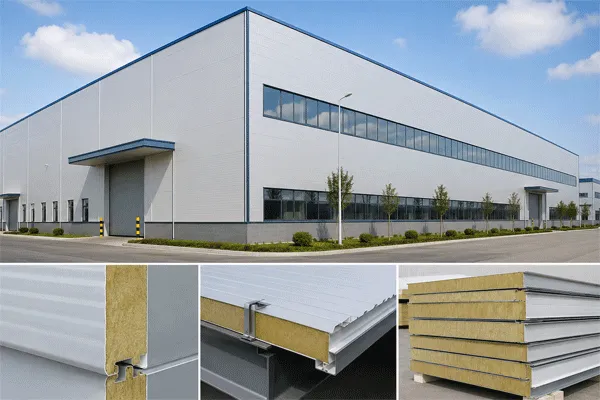
A 암면 샌드위치 패널 금속 표면재와 고밀도 미네랄울 심재를 결합하여 우수한 내화 성능, 유용한 단열 성능, 흡음 성능 및 장기적인 내구성을 갖춘 건물 외피 시스템을 만듭니다. 이러한 패널은 안전성과 성능의 균형이 필요한 공장 벽체, 창고, 상업 시설, 공공 건물, 칸막이 및 단열 지붕 시스템에 널리 고려됩니다.
이 가이드는 울 샌드위치 패널의 구조, 미네랄울이 사용되는 이유, 벽면용과 지붕용의 차이, 주문 전에 구매자가 확인해야 할 사항, 그리고 설치가 최종 성능에 미치는 영향을 설명합니다. 다양한 샌드위치 패널 시스템을 비교하는 시공업체, 유통업체, 건축가, EPC 기업 및 건축자재 구매자에게 특히 유용합니다.
암면 샌드위치 패널 가이드: 내화 지붕 및 벽 패널을 위한 미네랄울 코어 솔루션
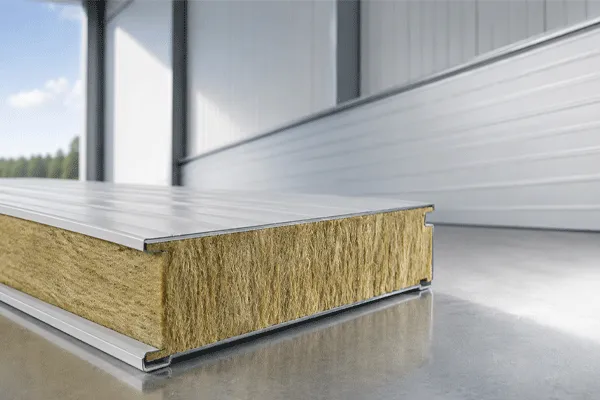
A 샌드위치 패널 두 개의 보호용 금속 표면재를 단열 코어에 접착한 조립식 복합 건축 자재입니다. 미네랄울 제품에서는 일반적으로 외부 및 내부 금속 시트 사이에 암면 코어가 배치됩니다. 외부 강판은 기후 보호, 외관 및 기계적 지지를 제공하며, 코어는 단열, 흡음 및 내화 성능에 기여합니다.
암면은 일반적으로 화산암을 포함한 광물 원료를 녹인 후, 용융된 재료를 가느다란 섬유로 방사하여 만듭니다. 이러한 섬유는 치수 안정성이 우수한 치밀한 구조로 가공됩니다. 이렇게 만들어진 울 심재는 조적 구조에 비해 상대적으로 가벼우면서도 조립식 건물 외피 구조에 필요한 기계적 강도를 제공합니다.
최종 성능은 코어에만 좌우되지 않습니다. 접착제, 외장재 프로파일, 이음부, 고정장치 설계, 패널 방향, 코팅 및 지지 구조가 모두 완성된 시스템에 영향을 미칩니다. 따라서 구매자는 록울 자체의 특성만 평가하기보다 시험을 거친 완전한 패널 시스템을 평가해야 합니다.
설계자가 미네랄울을 선택하는 주요 이유 중 하나는 고온에서의 거동입니다. 이 소재는 불연 특성을 지니므로 화재 안전이 주요 선정 요소인 프로젝트에 적합합니다. 미네랄울을 시험을 거친 시스템에 올바르게 적용하면 뛰어난 방화 성능에 기여하고 건축물의 방화구획 전략을 뒷받침할 수 있습니다.
일부 미네랄울 제품은 적용되는 화재 반응 표준에 따라 A1 등급을 받을 수 있습니다. 그러나 중요한 구분이 필요합니다. 단열재의 A1 등급이 완성된 샌드위치 패널 전체가 동일한 등급임을 자동으로 의미하지는 않습니다. 접착제, 코팅, 이음부, 표면재, 패널 두께 및 설치 구성은 모두 표시되는 화재 성능 결과에 영향을 줄 수 있습니다.
화재 발생 시, 적절하게 사양이 정해진 내화 록울 시스템은 화재 확산을 제한하고 열 전달을 지연시키는 데 도움이 될 수 있습니다. 이는 공장, 창고, 기계실, 작업장, 공공건물 및 강화된 방화 성능이 필요한 기타 시설에 특히 유용합니다. 프로젝트에 특정 내화 시간 또는 시험을 거친 조립체가 필요한 경우에는 제안된 정확한 시스템에 대한 문서를 반드시 요청해야 합니다.
암면 샌드위치 패널 가이드: 내화 지붕 및 벽 패널을 위한 미네랄울 코어 솔루션
암면 코어 내부의 섬유는 작은 공기층을 많이 형성하여 패널을 통한 열 전달을 늦춥니다. 이로 인해 미네랄울 단열재는 벽과 지붕 시스템 모두에 유용한 열적 특성을 갖습니다. 적절하게 사양을 정하면 패널이 여름철 열 유입, 겨울철 열 손실 및 실내 온도 변동을 줄이는 데 도움이 될 수 있습니다.
열전도율은 검토해야 할 가장 중요한 값 중 하나입니다. 일반적으로 동일한 두께에서 열전도율이 낮을수록 열 전달에 대한 저항성이 더 우수하다는 의미입니다. 그러나 전반적인 단열 성능은 패널 두께, 접합부 형상, 금속 연결부, 지지 구조 및 열교에도 영향을 받습니다.
For buildings with large envelope areas, appropriate insulation can contribute to improved building energy performance. Factories, warehouses, workshops, and other industrial buildings may have very large wall and roof surfaces, so controlling heat transfer through those areas can significantly affect heating or cooling demand.
A well-designed system therefore does more than simply insulate the building. It combines an appropriate core, correctly engineered joints, compatible accessories, and proper installation to achieve reliable long-term insulation performance.
The fibrous structure of rock wool gives it another important advantage: sound absorption. Rather than simply reflecting sound waves, the fibers can dissipate part of the acoustic energy passing through the panel. This makes wool insulation particularly useful in buildings where machinery, production processes, equipment, or vehicle activity generates significant noise.
A properly designed panel can contribute to acoustic insulation between spaces and help with noise reduction in factories, workshops, equipment rooms, commercial facilities, and other noisy environments. This can improve acoustic comfort for workers and occupants while helping limit external noise pollution.
Where both fire performance and sound control matter, fire resistance and acoustic insulation become a strong reason to consider a mineral wool system. Actual acoustic performance depends on panel thickness, wool density, joints, openings, supporting structure, and the full wall or roof assembly, so project-specific data should be reviewed rather than relying on a generic value.
Rock wool wall panels can be used for external walls, internal partitions, fire-separation areas, industrial enclosures, equipment rooms, warehouses, workshops, and certain commercial or institutional buildings. This type of panel is especially useful when a project requires a combination of insulation, fire protection, sound control, and durable metal finishes.
For external walls, coating and facing specifications should match the expected environmental conditions. Coastal areas, chemically aggressive locations, humid environments, or sites with heavy industrial pollution may need higher-performance coatings or more corrosion-resistant metal surfaces.
Internal applications can have different priorities. A factory partition may emphasize fire separation and sound control, while a clean production zone may prioritize a smooth finish and easy maintenance. The same general sandwich construction can therefore be adapted through changes in core density, panel thickness, surface coating, profile, and joint design.
In industrial and commercial buildings, the wall system must also resist wind pressure, impact, cleaning, temperature variation, and repeated daily use. Proper support spacing and fastening are essential to maintaining the strength and durability of the finished installation.
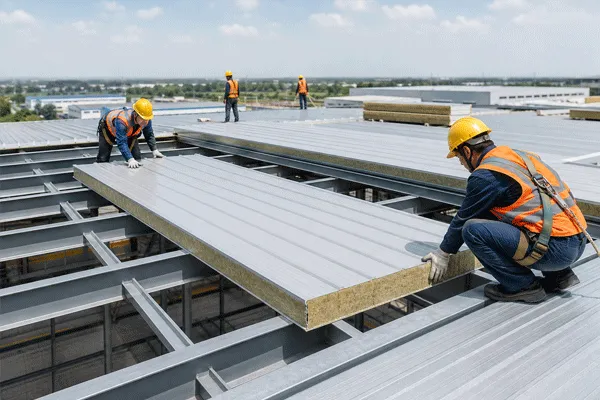
A roof sandwich panel faces more demanding exposure than most wall products. In addition to insulation and fire performance, the roof must manage rainwater, snow where applicable, solar heat, wind uplift, drainage, overlaps, penetrations, and long-term sealing.
A typical rockwool roof construction uses a profiled exterior metal facing to increase stiffness and encourage water shedding. A mineral wool insulating layer sits beneath the exterior sheet, while the internal facing completes the composite structure. Panel geometry must be appropriate for the required span and roof slope.
Correct detailing is particularly important around:
Even a high-quality mineral wool insulating system cannot compensate for poor drainage or incorrectly sealed joints. Buyers should therefore review roof slope, fastening pattern, flashing details, sealing materials, accessory compatibility, and manufacturer installation requirements before construction begins.
암면 샌드위치 패널 가이드: 내화 지붕 및 벽 패널을 위한 미네랄울 코어 솔루션
There is no single ideal core for every building. Foam-based systems can provide very strong thermal properties at relatively low thickness, while a mineral wool sandwich panel is often selected when non-combustible behavior, fire protection, acoustic control, and dimensional stability carry greater importance.
Panels with mineral wool core may be particularly attractive for fire-rated partitions, factories, warehouses, machine rooms, public facilities, or buildings containing processes that increase fire risk. Their fibrous structure also gives them useful thermal and acoustic characteristics.
At the same time, mineral wool products can be heavier than some foam alternatives. That affects transportation, lifting, panel length, support design, installation labor, and site handling. These practical factors should be included when comparing total installed cost.
Selection should therefore consider several criteria together:
The right type of panel is the system that satisfies the overall project specification rather than simply maximizing one property.
Before ordering a 샌드위치 패널, buyers should confirm the core material, density, panel thickness, facing thickness, coating system, effective width, available length, joint profile, and intended wall or roof application.
프로젝트에 특정한 내화 요구 사항이 있는 경우, 전체 구성에 적합한 화재 시험 문서를 요청해야 합니다. 음향 성능이 중요한 경우에는 명시된 음향 특성이나 시험 결과를 요청해야 합니다. 에너지 성능이 중요한 경우에는 모든 암면 제품의 성능이 동일하다고 가정하지 말고 관련 열 성능 값을 검토해야 합니다.
Important purchasing parameters typically include:
The manufacturing production line and quality-control process also matter. Consistent bonding, accurate profiling, uniform core distribution, controlled cutting, and proper packaging all contribute to finished-panel reliability.
For custom projects, drawings should be reviewed before production so that corners, windows, doors, roof transitions, trims, and other accessories can be coordinated with the wall and roof systems.
Even a technically strong product can perform poorly if installed incorrectly. Proper installation of mineral wool panels requires suitable support spacing, correct lifting, accurate alignment, approved fasteners, proper sealing, and well-designed flashing.
The fastener should be selected according to panel thickness, support material, wind load, and manufacturer guidance. Over-tightening can damage the surface or compress the panel locally, while insufficient fastening may affect wind resistance and joint stability.
Moisture management is especially important. Panels should be stored off the ground and protected from standing water before installation. Once installed, joints, openings, penetrations, and roof details should prevent long-term water entry. Although mineral wool itself offers many useful properties, persistent moisture can reduce insulation effectiveness and cause corrosion or damage to adjacent components.
The durability of sandwich panel systems therefore depends on several interconnected elements: coating quality, edge protection, joints, sealing, transport, handling, storage, and workmanship. Good installation helps preserve thermal performance, fire-related behavior, appearance, and structural reliability over time.
Start by determining the application: exterior wall, internal partition, ceiling, or roof. Then define the most important performance requirements. These may include high fire resistance, thermal insulation, acoustic comfort, corrosion resistance, architectural appearance, structural span, cleanability, or project budget.
For a warehouse or factory, fire protection and thermal performance may be the highest priorities. For a noisy workshop, thermal and acoustic insulation may matter equally. A school, hospital, commercial building, or other public facility may require a balance of fire safety, acoustic comfort, surface appearance, and maintenance.
When speaking with the supplier, provide:
The supplier should then recommend a suitable panel with a mineral wool core and compatible joint system. If a specific fire rating is required, verify that the proposed panel configuration matches the relevant test documentation.
A correctly selected wool sandwich panel should provide a balanced combination of fireproof performance, good thermal properties, sound control, durability, and practical installation. The objective is not simply to choose the thickest product, but to specify a complete system that matches the actual building conditions.
A rock wool sandwich panel is a prefabricated building panel made with two metal facings and a mineral wool insulating core. It is commonly used for wall and roof systems where fire resistance, thermal insulation, acoustic performance, and durability are important.
Rock wool has non-combustible properties and can provide excellent fire protection. However, the fire rating of the complete sandwich panel depends on the full tested system, including the core, metal facing, adhesive, joints, thickness, and installation method. Buyers should verify the relevant fire-test documentation for the exact panel configuration.
Mineral wool sandwich panels are suitable for factories, warehouses, workshops, commercial buildings, public buildings, internal partitions, external walls, equipment rooms, and insulated roofing systems. They are particularly useful where fire safety and acoustic insulation are important.
A rock wool roof sandwich panel is designed to handle additional requirements such as rainwater drainage, wind uplift, roof slope, overlaps, and weather sealing. Wall panels mainly focus on façade protection, insulation, fire performance, and architectural appearance.
Yes. The fibrous mineral wool core traps air and reduces heat transfer through the building envelope. Actual thermal insulation performance depends on panel thickness, wool density, thermal conductivity, joint design, and installation quality.
Yes. The fibrous structure of rock wool helps absorb sound energy and can improve acoustic insulation and noise reduction. This makes rock wool panels suitable for factories, workshops, equipment rooms, and other buildings where acoustic comfort is important.
Start with the building application and required performance, including fire safety, thermal insulation, acoustic insulation, structural span, environmental conditions, and roof or wall use. Providing project drawings, installation details, and performance requirements allows the manufacturer to recommend a more suitable panel configuration.
24시간 이내에 답변드리겠습니다. 긴급한 경우 WhatsApp/WeChat(+86 13789803607)으로 연락하시거나 +86 13789802672로 직접 전화해 주세요.
*고객님의 기밀을 존중하며 모든 정보는 보호됩니다.
귀하의 문의에 답변하기 위한 목적으로만 귀하의 정보를 사용하며, 원치 않는 이메일이나 홍보 메시지는 절대 보내지 않습니다.