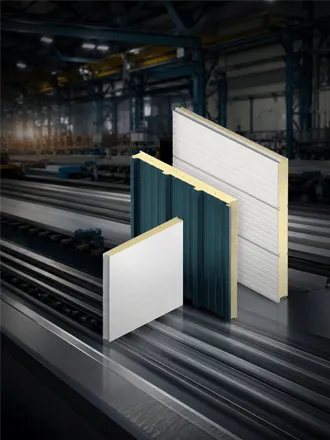
A rock wool sandwich panel combines metal facings with a dense mineral wool core to create a building-envelope system with strong fire protection, useful thermal performance, acoustic control, and long-term durability. These panels are widely considered for factory walls, warehouses, commercial facilities, public buildings, partitions, and insulated roof systems where safety and performance need to be balanced.
This guide explains how a wool sandwich panel is constructed, why mineral wool is used, how wall and roof applications differ, what buyers should check before ordering, and how installation affects final performance. It is particularly useful for contractors, distributors, architects, EPC companies, and building-material buyers comparing different sandwich panel systems.
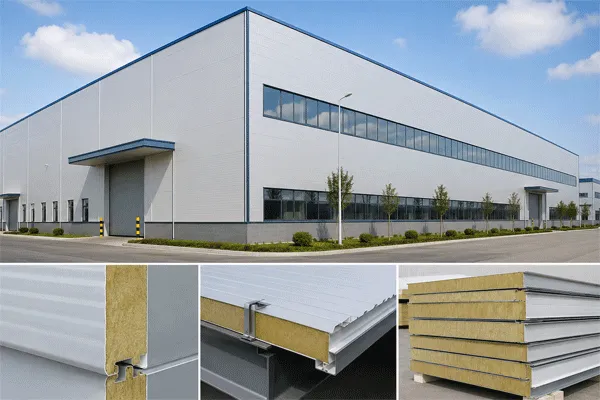
Rock Wool Sandwich Panel Guide: Mineral Wool Core Solutions for Fireproof Roof and Wall Panels
Article Outline
- What is a rock wool sandwich panel and how is it constructed?
- Why is mineral wool used when fire resistance matters?
- How does the wool core provide thermal insulation?
- What acoustic insulation benefits can mineral wool provide?
- Where should rock wool wall panels be used?
- How is a roof sandwich panel different from a wall panel?
- How do mineral wool panels compare with other core materials?
- What specifications should buyers check before ordering?
- How do installation requirements affect durability and performance?
- How can you select the right rock wool sandwich panels for a project?
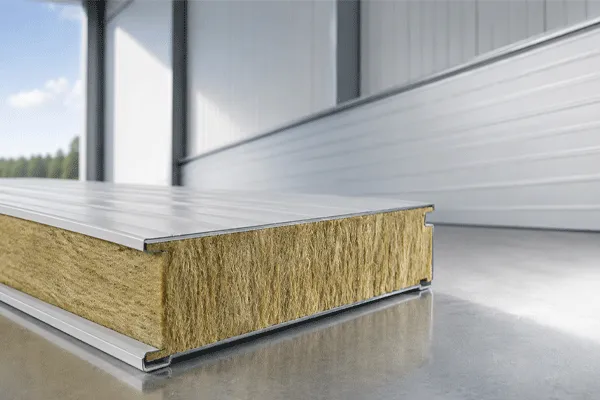
A sandwich panel is a prefabricated composite building material consisting of two protective metal facings bonded to an insulating core. In a mineral wool version, the core material is usually rock wool arranged between external and internal metal sheets. The outer steel sheet provides weather protection, appearance, and mechanical support, while the core contributes insulation, sound absorption, and fire-related performance.
Rock wool is made by melting mineral raw materials, commonly including volcanic rock, and spinning the molten material into fine fibers. These fibers are processed into a dense structure with good dimensional stability. The resulting wool core is relatively lightweight compared with masonry while still providing useful mechanical strength for prefabricated building-envelope construction.
The final performance does not depend on the core alone. Adhesive, facing profile, joints, fastener design, panel orientation, coating, and supporting structure all influence the completed system. For this reason, buyers should evaluate a complete tested panel rather than assessing only the properties of rock wool itself.
Why Is Mineral Wool Used When Fire Resistance Matters?
One of the main reasons designers choose mineral wool is its behavior at elevated temperatures. The material has non-combustible properties, making it suitable for projects where fire safety is a major selection factor. When correctly incorporated into a tested system, mineral wool can contribute to excellent fire protection properties and help support building-compartmentation strategies.
Some mineral wool products may achieve classification A1 under applicable reaction-to-fire standards. However, an important distinction must be made: an A1 rating for the insulating material does not automatically mean that the complete finished sandwich panel has the same rating. Adhesives, coatings, joints, facings, panel thickness, and installation configuration can all influence the declared fire result.
In the event of a fire, a properly specified fireproof rock wool system can help limit fire spread and delay heat transfer. This is especially valuable for factories, warehouses, machine rooms, workshops, public buildings, and other facilities requiring increased fire protection. Where a project requires a specific fire-resistance duration or tested assembly, always request documentation for the exact proposed system.
Rock Wool Sandwich Panel Guide: Mineral Wool Core Solutions for Fireproof Roof and Wall Panels
How Does the Wool Core Provide Thermal Insulation?
The fibers inside the wool core trap many small pockets of air, slowing heat transfer through the panel. This gives mineral wool insulation useful thermal properties for both walls and roof systems. When properly specified, the panels can help reduce summer heat gain, winter heat loss, and fluctuations in indoor temperature.
Thermal conductivity is one of the most important values to review. Lower conductivity generally indicates better resistance to heat transfer at an equivalent thickness. However, overall thermal insulation performance also depends on panel thickness, joint geometry, metal connections, support structure, and thermal bridging.
For buildings with large envelope areas, appropriate insulation can contribute to improved building energy performance. Factories, warehouses, workshops, and other industrial buildings may have very large wall and roof surfaces, so controlling heat transfer through those areas can significantly affect heating or cooling demand.
A well-designed system therefore does more than simply insulate the building. It combines an appropriate core, correctly engineered joints, compatible accessories, and proper installation to achieve reliable long-term insulation performance.
What Acoustic Insulation Benefits Can Mineral Wool Provide?
The fibrous structure of rock wool gives it another important advantage: sound absorption. Rather than simply reflecting sound waves, the fibers can dissipate part of the acoustic energy passing through the panel. This makes wool insulation particularly useful in buildings where machinery, production processes, equipment, or vehicle activity generates significant noise.
A properly designed panel can contribute to acoustic insulation between spaces and help with noise reduction in factories, workshops, equipment rooms, commercial facilities, and other noisy environments. This can improve acoustic comfort for workers and occupants while helping limit external noise pollution.
Where both fire performance and sound control matter, fire resistance and acoustic insulation become a strong reason to consider a mineral wool system. Actual acoustic performance depends on panel thickness, wool density, joints, openings, supporting structure, and the full wall or roof assembly, so project-specific data should be reviewed rather than relying on a generic value.
Where Should Rock Wool Wall Panels Be Used?
Rock wool wall panels can be used for external walls, internal partitions, fire-separation areas, industrial enclosures, equipment rooms, warehouses, workshops, and certain commercial or institutional buildings. This type of panel is especially useful when a project requires a combination of insulation, fire protection, sound control, and durable metal finishes.
For external walls, coating and facing specifications should match the expected environmental conditions. Coastal areas, chemically aggressive locations, humid environments, or sites with heavy industrial pollution may need higher-performance coatings or more corrosion-resistant metal surfaces.
Internal applications can have different priorities. A factory partition may emphasize fire separation and sound control, while a clean production zone may prioritize a smooth finish and easy maintenance. The same general sandwich construction can therefore be adapted through changes in core density, panel thickness, surface coating, profile, and joint design.
In industrial and commercial buildings, the wall system must also resist wind pressure, impact, cleaning, temperature variation, and repeated daily use. Proper support spacing and fastening are essential to maintaining the strength and durability of the finished installation.
How Is a Roof Sandwich Panel Different from a Wall Panel?
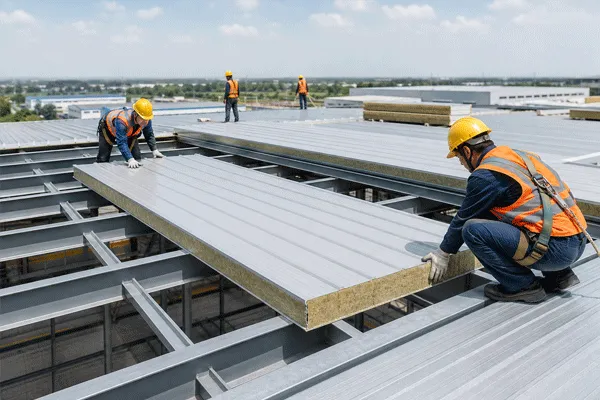
A roof sandwich panel faces more demanding exposure than most wall products. In addition to insulation and fire performance, the roof must manage rainwater, snow where applicable, solar heat, wind uplift, drainage, overlaps, penetrations, and long-term sealing.
A typical rockwool roof construction uses a profiled exterior metal facing to increase stiffness and encourage water shedding. A mineral wool insulating layer sits beneath the exterior sheet, while the internal facing completes the composite structure. Panel geometry must be appropriate for the required span and roof slope.
Correct detailing is particularly important around:
- Eaves
- Ridges
- Roof penetrations
- Flashings
- Gutters
- Overlaps
- Fastener locations
Even a high-quality mineral wool insulating system cannot compensate for poor drainage or incorrectly sealed joints. Buyers should therefore review roof slope, fastening pattern, flashing details, sealing materials, accessory compatibility, and manufacturer installation requirements before construction begins.
Rock Wool Sandwich Panel Guide: Mineral Wool Core Solutions for Fireproof Roof and Wall Panels
How Do Mineral Wool Panels Compare with Other Core Materials?
There is no single ideal core for every building. Foam-based systems can provide very strong thermal properties at relatively low thickness, while a mineral wool sandwich panel is often selected when non-combustible behavior, fire protection, acoustic control, and dimensional stability carry greater importance.
Panels with mineral wool core may be particularly attractive for fire-rated partitions, factories, warehouses, machine rooms, public facilities, or buildings containing processes that increase fire risk. Their fibrous structure also gives them useful thermal and acoustic characteristics.
At the same time, mineral wool products can be heavier than some foam alternatives. That affects transportation, lifting, panel length, support design, installation labor, and site handling. These practical factors should be included when comparing total installed cost.
Selection should therefore consider several criteria together:
- Fire protection requirements
- Thermal requirements
- Sound insulation
- Panel weight
- Structural span
- Moisture exposure
- Exterior coating
- Installation speed
- Building use
- Lifecycle cost
The right type of panel is the system that satisfies the overall project specification rather than simply maximizing one property.
What Specifications Should Buyers Check Before Ordering?
Before ordering a sandwich panel, buyers should confirm the core material, density, panel thickness, facing thickness, coating system, effective width, available length, joint profile, and intended wall or roof application.
If the project has specific fire requirements, request the appropriate fire-test documentation for the complete configuration. If acoustics matter, ask for declared acoustic properties or test results. Where energy performance is important, review the relevant thermal values instead of assuming that all rock wool products perform identically.
Important purchasing parameters typically include:
- Mineral wool density
- Panel thickness
- Metal facing thickness
- Surface coating
- Panel profile
- Effective width
- Length
- Joint system
- Fastener requirements
- Fire test data
- Thermal data
- Acoustic data
- Packaging and loading method
The manufacturing production line and quality-control process also matter. Consistent bonding, accurate profiling, uniform core distribution, controlled cutting, and proper packaging all contribute to finished-panel reliability.
For custom projects, drawings should be reviewed before production so that corners, windows, doors, roof transitions, trims, and other accessories can be coordinated with the wall and roof systems.
How Do Installation Requirements Affect Durability and Performance?
Even a technically strong product can perform poorly if installed incorrectly. Proper installation of mineral wool panels requires suitable support spacing, correct lifting, accurate alignment, approved fasteners, proper sealing, and well-designed flashing.
The fastener should be selected according to panel thickness, support material, wind load, and manufacturer guidance. Over-tightening can damage the surface or compress the panel locally, while insufficient fastening may affect wind resistance and joint stability.
Moisture management is especially important. Panels should be stored off the ground and protected from standing water before installation. Once installed, joints, openings, penetrations, and roof details should prevent long-term water entry. Although mineral wool itself offers many useful properties, persistent moisture can reduce insulation effectiveness and cause corrosion or damage to adjacent components.
The durability of sandwich panel systems therefore depends on several interconnected elements: coating quality, edge protection, joints, sealing, transport, handling, storage, and workmanship. Good installation helps preserve thermal performance, fire-related behavior, appearance, and structural reliability over time.
How Can You Select the Right Rock Wool Sandwich Panels for a Project?
Start by determining the application: exterior wall, internal partition, ceiling, or roof. Then define the most important performance requirements. These may include high fire resistance, thermal insulation, acoustic comfort, corrosion resistance, architectural appearance, structural span, cleanability, or project budget.
For a warehouse or factory, fire protection and thermal performance may be the highest priorities. For a noisy workshop, thermal and acoustic insulation may matter equally. A school, hospital, commercial building, or other public facility may require a balance of fire safety, acoustic comfort, surface appearance, and maintenance.
When speaking with the supplier, provide:
- Building drawings
- Project location
- Application
- Required panel thickness
- Required fire performance
- Structural support spacing
- Roof slope where relevant
- Surface coating requirements
- Environmental exposure
- Required lengths and quantities
The supplier should then recommend a suitable panel with a mineral wool core and compatible joint system. If a specific fire rating is required, verify that the proposed panel configuration matches the relevant test documentation.
A correctly selected wool sandwich panel should provide a balanced combination of fireproof performance, good thermal properties, sound control, durability, and practical installation. The objective is not simply to choose the thickest product, but to specify a complete system that matches the actual building conditions.
Key Takeaways
- A rock wool sandwich panel combines protective metal facings with a fibrous mineral insulating core.
- Mineral wool is valued for non-combustible behavior, fire protection, thermal performance, and sound absorption.
- The fire rating of the complete panel system must be verified separately from the rating of the mineral wool material itself.
- Rock wool sandwich panels can be used for external walls, internal partitions, warehouses, factories, commercial facilities, and roof systems.
- A roof panel requires careful attention to slope, drainage, fasteners, joints, flashing, and weather sealing.
- Panel thickness, wool density, facing specification, and joint geometry all influence final performance.
- Mineral wool panels are often selected when fire safety and acoustic performance are more important than minimizing panel weight.
- Correct transport, storage, fastening, sealing, and installation are essential for long-term durability.
- Buyers should compare complete tested panel systems rather than judging products only by core material or price.
- Project drawings, environmental conditions, fire requirements, structural loads, and energy targets should guide the final panel selection.
FAQ
What is a rock wool sandwich panel?
A rock wool sandwich panel is a prefabricated building panel made with two metal facings and a mineral wool insulating core. It is commonly used for wall and roof systems where fire resistance, thermal insulation, acoustic performance, and durability are important.
Are rock wool sandwich panels fireproof?
Rock wool has non-combustible properties and can provide excellent fire protection. However, the fire rating of the complete sandwich panel depends on the full tested system, including the core, metal facing, adhesive, joints, thickness, and installation method. Buyers should verify the relevant fire-test documentation for the exact panel configuration.
Where are mineral wool sandwich panels commonly used?
Mineral wool sandwich panels are suitable for factories, warehouses, workshops, commercial buildings, public buildings, internal partitions, external walls, equipment rooms, and insulated roofing systems. They are particularly useful where fire safety and acoustic insulation are important.
What is the difference between a rock wool roof panel and a wall panel?
A rock wool roof sandwich panel is designed to handle additional requirements such as rainwater drainage, wind uplift, roof slope, overlaps, and weather sealing. Wall panels mainly focus on façade protection, insulation, fire performance, and architectural appearance.
Do rock wool sandwich panels provide good thermal insulation?
Yes. The fibrous mineral wool core traps air and reduces heat transfer through the building envelope. Actual thermal insulation performance depends on panel thickness, wool density, thermal conductivity, joint design, and installation quality.
Are rock wool panels good for sound insulation?
Yes. The fibrous structure of rock wool helps absorb sound energy and can improve acoustic insulation and noise reduction. This makes rock wool panels suitable for factories, workshops, equipment rooms, and other buildings where acoustic comfort is important.
How can I choose the right rock wool sandwich panel for my project?
Start with the building application and required performance, including fire safety, thermal insulation, acoustic insulation, structural span, environmental conditions, and roof or wall use. Providing project drawings, installation details, and performance requirements allows the manufacturer to recommend a more suitable panel configuration.



 August 08, 2026